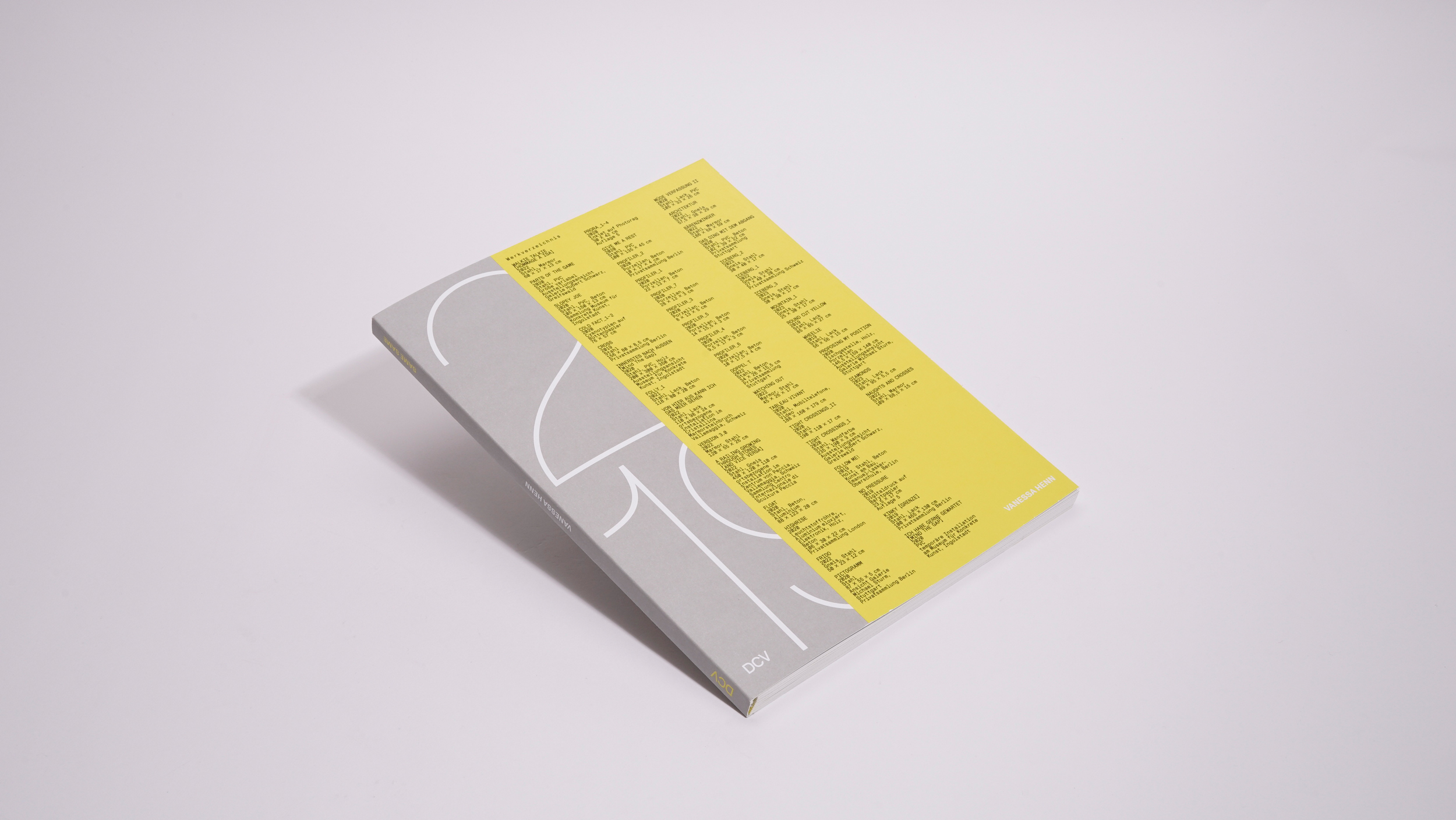
Vanessa Henn
Same Same
 | |
|---|---|
| Editor(s) | Simone Schimpf |
| Author(s) | Ralf Christofori, Simone Schimpf |
| Design | Studio Jung, Gilbert Schneider |
| Size | 20,5 x 26,5 cm |
| Cover | Swiss brochure |
| Pages | 132 |
| Illustrations | 94 |
| Language(s) | German, English |
| ISBN | 978-3-96912-174-0 |
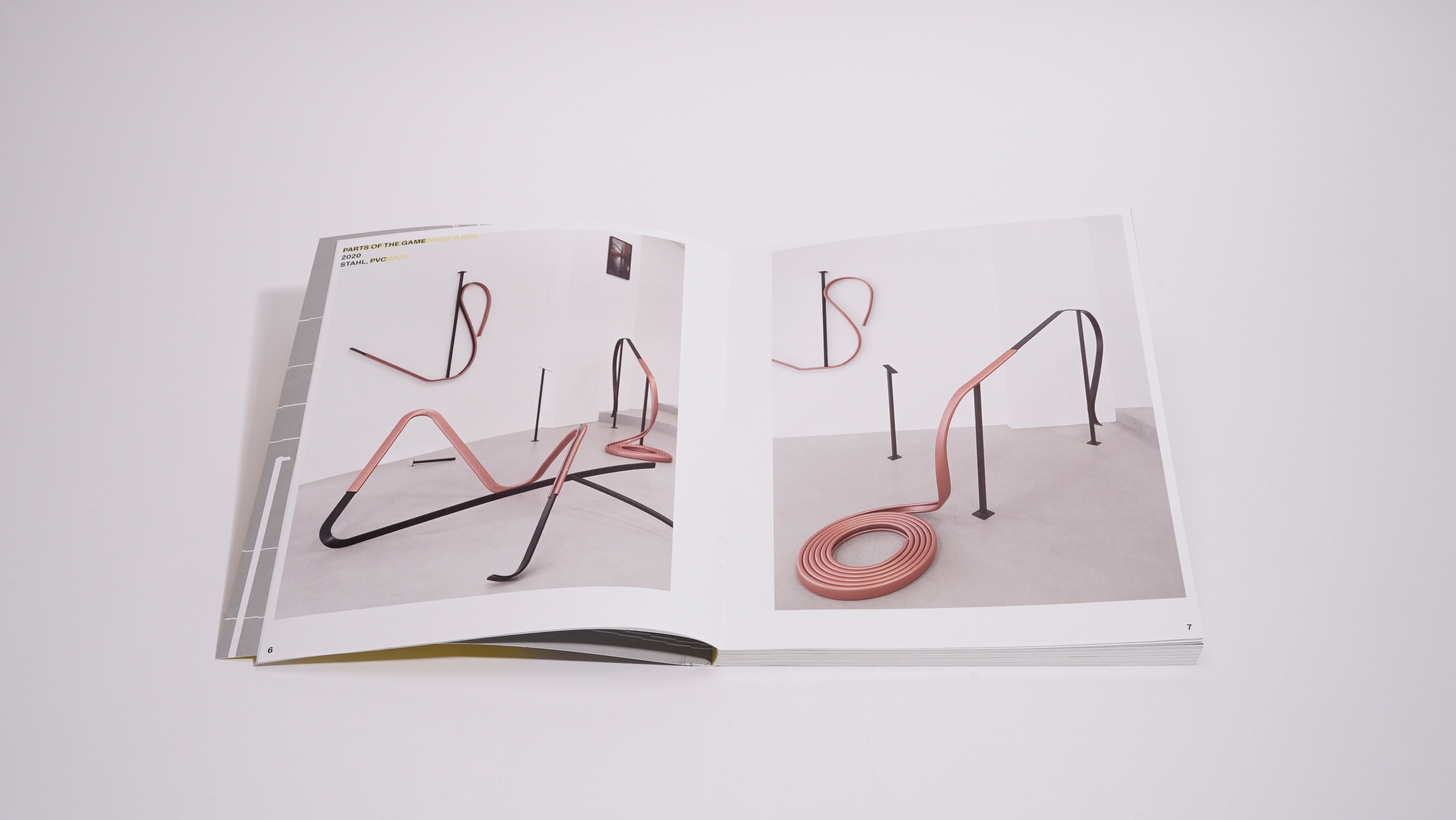
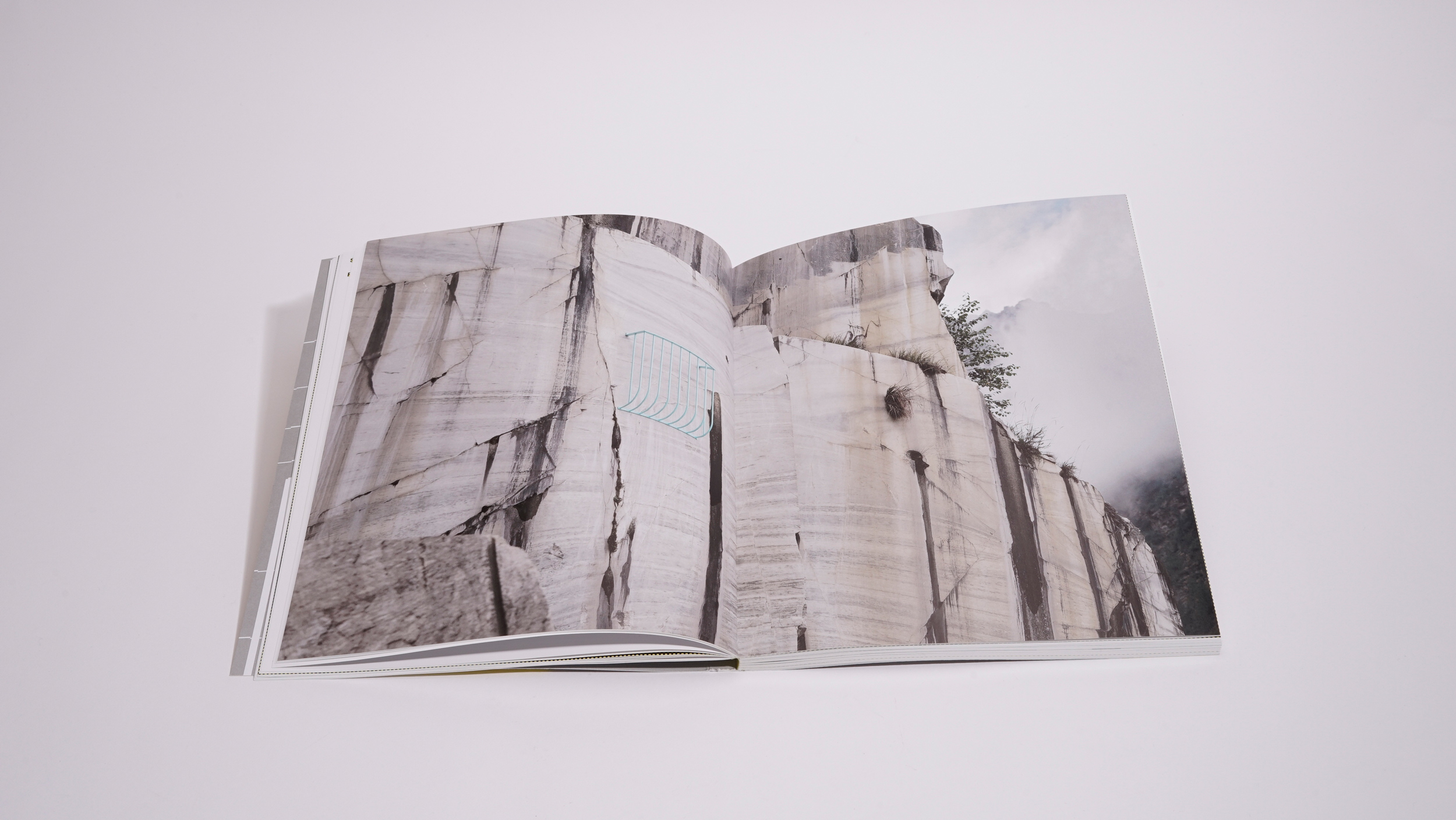
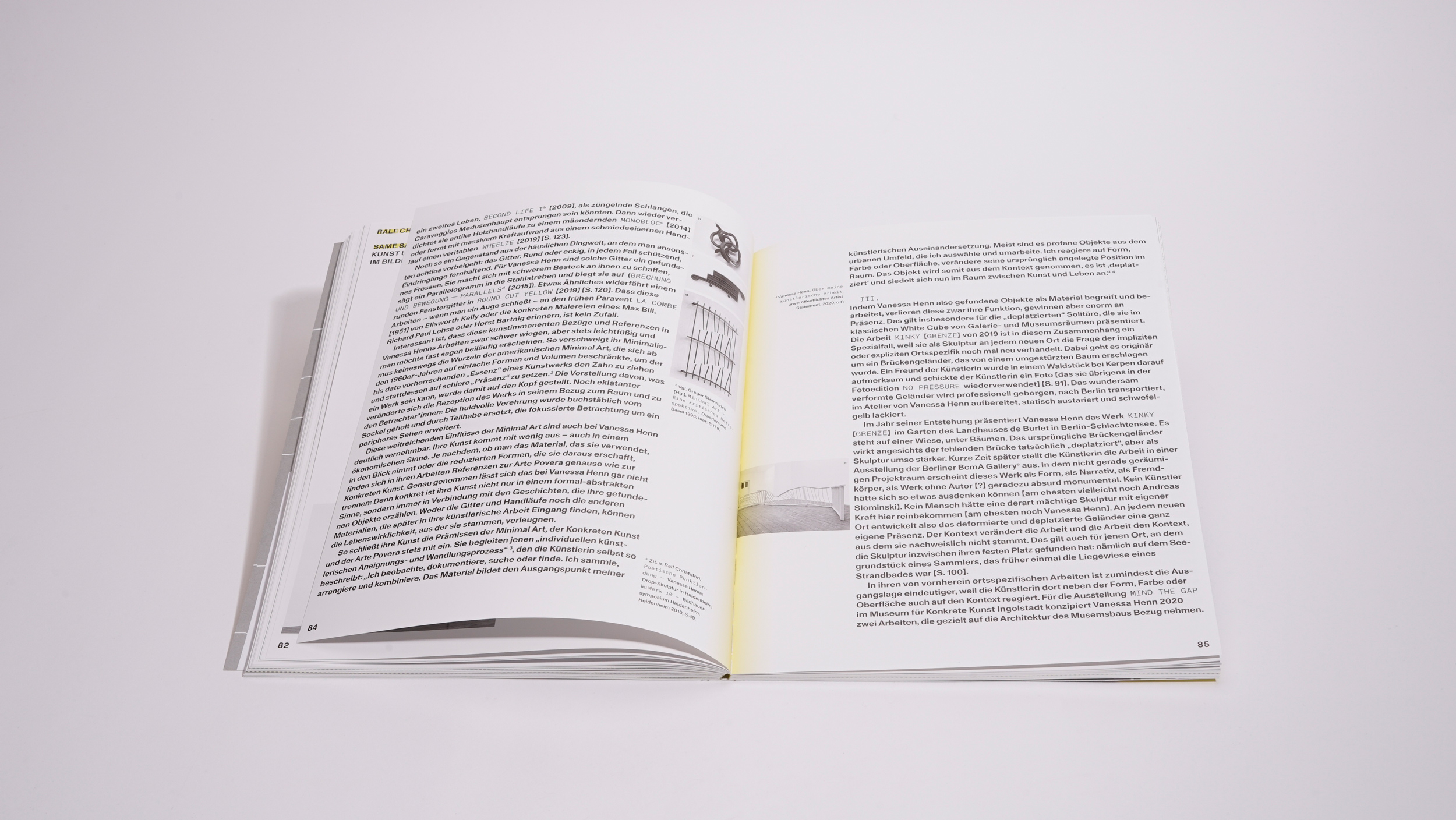
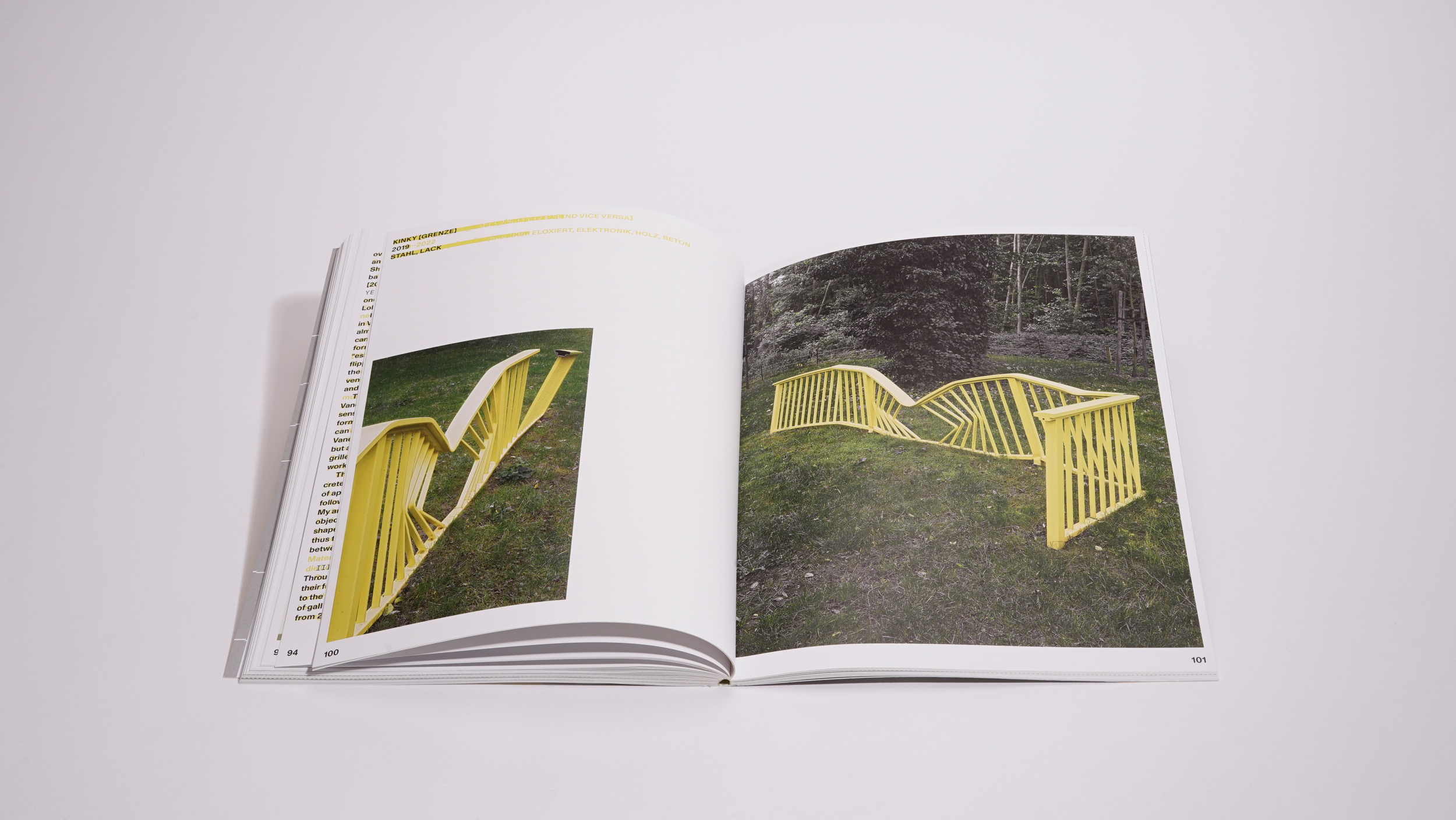
Vanessa Henn’s (b. Stuttgart, 1970; lives and works in Berlin) objects and installations blend formal reduction with playful comedy. The handrails she makes out of a wide variety of materials run along walls, project into rooms, trace spirals, mark lines or arcs, and often solicit our active engagement. Besides banisters, her oeuvre, which straddles the line between architecture and sculpture, also comprises bridges, stairs, and fences. All her creations are energized by the tension between the static work of art and its dynamic environment, which the artist resolves by integrating her works into the goings-on of everyday life. A guardrail that runs perpendicular to a flight of stairs or abruptly ends in the ceiling or floor is relieved of its function; rather than helping us go where we are going, it is a companion who invites us on a stroll into the imaginary and uncertain. And that is what makes Vanessa Henn’s art so alluring.
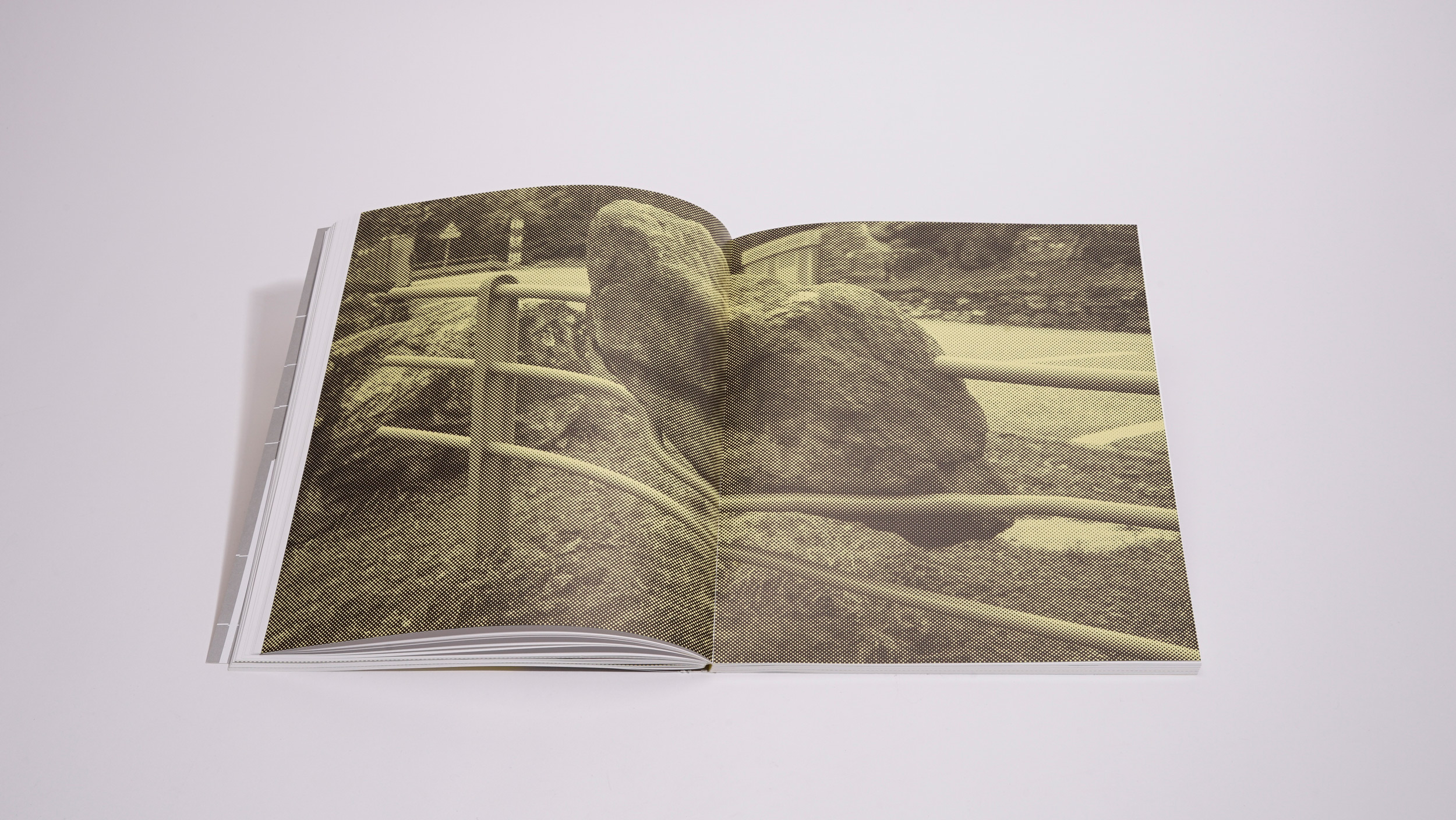
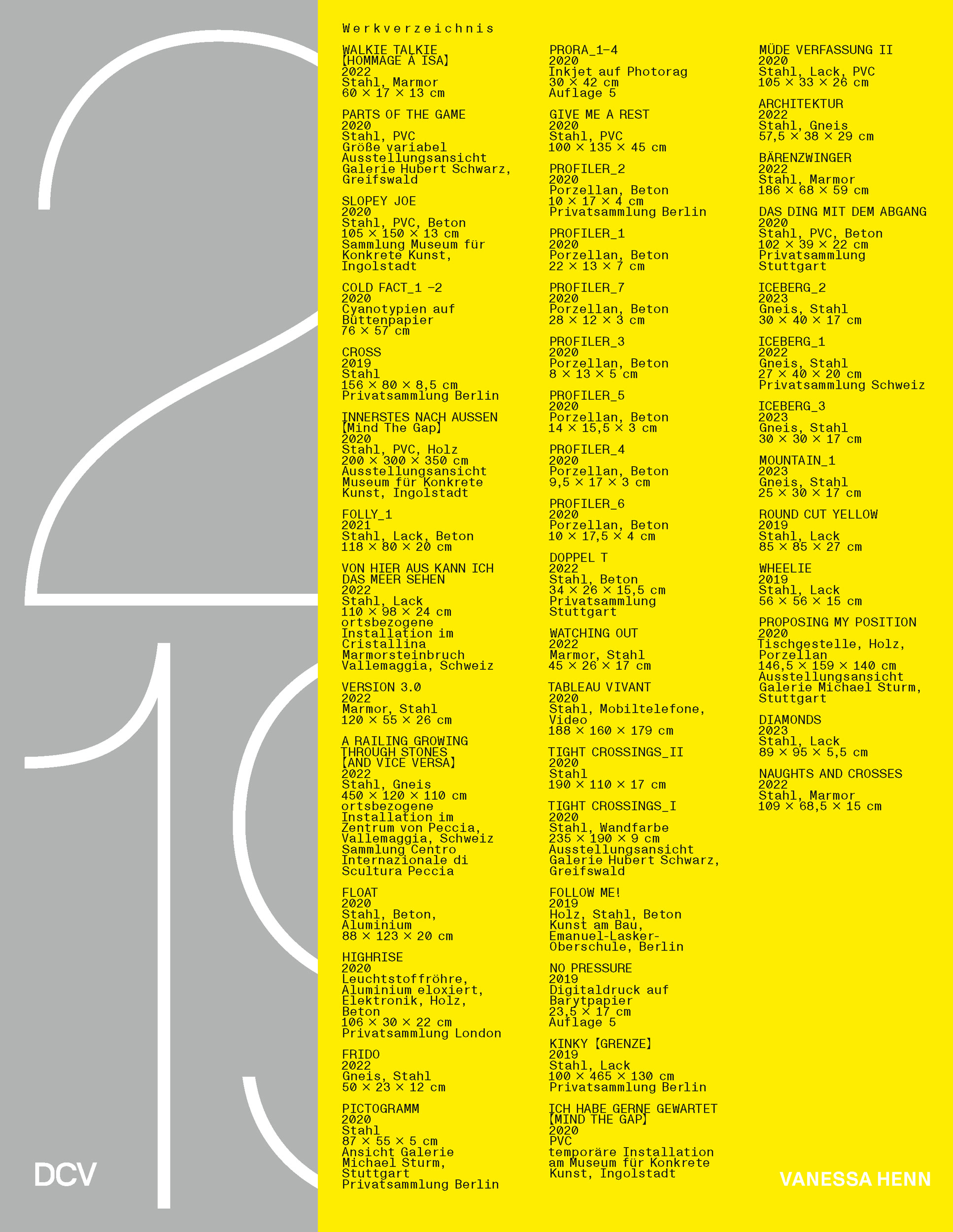
The book presents Vanessa Henn’s latest works from the years 2019-2023.
Vanessa Henn studied sculpture at the State Academy of Fine Arts Stuttgart (1992–2001) and at Edinburgh College of Art (1995–1996) and completed a Master of Fine Art at the University of Canterbury School of Fine Art in Christchurch, New Zealand (1999–2000).
More books
-

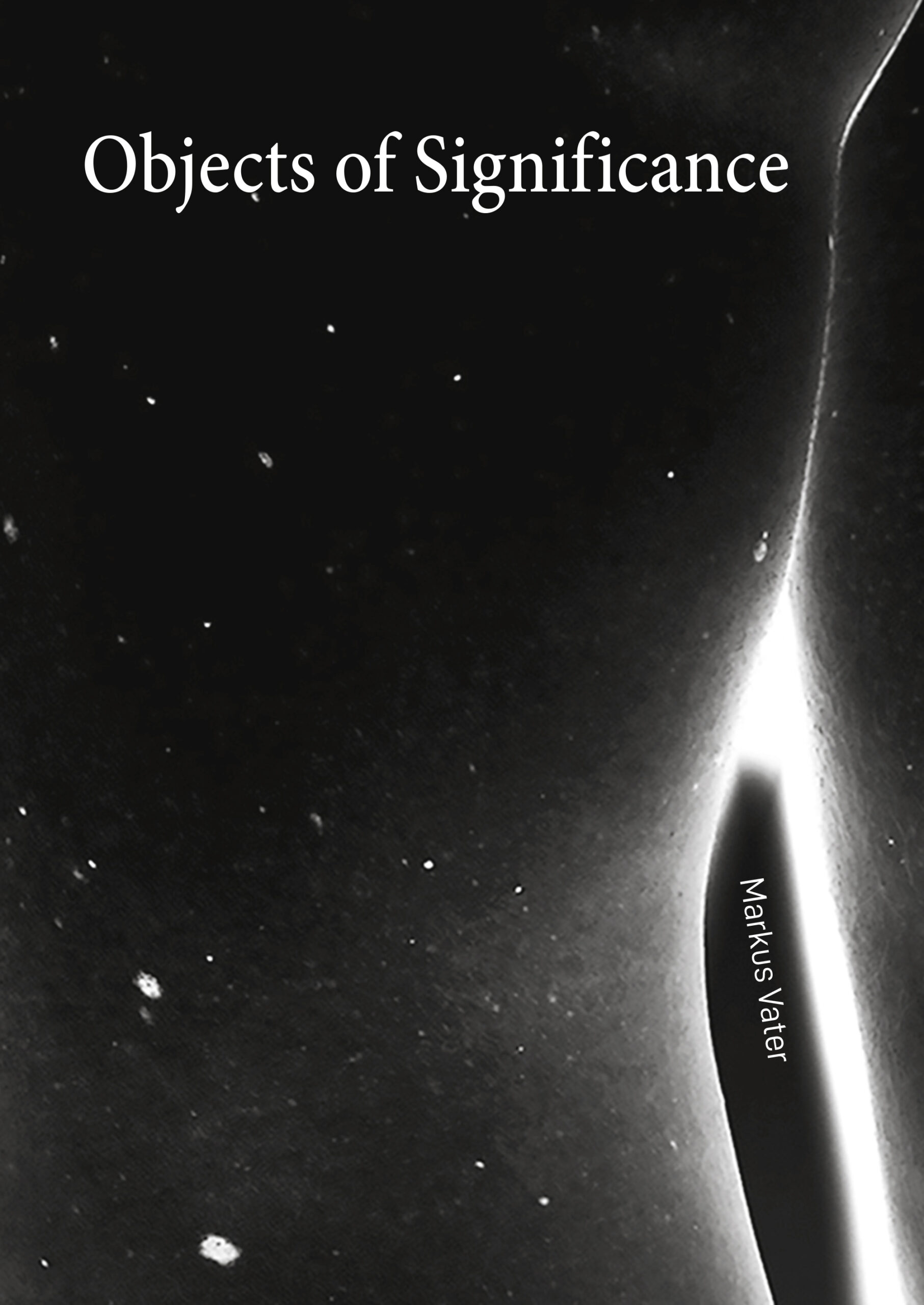
Markus Vater
Objects of Significance32€ Add to cartObjects of Significance is an artist’s book that grew out of a series of photographs and writings which Markus Vater (b. Dusseldorf, 1970; lives and works in London and Dusseldorf) collected over several years. They show and describe what matters to the artist: objects fraught with meaning, questions, relationships, memories. It is a creative and philosophical book, as funny as it is serious, delving into questions like: What do you see when you close your eyes and turn your head toward the sun? Or: How much does a cloud weigh? Vater has interviewed the North Sea for the book and ponders the wind. He sheds light on the conditions in which art comes into being and meditates on what holes are.
- Out of stock

Eva Jospin
Wald(t)räume22€ Read moreThe Forest as a Place of Longing: Eva Jospin’s Magical Corrugated Cardboard Sculptures
The French artist Eva Jospin (b. 1975, Paris; lives and works in Paris) cuts and layers corrugated cardboard to create sculptures and reliefs. Handcraft and precision are essential aspects of her work. The artist retains the original color of the cardboard, since, for her, the material itself already contains sufficient color variations and nuances. The recurring motif is the forest — consisting of numerous trunks, branches, and twigs in extreme density and interspersed with black shadows. They suggest depth and stimulate the viewer’s imagination. Eva Jospin does not reproduce nature one to one, but conveys the feelings of fear, anarchy, or freedom that it triggers: The forest as a universal place of longing.
-

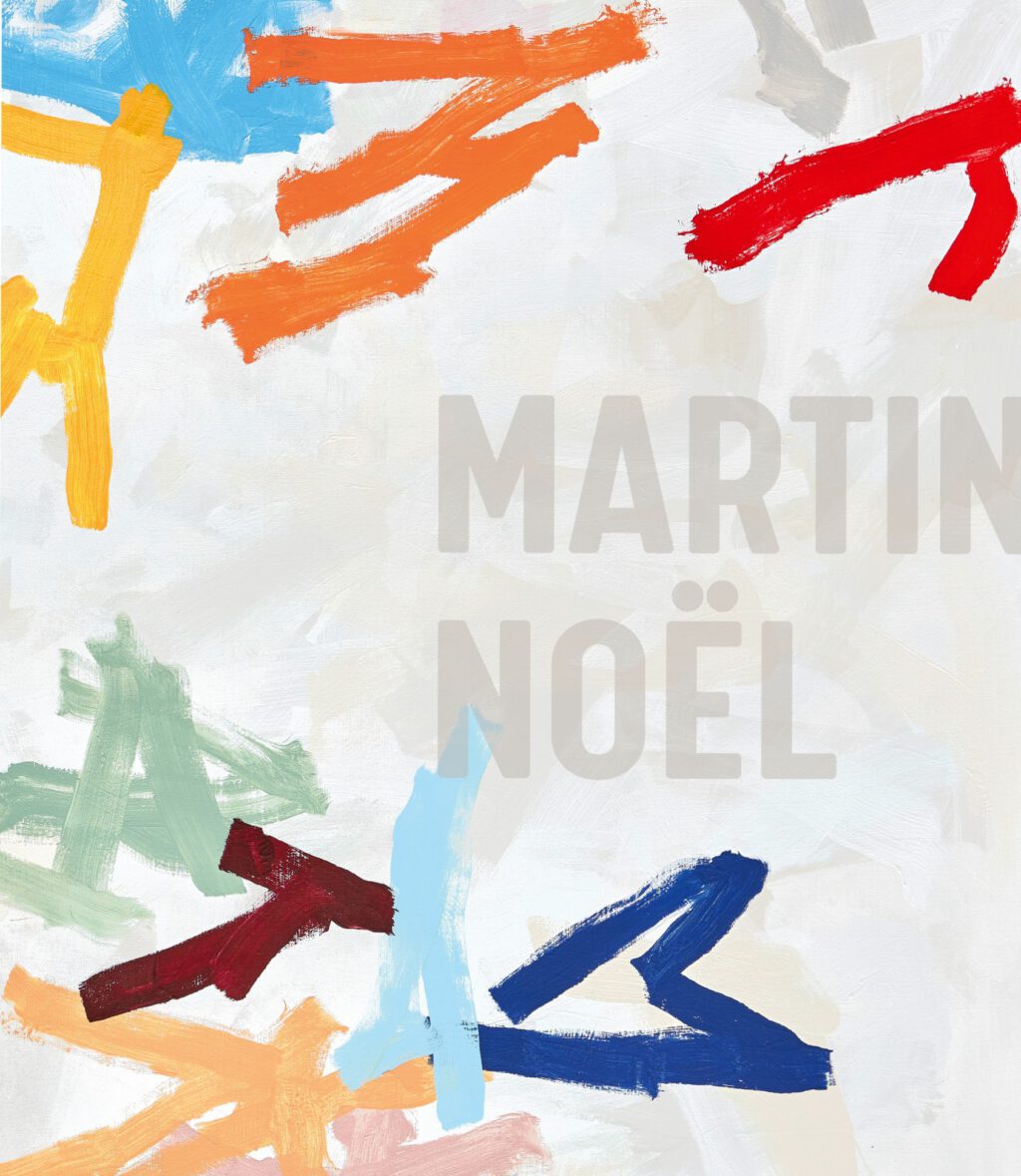
Martin Noël
paintprintpaint35€ Add to cartA Comprehensive Overview on the tenth Anniversary of the Death of Martin Noël
Martin Noël (b. 1956, Berlin; d. 2010, Bonn) was a German painter, draftsman, and printmaker. He was one of the formative innovators of the long-neglected techniques of linocut and woodcut. With his large-format works on paper, he created a position for himself in contemporary art that is as much respected as it is independent. On the occasion of the tenth anniversary of the artist’s death, this volume presents a comprehensive overview of his work from the mid-1980s to the last year of his life in 2010. Thirty-five exceptional works document Noël’s path from his early years as a painter, via the middle phase marked by printing blocks, linocuts and woodcuts, up to his late paintings.
Martin Noël studied Graphics and Painting at the Rheinische Fachhochschule Köln, Cologne. His works are included in, among others, the Federal Collection of Contemporary Art, the Kunstsammlungen Chemnitz, and the collection of the Museum Pfalzgalerie Kaiserslautern.
-

Freeters
HELP! Artistic Intelligence38€ Add to cartFREETERS stands for an artist collective that designs, creates, transforms and plays with spaces, for and with the people who experience their time there. The artistic intelligence used in the process transforms into spaces for thinking, working, living, playing and learning, creating identity, emotion and inspiration.
This book is about the mediation of artistic thinking and artistic action in processes. The artistic practice of Freeters is characterized by strategies of thought and action that are needed in a society with constantly changing conditions, in a working world that overturns itself in its dynamics. The necessity of shaping the present through artistic thought and action can no longer be limited to the art context.
FREETERS’ AI approach should be understood less as a scientific methodology and more as a call not to reduce our intelligence to only rational thought processes with a utility maxim. Of course, AI has already made impressive progress in many areas of our public services via the hard components of machine learning. However, it is doubtful whether this approach alone can really give rise to a superintelligence that will one day create a resource-saving paradise on earth. Nor is it guaranteed that we as Homo Sapiens will be assigned a place in this paradise by such a unilaterally gifted superintelligence. Cognitively, this machine will be superior to us in any case – only the necessary feeling of happiness of a consensual coexistence does not seem quite conceivable.
-

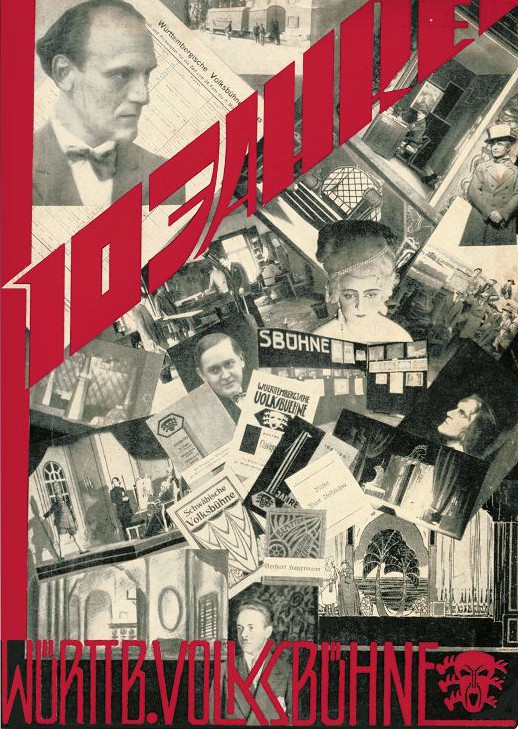
10 Jahre Württembergische Volksbühne
Reprint der Festschrift von 192915€ Add to cartCentennial Publication of the Württembergische Landesbühne Esslingen
In 2019, the Württembergische Landesbühne Esslingen (WLB)—one of the oldest regional theatres in Germany—is celebrating its 100th anniversary. On the occasion of this anniversary, the tenth commemorative publication by the Württembergische Volksbühne from 1929 is being reprinted. The unique document of the time visualizes in a special way the important role that the topics of cultural education and culture in rural areas, which are still relevant today, played in the young Weimar Republic immediately after the First World War. The brochure also documents both the mission and the daily work of the theater. In addition, the reprint is complemented by an essay from Joachim J. Halbekann, the principal of municipal archive of Esslingen, providing—for the first time in the history of the WLB—a comprehensive historical essay that examines the time betweeen 1919 and 1933/34.
- Release Spring 2026

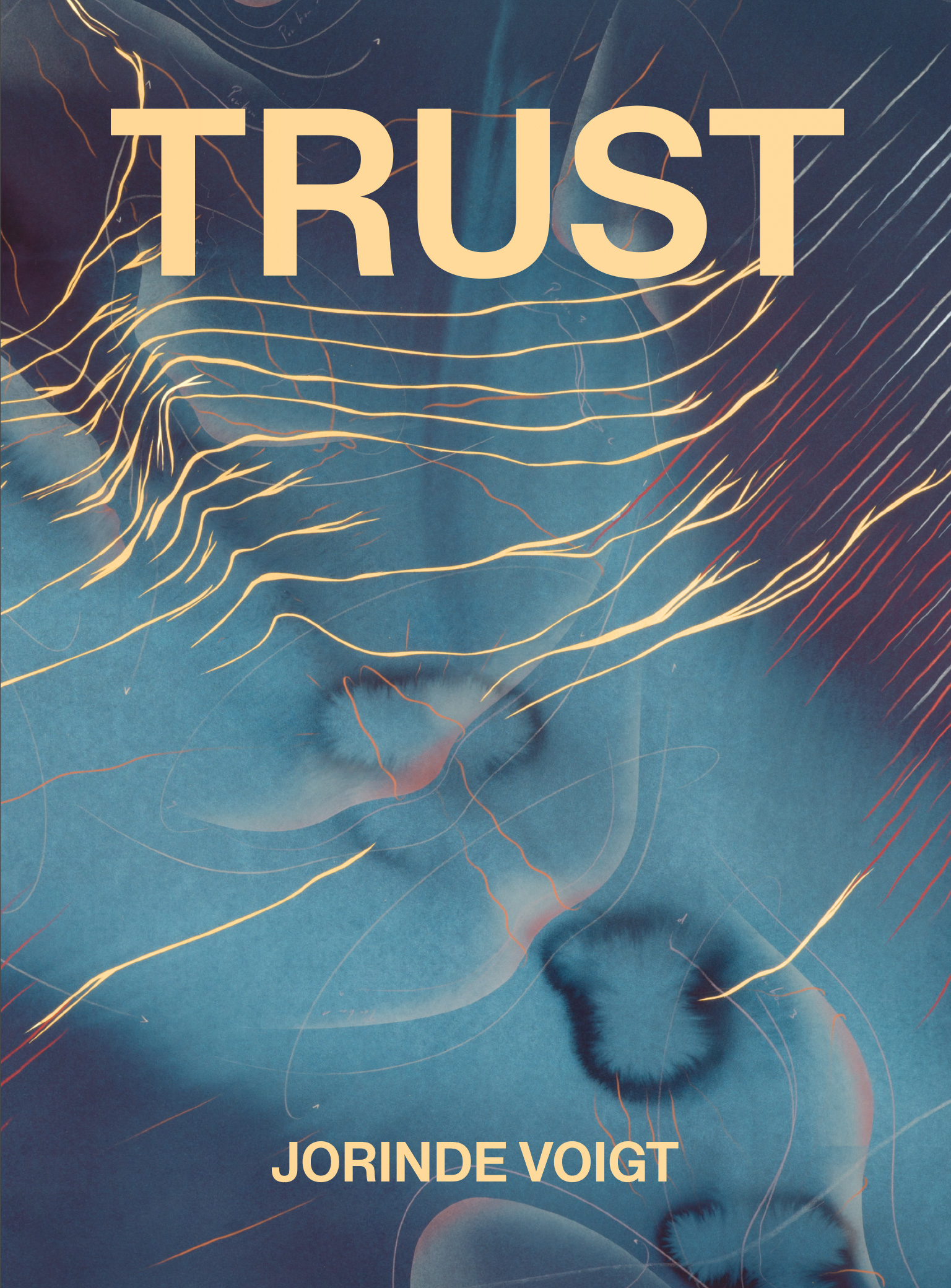
Jorinde Voigt
Trust42€ Add to cartJorinde Voigt (b. Frankfurt am Main 1977, lives and works in Berlin), declared about the title of the book “Trust is a hybrid of longing for something and the engagement to reach it”. Voigt has thus decided to compile her works, which she realized from May 2019 to spring 2021, under the sign of confidence, connectedness, reliability and integrity. Many of the works presented place themselves in the continuity of those in Immersion, a book that brought together works from the period 2018-2019.
In the extensive volume Trust, sculptures and mobiles are shown alongside the works on paper for which she is known – here immersed in a pigment bath and then worked on with pastel, ink, India ink, oil pastels and gold leaf–.
Jorinde Voigt studied philosophy and modern German literature at the University of Göttingen from 1996. In 1998 she moved to Berlin and studied sociology, philosophy and general and comparative literature at the Free University of Berlin. 1999-2003 she studied art in multimedia at the University of the Arts with Christiane Möbus and visual arts and photography with Katharina Sieverding, whose master student she became in 2004. 2014-2019 she was professor of conceptual drawing and painting at the Academy of Fine Arts Munich. Since 2019 she is professor at the Hamburg University of Fine Arts.
-

Hans Karl Zeisel
Hundred and more34,95€ Add to cartPossibilities of Concrete Art
What is possible without turning away from the cocrete? In the Bauhaus tradition, the typographer, graphic artist, designer and author Hans Karl Zeisel opens up countless design options with basic forms. His wooden cuboids demand a humorous approach to sculpture. They are creativity training, study tools and meditation game all in once. A playful experiment that reveals the diversity of concrete art.
-

João Onofre
Untitled (in awe of)25€ Add to cartJoão Onofre’s works are tributes to art history and pop. He gleans what is in danger of being lost right now, realigns it, and translates it into something sublime. His art encourages the beholders to reconsider a past that has faded in collective memory with a critical eye and make peace with it. His creative process is guided by the material and a clearly defined concept that nonetheless does not restrict a work’s finding its own way. That is why he does not commit to a particular medium, making videos, performances, installations, and much more. What all his works have in common is that they probe the limitations of their medium and our perceptive capacities in novel ways. This catalogue presents three recent works in which the essence of Onofre’s art becomes manifest: he molds myths and symbols into awe-inspiring images, sounds, and forms—not for nothing have critics labeled him an alchemist. In the catalogue, his tangible compressions of cultural history are rendered in imposing pictures and flanked by an ambitious essay that places them in their context.
-

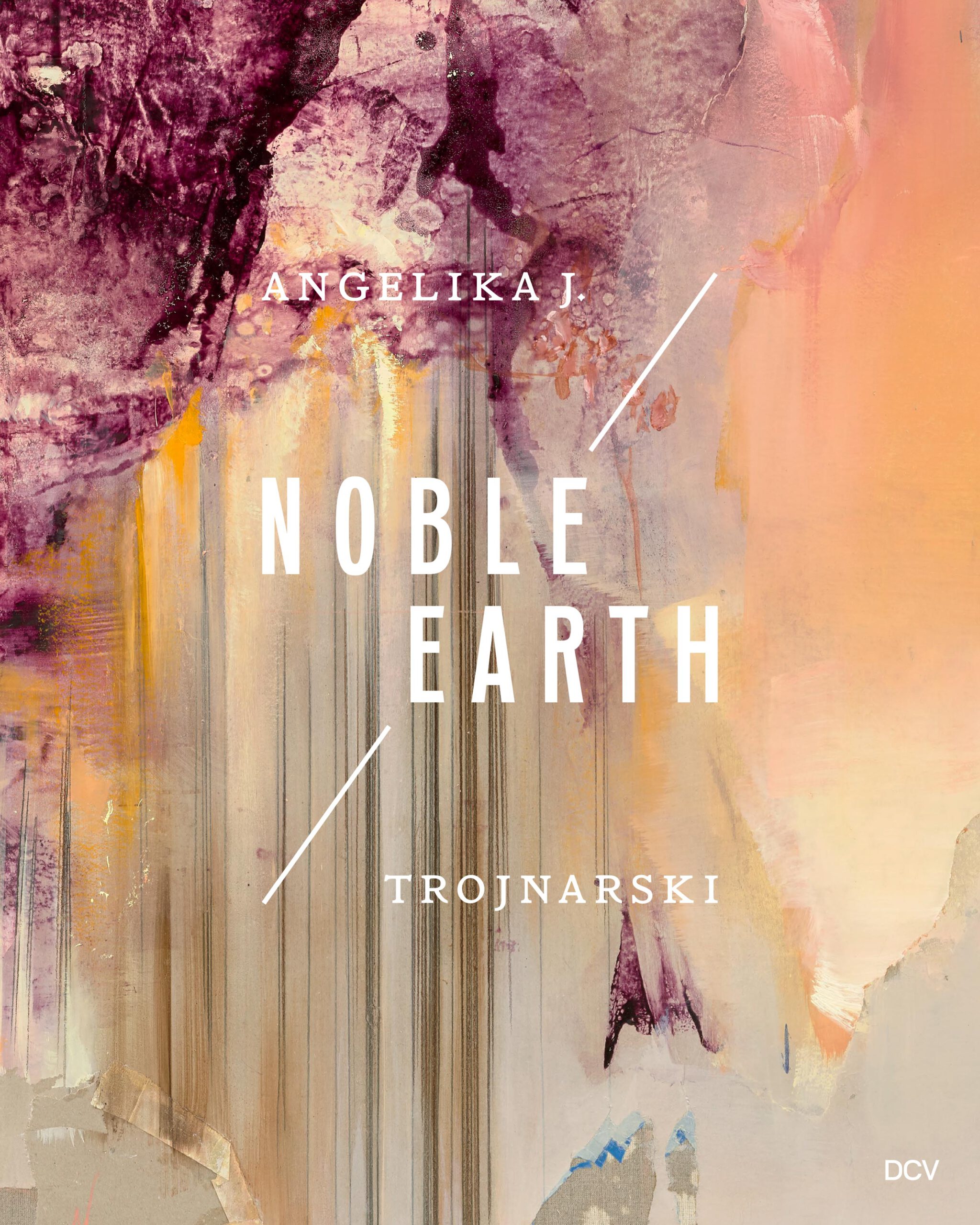
Angelika J. Trojnarski
Noble Earth38€ Add to cartAngelika J. Trojnarski (born 1979 in Mrągowo/Polen; lives and works in Düsseldorf) examines facets of nature through an ecological, scientific, poetic study of their phenomena. Through a process centered on painting, her art articulates allegorical relationships between some of the most significant contentions of our time: humans and nature, strength and fragility, crisis and hope. She expresses a desire to understand nature by reproducing its workings, pointing to its incredible might while underscoring its increasing fragility. Trojnarski overlays raw canvases with paper fragments, employing brushwork and collage to apply materials like graphite or soot, generating a source of energy and suspense through color and contrast. The monograph offers an overview of the last decade of Trojnarski’s work.
Angelika J. Trojnarski 2006–2013 studies at Kunstakademie Düsseldorf. 2006–2009 Painting with Jörg Immendorff, Markus Lüpertz and Herbert Brandl, from 2010 Free Art with Andreas Gursky.
-

Winston Roeth
Speed of Light32€ Add to cartColor Is Light
Intense monochrome areas of color, radiant pigments, and multifaceted surfaces are the characteristics of the art of Winston Roeth (b. Chicago, 1945; lives and works in Beacon, New York, and Waldoboro, Maine). He has devoted himself to abstract color field painting since the 1970s, with the grid as a leitmotif running through his oeuvre; both are fraught with painterly memories of light, “a light that can jump out and grasp the beholders, a color saturation that throbs with a deep glow,” as the artist himself puts it. It emanates from the strata of paint in his pictures, encountering the light that, falling upon his works, molds their chromatic effect. Roeth experiments with pure pigments, which he mixes by hand to make paints he applies in layers to diverse media including paper, aluminum, honeycomb, slate, and wood panels. The book documents a tour of an exhibition, presenting works dating from between the early 1990s and 2020.
-

Jan Zöller
Ritual Believer40€ Add to cartJan Zöller’s (b. Haslach, 1992; lives and works in Karlsruhe) paintings, sculptures, and installations probe the discrepancy between economic production and the spiritual and magical dimension of art. The artist’s book Ritual Believer surveys the so-called charcoal paintings series, created between 2019 and 2023. For these works, the artist paints directly in charcoal on the unprimed canvas, making it impossible to correct “blunders.” Another distinguishing feature is the virtual absence of color; the austerity of the compositions contrasts with Zöller’s other, often intensely colorful paintings. The motifs that are the hallmark of his oeuvre—birds, running legs—are complemented by writing and text. Another aspect of this shift is that the works’ titles play a central part and almost figure as a creative element in their own right. For the text in the book, the artist sent the titles of the works shown to his brother, who wove them into a story. An appendix presents scanned archival materials. Notebooks and zines Zöller produced between 2015 and 2017 provide interesting insight into how he finds his motifs and his compositional process.
Jan Zöller studied with Marijke van Warmerdam and Leni Hoffmann at the Akademie der Bildenden Künste Karlsruhe from 2012 until 2017 and with Jean-Marc Bustamante and Götz Arndt at the École Nationale Supérieure des Beaux-Arts de Paris in 2016.
- English edition not available anymore

YAEL BARTANA
THE BOOK OF MALKA GERMANIARead moreShe Is Hope. She Is the Leader. She Is the Messiah. She Is History. She Is Fake.
The video artist Yael Bartana (b. Kfar Yehezkel, Israel, 1970; lives and works in Amsterdam and Berlin) makes work that explores the visual language of identity and the politics of commemoration. The critical scrutiny of collective expectations of political or religious salvation is a central concern in her art. In the video installation Malka Germania—Hebrew for “Queen Germany”—Bartana creates alternative realities from the German-Jewish past and present that bring scenes of the collective unconscious to light. The publication follows the epiphany of Malka Germania, a female redeemer figure, in five chapters whose layout is modeled on that of the Talmud, the central text in Rabbinical Judaism. This organization reflects the polyphonic complexity, rich nuance, and ambivalence that the work casts into visuals and underscores that there is no simple answer. The book includes an interview with the artist and contributions by Sami Berdugo, Christina von Braun, Michael Brenner, Max Czollek, and others. It is published on occasion of the exhibition Yael Bartana—Redemption Now at the Jewish Museum Berlin.
Yael Bartana studied at the Bezalel Academy of Arts and Design, Jerusalem, the School of Visual Arts, New York, and the Rijksakademie van beeldende kunsten, Amsterdam. Her work is held by collections all over the world and has been presented in solo exhibitions at venues including the Stedelijk Museum, Amsterdam, the Pérez Art Museum Miami, and the Moderna Museet, Malmö.
Click here for the German edition.
-
Simone Haack
HAIR30€ Add to cartSimone Haack (b. 1978 in Rotenburg/Wümme, lives and works in Berlin) has always made the inwards legible in the outer appearance of her figures in her painting. This is also the case in her block of works in the exhibition of the same name, Hair. Already in the late 17th century, magic and superstition were attributed to hair. In it one suspected the whole power of the soul. The artist, who was formed in the painting class of Katharina Grosse and Karin Kneffel, symbolically reveals the fragility of the DNA of human beings through her hair landscapes, which are sometimes placed macroscopically in the picture in the spirit of a New Magic Realism. At the same time, her accompanying exhibition publication always also tells of the triangle of tension of physical as well as psychological existence, which in her case runs through the painterly psychoanalysis.
-

Anaïs Horn
Fading14€ Add to cartThe mystery of love and its language, translated into a photographic discourse
The starting point for the series by Anaïs Horn, which the artist, who works in Vienna and Paris, began in 2013 and now comprises eighty photographs, is the book Fragments d’un discours amoureux (Fragments of a Language of Love) by the French philosopher and author Roland Barthes. Terms such as “asceticism,” “magic,” “yearning,” “venerable,” and “unfathomable” serve Horn as models for her staged photographs. The linguistic “figures,” from which Barthes developed his “discourse” in an open structure, find their counterparts in views of people, landscapes, objects, and spaces. The result is a cosmos of images that is as non-binding as it is intimate, as touching as it is light, as vulnerable as it is challenging, and appears to be infinitely expandable. Viewed together, fragments of collective experiences and cultural codes of our notions of love become visible.
- Shortlist German Photo Book Award 2019/2020

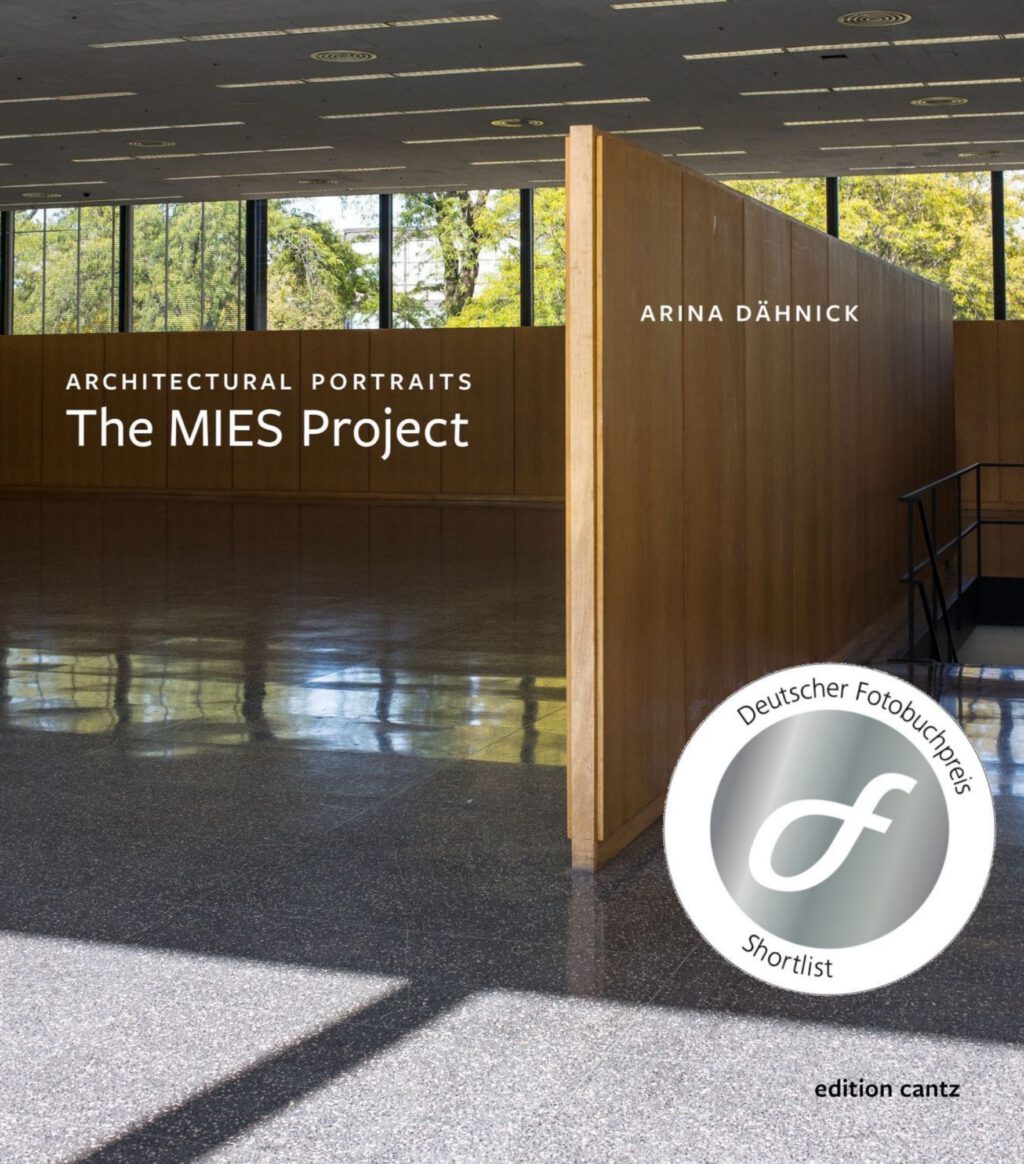
Arina Dähnick
The MIES Project45€ Add to cartIn the Footsteps of Ludwig Mies van der Rohe
In her photographic works, Arina Dähnick (b. 1965, Krefeld; lives and works in Berlin) deals with urbanity, spatial reality and visual perception. She discovered the architecture of Ludwig Mies van der Rohe in 2012, when, after a thunderstorm, she perceived the Neue Nationalgalerie in a both fascinating and paradoxical spatial experience of boundless vastness – and a simultaneous feeling of being held. From then on she photographed the building under various conditions until its closure in 2015, afterwards following in Mies van der Rohe’s footsteps from Berlin to Brno, from Chicago to New York. Dähnick captured his most famous buildings – including the Villa Tugendhat, the Seagram Building, and the Lake Shore Drive Apartments – in impressive photo series, which have been exhibited during the Chicago Architecture Biennial amongst others. The book was awarded the silver medal of the Deutscher Fotobuchpreis.
-
Steven Shearer
Working from Life58€ Add to cart“Today’s images are echoes of how people have always been depicted.”
Steven Shearer (b. New Westminster, BC, 1968; lives and works in Vancouver) works in a range of media including printmaking, sculpture, painting, drawing, and collages of found photographs. His portraits of individuals in decorated settings earned Shearer international acclaim. They show heroes from the past—protagonists of musical subcultures or the history of art. The archetypal creative minds in their studios appear together with their works; the interiors surrounding them reflect their psychological constitution. Shearer paints them in the style of Symbolism, the German Romantics, or the Fauves. Imitating the perspective painting of the Renaissance, he virtually pulls the beholder into his pictures.
Steven Shearer participated in the Nova Scotia College of Art and Design New York Summer Studio Programme in 1992 and studied at the Emily Carr College of Art, Vancouver, in 1992. In 2011, he represented Canada at the 54th Venice Biennale.
-

Maxim Gunga
10€ Add to cartThe painter Maxim Gunga is utterly unafraid of physicality. His canvas is a riot of oil paints huddling up against one another, fusing like the beasts, the humans, and the urban landscape of Berlin that serve him as motifs. Body and soul, animal nature and architecture, the profane and the sacred, subculture and mass culture—everything interpenetrates in Gunga’s paintings in large formats, melded into hybrid bodies. The result is an ecstatic intimacy, a flowing of colors and more or less abstracted dynamic forms toward their primal state, toward the matrix, toward pure energy: eternal transformation. It makes sense, then, that his pictures also amalgamate diverse styles and periods in the history of painting. He borrows from (Neo-)Expressionism, from Art Brut, from Baselitz, Lüpertz, the Neue Wilde, from modernism and Fauvism, from van Gogh and Matisse. His pinpoint brushwork, which reveals his extensive training, interweaves art history with our contemporary lifeworld and our affects. All the specters of the past and the present come to meet us in the pictures gathered in this catalogue, in a frenzy of the senses, in the primordial soup of Berlin, into which we dive with joyful abandon.
-

Lovis Corinth
Maestro del colore – Maestro della grafica35€ Add to cartLovis Corinth (b. Tapiau, East Prussia, 1858; d. Zandvoort, Netherlands, 1925) ranks among the leading German Impressionists. But he has also been described as a precursor of Expressionism for his impulsive and passionate style in painting and graphic art as well his liberal handling of form, which vividly conveys agitated states of mind and powerful emotions. In addition to an eminent body of paintings and numerous drawings and watercolors, he left a graphic oeuvre encompassing over a thousand prints. In his paintings as in his etchings and lithographs, Corinth dedicates himself to a set of recurring themes: mythological and religious motifs, nudes, still lifes, landscapes, and portraits of his family and close friends. His graphic work also shows him engaging with the challenges of self-portraiture.
-

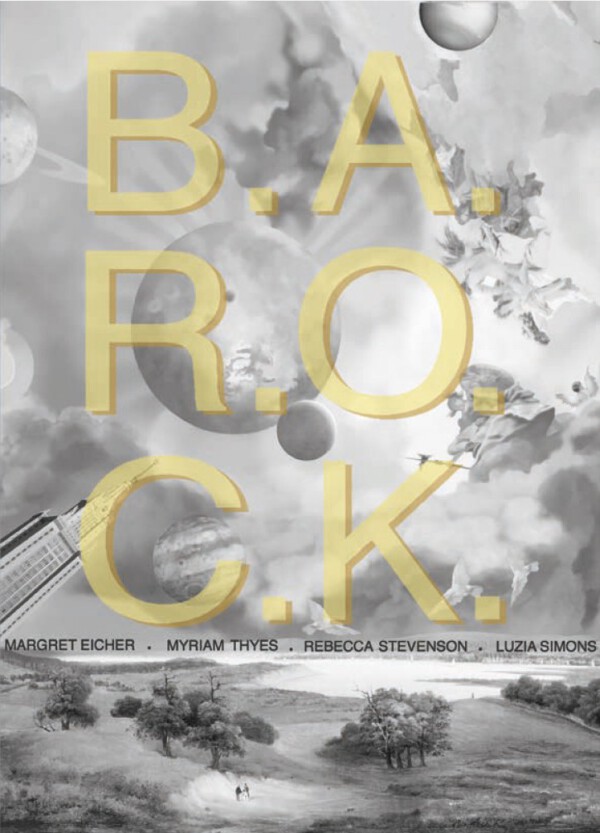
B.A.R.O.C.K.
24,80€ Add to cartArtistic Interventions in the Caputh Palace. Contemporary Parallels to the Baroque Era
Four international women artists spent more than three years studying Caputh Palace near Potsdam and creating works specifically for this magnificent location. The tapestries by Margret Eicher (b. 1955, Viersen; lives and works in Berlin), the floral scans by Luzia Simons (b. 1953, Quixadá, Brazil; lives and works in Berlin), the wax sculptures by Rebecca Stevenson (b. 1971; lives and works in London), and the ceiling painting projections by Myriam Thyes (b. 1963, Luxembourg; lives and works in Düsseldorf) blend into the surrounding space both naturally and surprisingly. With twelve double-page collages, the large-sized catalog is an artistic commentary on the ambitious project.
-

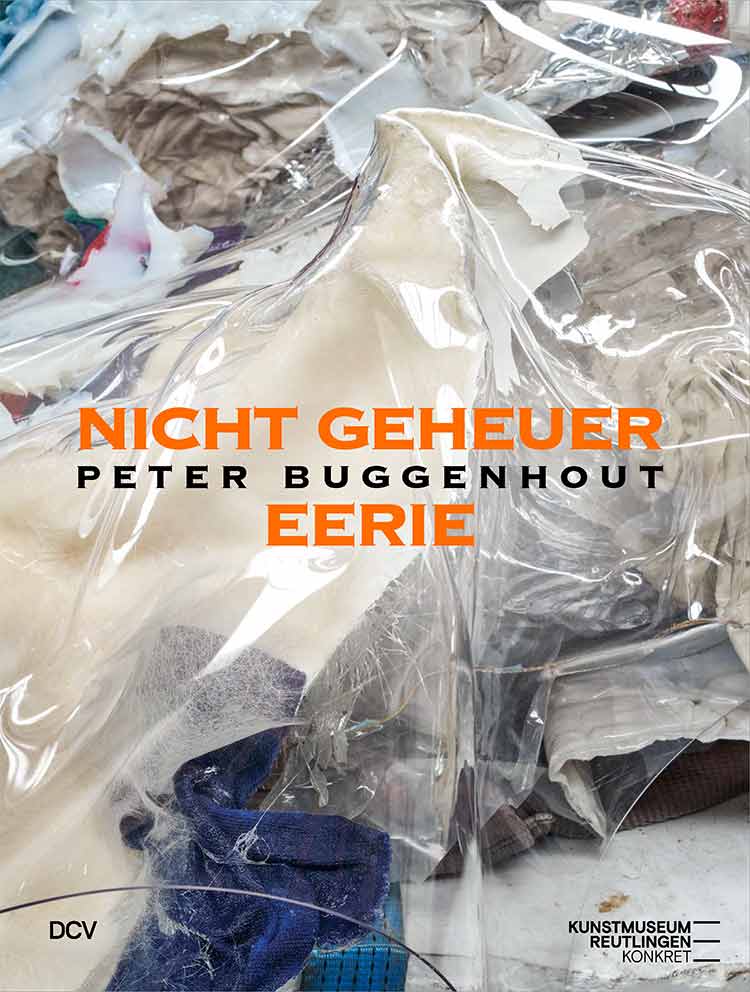
Peter Buggenhout
Eerie28€ Add to cartAn Autonomous Counterpart
The renowned sculptor Peter Buggenhout (b. 1963, Dendermonde, Belgium; lives and works in Ghent) describes his hybrid pieces as “abject things” that defy classification and even the label “work of art.” He aggregates and manipulates found and discarded objects as well as both technical and organic materials including pig blood, cow stomachs, and horsehair until he achieves a certain degree of abstraction. Buggenhout’s sculptures confront the beholder as creatures that are somehow “off,” exuding an eerie atmosphere by allowing something sinister to rise to the surface that, it appears, lurks just behind the façades of the physical world: vestiges of humanity, society’s sedimented refuse. The book presents a comprehensive survey of his growing oeuvre; it is the first publication to cover his most recent creations in marble.
Peter Buggenhout’s art has been featured at the Palais de Tokyo, Paris; the MoMA PS1, New York; the 2014 Taipei Biennial; and elsewhere.