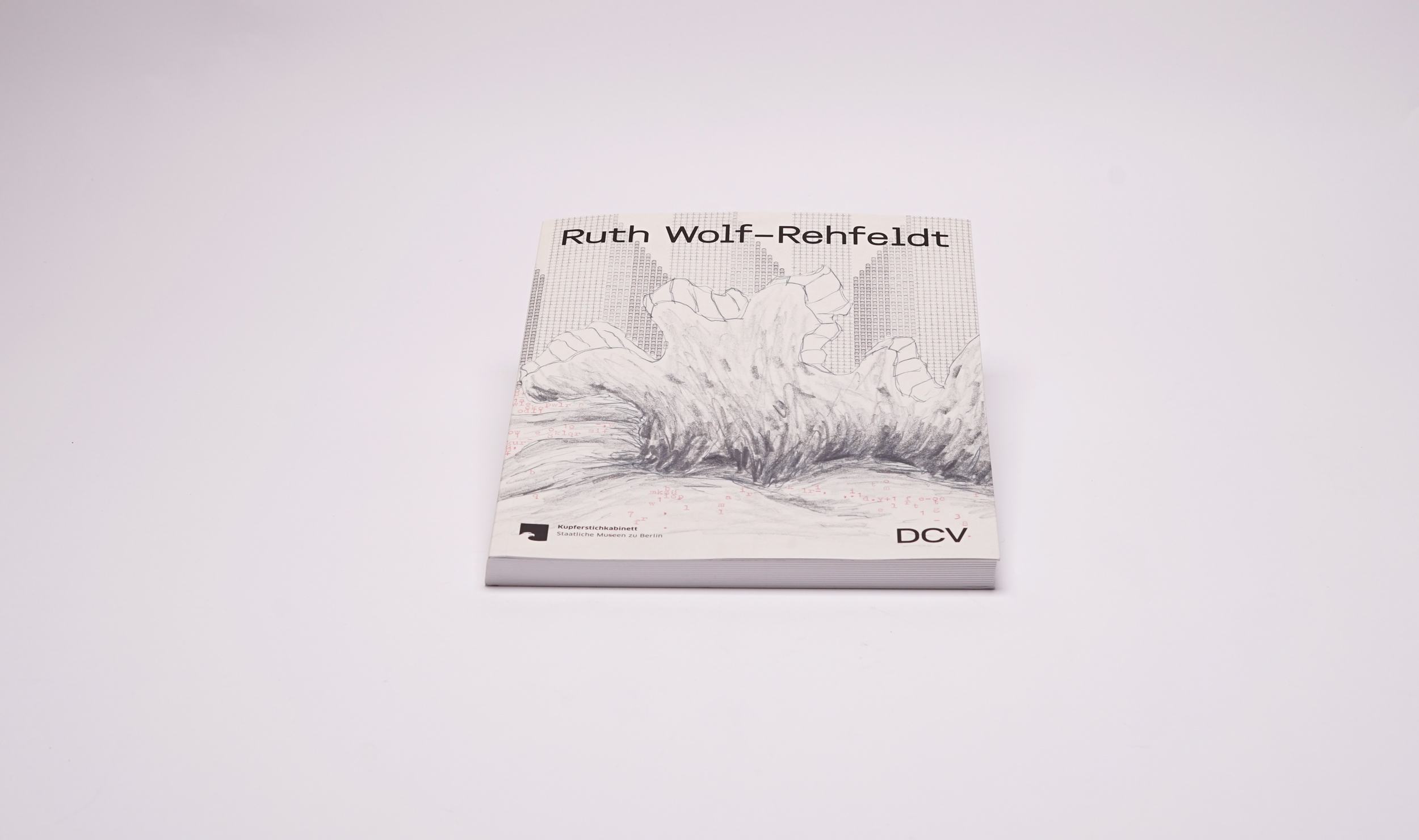
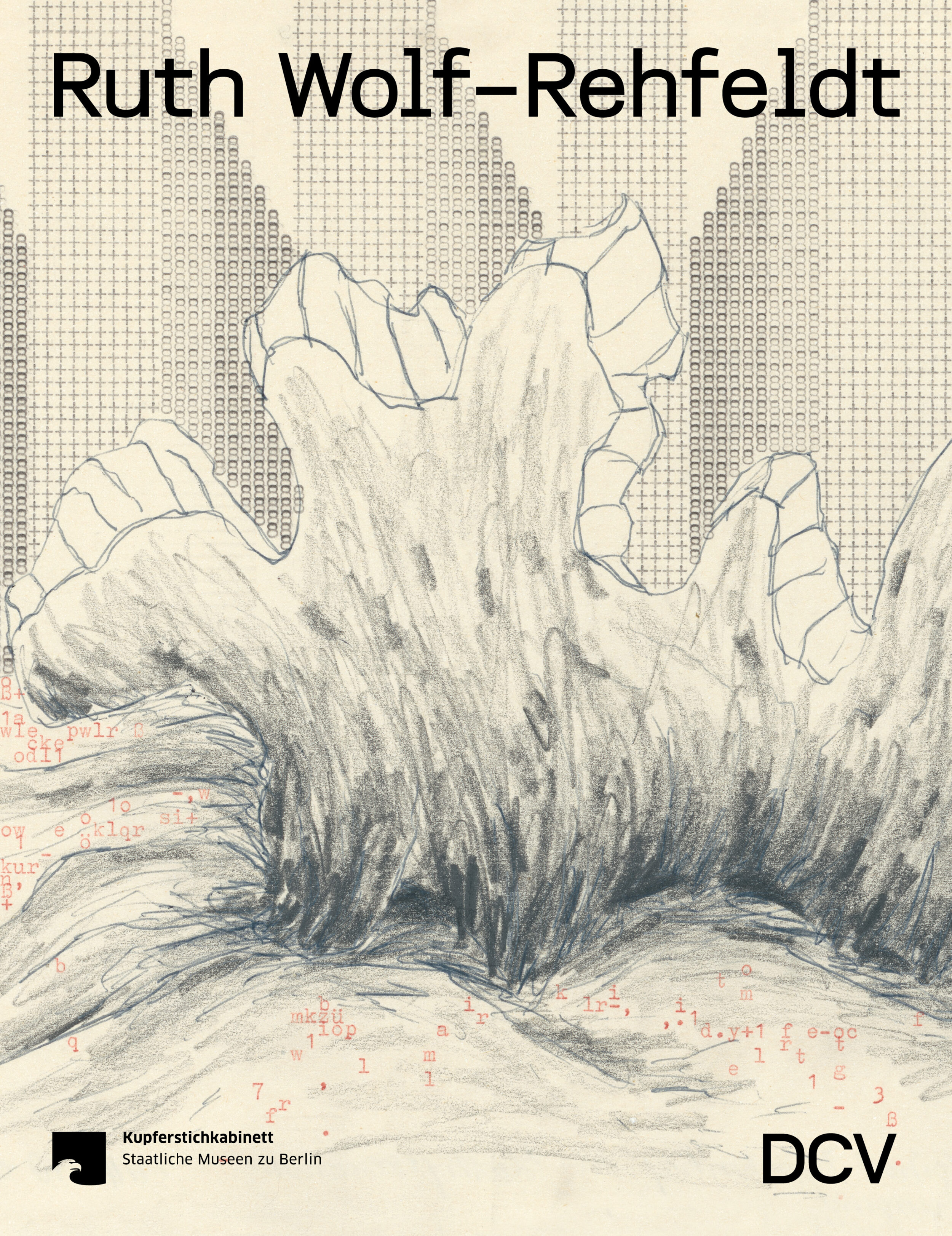
Ruth Wolf-Rehfeldt – Wie eine Spinne im Netz
 | |
|---|---|
| Editor(s) | Jenny Graser |
| Author(s) | Jenny Graser, Dagmar Korbacher, Klaus Lederer, Fabienne Meyer, Kathleen Reinhardt |
| Design | Book Book, Berlin |
| Cover | Softcover with flaps |
| Size | 22,6 × 29,7 cm |
| Pages | 216 |
| Illustrations | 172 |
| Language(s) | German |
| ISBN | 978-3-96912-104-7 |
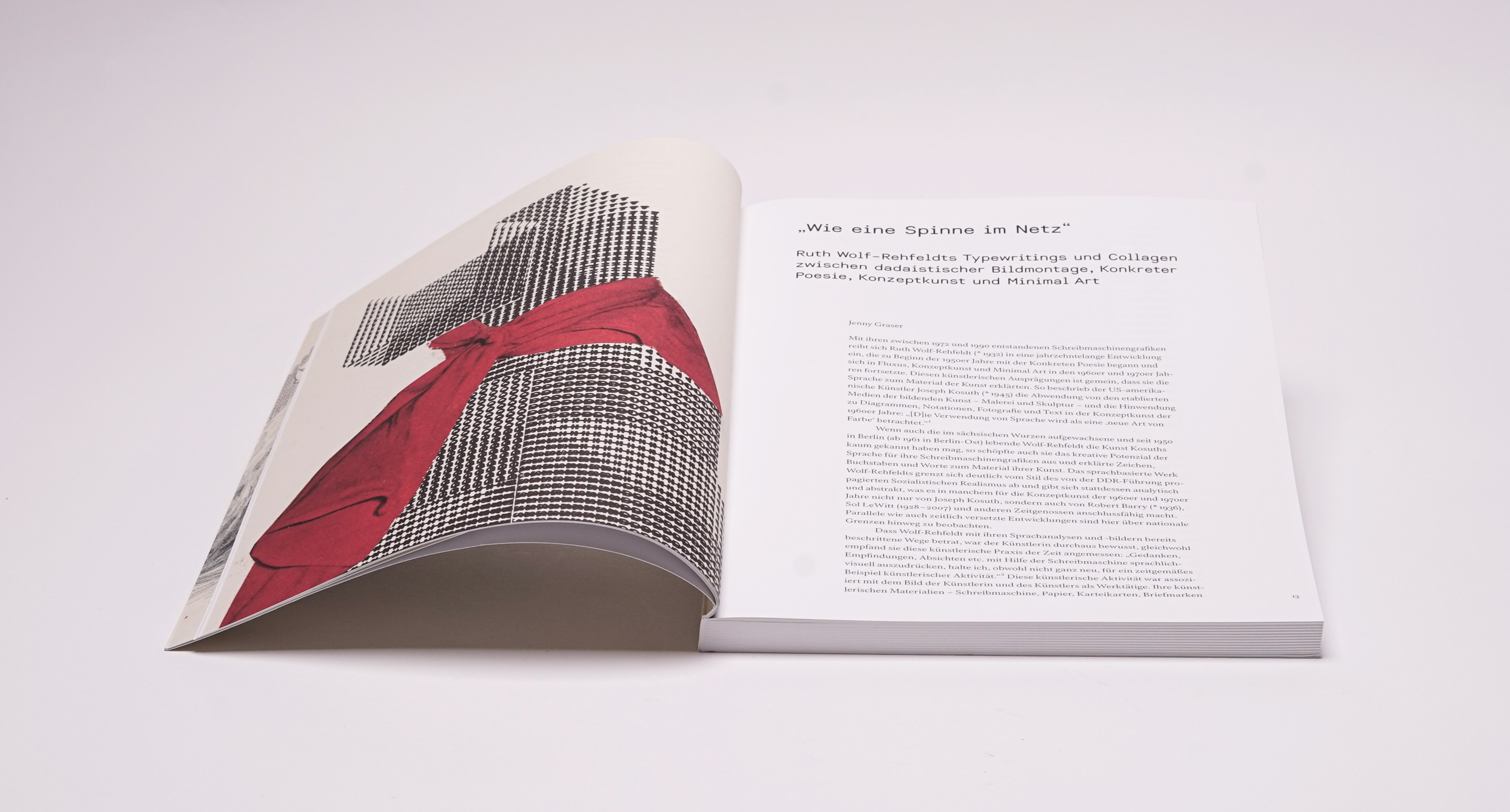
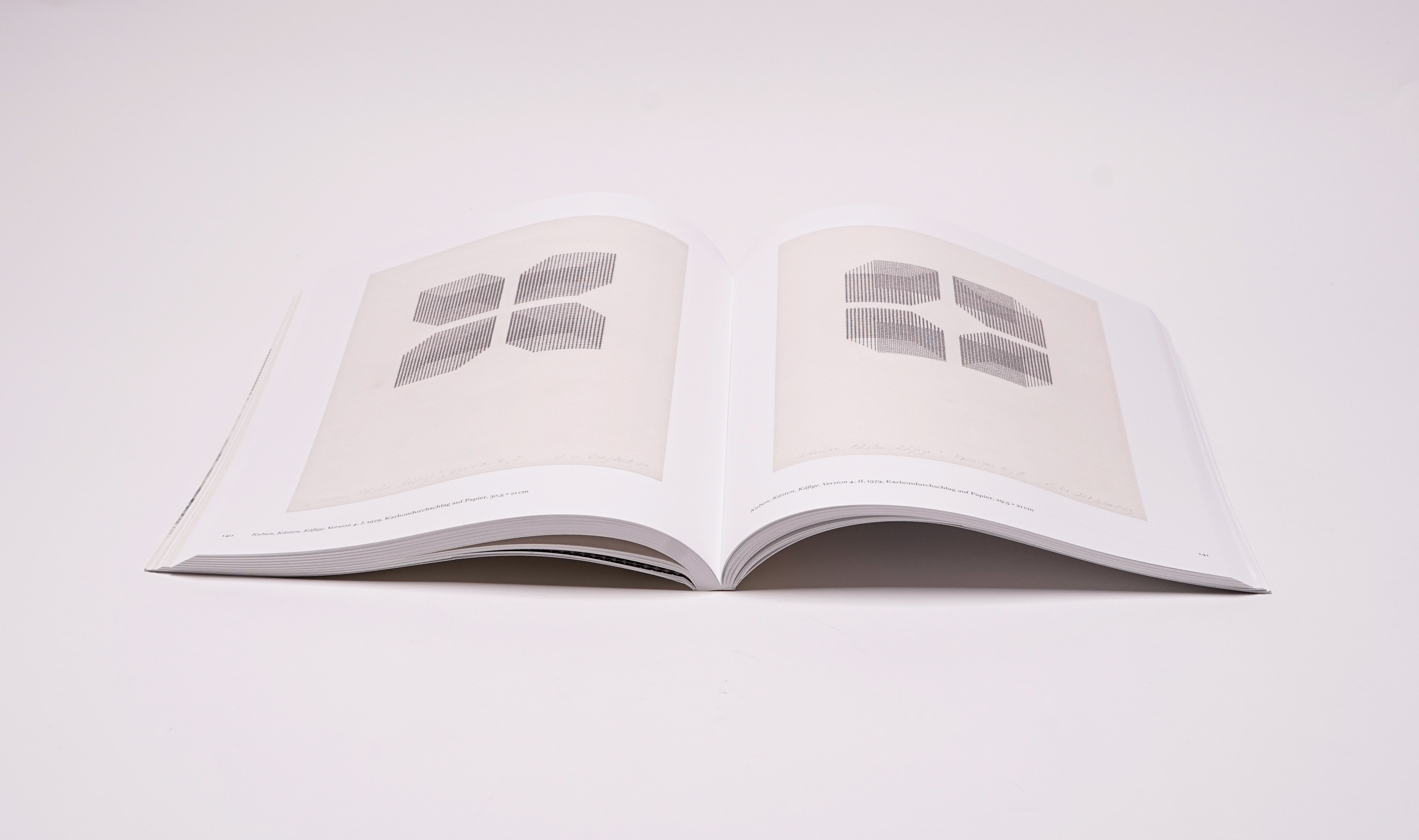
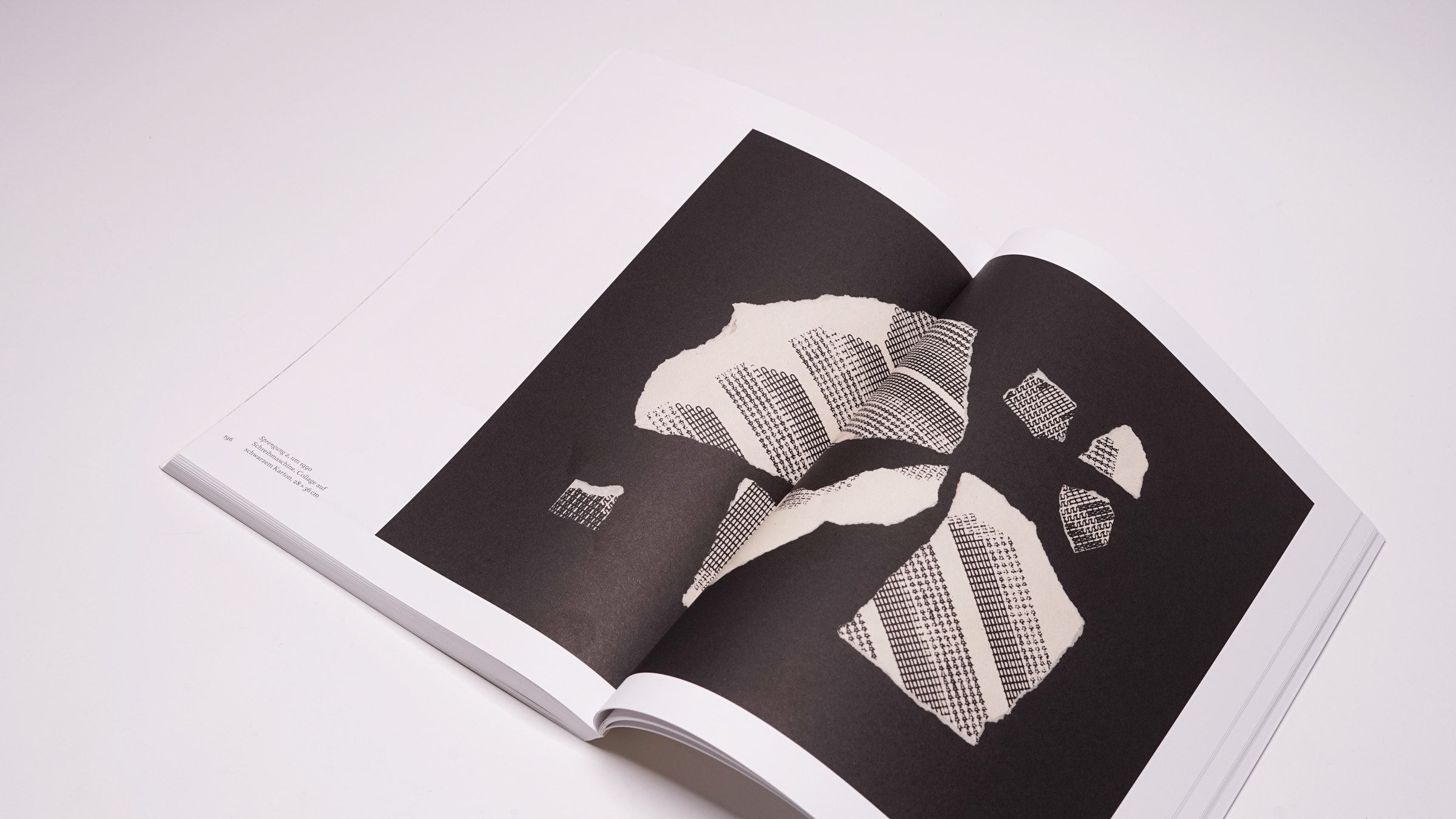
Ruth Wolf-Rehfeldt (b. Wurzen, Germany, 1932; lives in Berlin) is one the few East German female artists who devoted themselves to graphic art produced on the typewriter. Working on her trusty “Erika,” she arranged letters, digits, commas, and plus signs to compose imaginative visual creations. Under her hands, the black and red characters were transformed into poetic verbal images, gently undulating waves, serial patterns, and architectonic or figurative formations. Sometimes verging on concrete poetry, these typewritings also evince unmistakable affinities with conceptual and minimalist art. In the 1980s, the artist expanded on them in collages that recall Hannah Höch’s Dadaist visual montages. With her graphic work, Wolf-Rehfeldt was also an active participant in the GDR’s mail-art program: she sent the typewritings to artists beyond the impassable borders of her country, building an extensive network of correspondences that spanned the globe.
The richly illustrated monograph underscores the diversity and contemporary relevance of Wolf-Rehfeldt’s works, which were created in the shadow of the Cold War and address the fragility of peace as well as early manifestations of the environmental devastation wrought by the industrial age.
More books
-

Kai Schiemenz
Priel38€ Add to cartTidal creeks are watercourses that crisscross coastal mudflats. Running between sandbars, they flush deposits out into the sea with the falling tide, and when the tide rises, the water flows back in. In other works, tidal creeks are effectively rivers in the sea. Delving into the implications of this idea, the book presents Kai Schiemenz’s (b. Erfurt, 1966; lives and works in Berlin) major works and projects of the past four years. The publication offers insight into the provenance of selected bodies of work and their genesis. Kai Schiemenz’s art examines the city, spaces, and architecture. His small-format sculptures are self-contained creations that combine digital technologies with natural materials like wood or paper. At the same time, they function as models for expansive installations and outdoor and indoor architectures in which Schiemenz orchestrates sight lines to construct spaces whose permeability makes the audience an integral aspect of the work. If his sculptures are architecture, his exhibitions are landscapes in which the visitors encounter one another as they would in a park. Their central question, time and again, concerns the impact of the built environment and urban landscapes on their inhabitants.
-

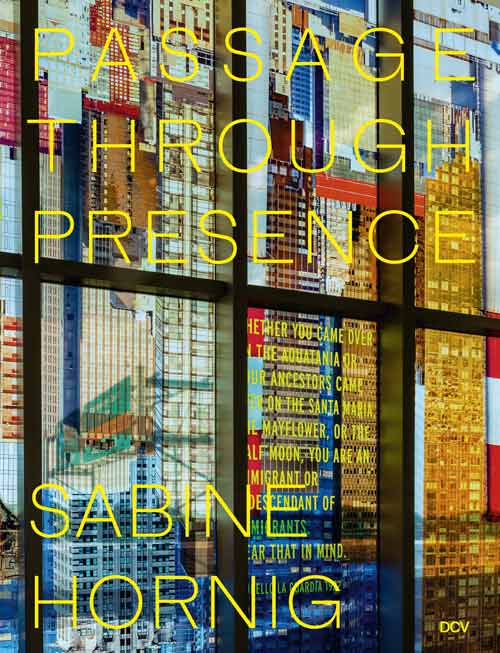
Sabine Hornig
Passage through Presence45€ Add to cartLayered Spacetimes in Large Formats
Sabine Hornig (b. 1964; lives and works in Berlin) has earned international acclaim with sculptures, photographs, and architectural interventions that interweave image, perspective, and space in distinctive ways. Her works feature translucent pictorial planes on glass panes; integrating these sculptural elements into the setting, she creates environments in which meaning unfolds as viewers allow their gazes—and themselves—to wander. For her new works, which engage with architecture, the artist superimposes enormous photographs on entire façades and concourses. This publication is the first to put the focus on Sabine Hornig’s art in three dimensions, detailing her process from the building of sculptural models and the combination with transparent photographic layers to her creation of works in public settings. It showcases her largest installation to date, at LaGuardia Airport in New York City, which she discusses in a conversation with Nicholas Baume, director and chief curator, Public Art Fund, New York.
-

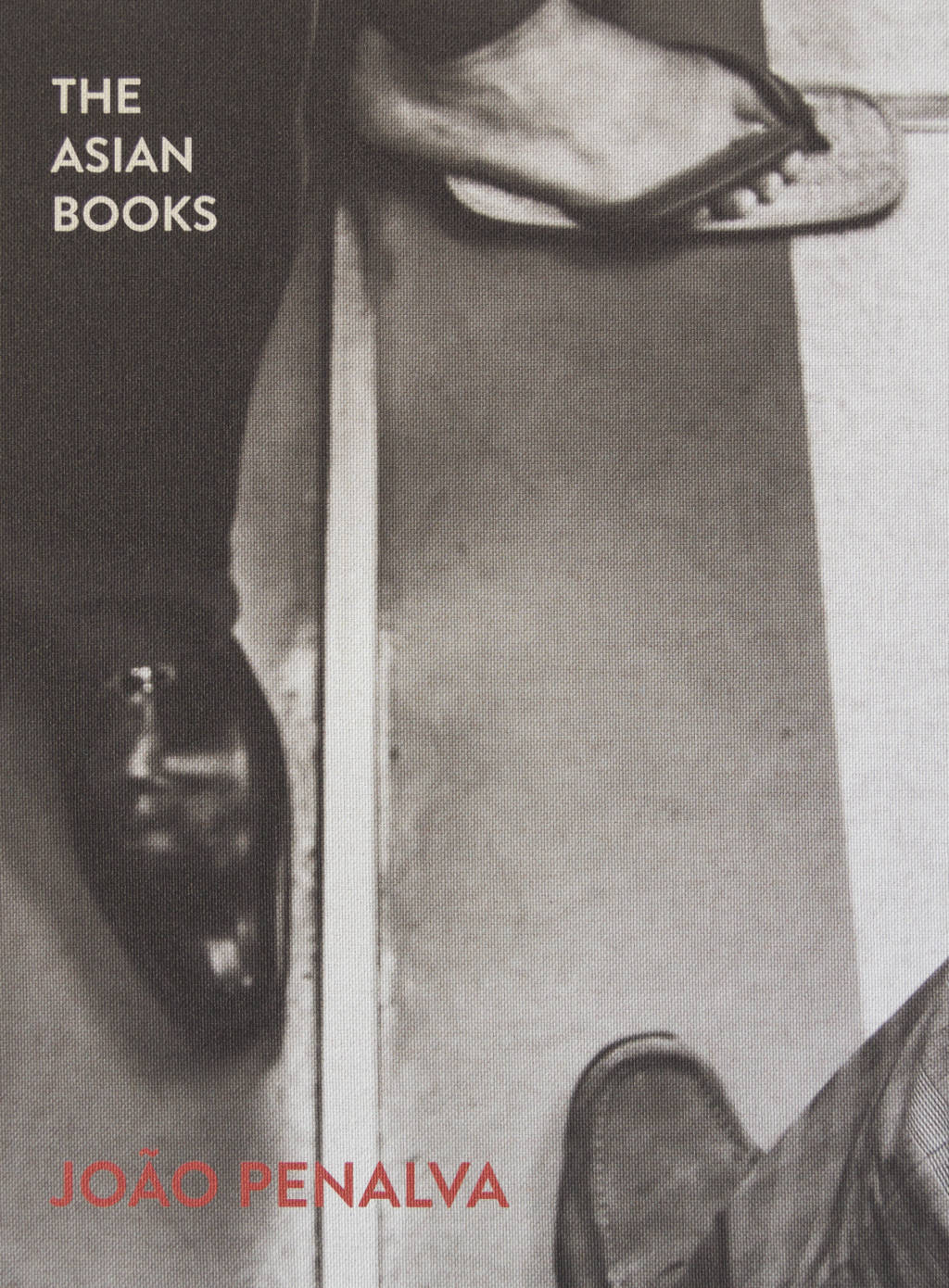
João Penalva
The Asian Books40€ Add to cartThe First Survey on the Exceptional Artist Books of João Penalva
Since 2007 João Penalva (b. 1949, Lissabon; lives and works in London) has exhibited large format unbound books, printed with archival inks on fine art paper, displayed on tables with chairs, to be handled freely. Each one is published in an edition of three and one artist’s proof. Those whose content relate to Asia, whether factually or fictionally, are collected here for the first time: Taipei Story, 2007; Portraits: Machines and Kabuki Wigs, 2009; The Toshiba Book of Happiness, 2009; Hello? Are you there?, 2009; Michio Harada, 2015; Boro, 2017.
João Penalva studied Fine Art at the Chelsea School of Art in London. His works have been shown in manifold international exhibitions. Penalva represented Portugal 2001 at the Venice Biennale and 1996 at the São Paulo Biennale.
-

Konrad Mühe
Guide38€ Add to cartAn Artist’s Book as an “Optical Illusion”
Konrad Mühe’s (b. Karl-Marx-Stadt, East Germany, 1982; lives and works in Berlin) works interrogate the construction of our identities by uncovering the technological and media apparatuses that sustain it and confronting it with the autonomous lives of objects. Their basic formal principle is the installation hybridizing sculpture and digital moving image, with a particular focus on the projector and the interaction of pedestal or suspension and projection screen. Where the classical black box in the movie theater or exhibition venue seeks to conceal the technical equipment in favor of an immersive visual experience, Mühe brings it to the fore and sets it out in the gallery space as sculpture and installation. Yet his works also undercut the conventional display regime in the white cube: the process of projection emerges as the true creative medium and subject. This book acts as a descriptive illustrated Guide to Mühe’s projects.
Konrad Mühe was Hito Steyerl’s master student and trained at the Berlin University of the Arts and the Burg Giebichenstein University of Art and Design Halle. His works have been featured at numerous film festivals including the 61st Berlinale and in exhibitions at Kunsthalle Düsseldorf, the Moscow Museum of Modern Art, and elsewhere.
-

Antonia Hirsch
Phenomenal Fracture24€ Add to cartIn a probing engagement with the screen, an omnipresent object in contemporary life, Antonia Hirsch charts the gulf between the digital and the analog, the two spheres of which our perceived reality is composed. In provocative installations and objects, the artist conceives the distinctions between screen, mirror, and blade as less than sharply defined. Her works show rigidly geometric shapes made of hard and shimmering glass and steel; they encounter eerily somatic and perishable-looking cardboard or soft foamed-plastic components that recall the bodies they perhaps once served. Reflective surfaces mirror our gaze, but the less classy materials, too, await recognition by the beholder’s body. The book accompanies Hirsch’s solo exhibition Phenomenal Fracture at Kunsthalle Lingen; photographs and writings convey extensive and sustained impressions that run the gamut from the uncanny to the darkly humorous.
-
Michelle Jezierski
Verge28€ Add to cartHow does a simple line become a horizon? When do we begin to see colors and shapes as a landscape? Michelle Jezierski’s painting homes in on the tipping point at which our perception begins to oscillate between color/surface and space/representation. At that very point, she captures the essence of the landscape as such, which is not a concrete place but a metaphor for inner states of affairs. To get there, Jezierski distills what she sees in her surroundings down to the elements of painting—shapes and colors—which just barely intimate a pictorial space while persistently drifting toward abstraction. The defining feature of her technique is that she layers several pictorial planes and spaces on the canvas in staggered arrangements. “Perpetually discovering new ways to unsettle the visual space,” as she puts it, she engenders ruptures and structures that open up multiple perspectives and a portal for reflection on one’s own perception. Above all, however, the cuts lend her pictures a peculiar rhythm that powerfully pulls in the gaze, making the reader paging through this catalogue forget time and space.
-

GABRIELE BASCH, GESA LANGE
UND_NEWS_FROM_NOW_HERE18€ Add to cartBeyond Painting
Gabriele Basch’s (b. 1964, Bad Homburg; lives and works in Berlin) cut-outs and Gesa Lange’s (b. 1972, Tongeren, Belgium; lives and works in Hamburg) drawings are meditations on construction and deconstruction as well as doubts and how to overcome them. Both artists expand the range of painting: Basch, with incisions into the medium and a creative handling of the tinged shadows that transform the painted panel into a wall-mounted object; Lange, by embroidering her canvases with colorful threads that open up the pictorial space on all sides. The book presents works by both artists, initiating an animated and dynamic dialogue between their nonrepresentational visual idioms. Gabriele Basch is professor of painting at the Hochschule für Angewandte Wissenschaften Hamburg. Gesa Lange is professor of graphic art at the Hochschule für Angewandte Wissenschaften Hamburg. She has received the Kunsthalle Rostock Prize and other awards.
-

The Art of Society
1900–194529€ Add to cartThe Collection of the Nationalgalerie, Berlin
The Neue Nationalgalerie in Berlin, the last building designed by Mies van der Rohe, has been closed a full six years for refurbishment. To mark its reopening the museum is presenting the highlights of its classical modernist collection under the title The Art of Society, 1900–1945. Visionary, critical, resigned or utopian, the paintings and sculptures bear witness to art’s dialogue with prevailing social conditions – from the German Empire to the First World War, the Weimar Republic and ultimately National Socialism. The catalogue documenting all works in the exhibition traces the major artistic tendencies during the first half of the 20th century in thirteen chapters. The Art of Society, 1900–1945 offers a renewed encounter with works by Edvard Munch, Ernst Ludwig Kirchner, Tamara de Lempicka, Lotte Laserstein, Otto Dix, George Grosz, Max Beckmann, and many others that is as captivating as it is illuminating.
Click here for the German edition.
-

Barthélémy Toguo
10€ Add to cartBarthélémy Toguo’s art is a call for community and love, but there is nothing naïve about it. His paintings, graphic art, sculptures, performances, and installations explicitly grapple with colonialism, migration, and inequality; he directs our attention to the devastations wrought by humans, to the slow deaths of nature and cultures. But he does not dwell in this abyss. He aspires to something greater: to create work that establishes non-hierarchical connections; to build, as he puts it, a “world of solidarity and generosity” that knows neither ego nor identity, a community of all forms of life that flourish and pass away so that new living beings can sprout from their remains—Endless Blossoms. His choice of words and the aesthetic of the works gathered in this catalogue suggest that he is not alone in this undertaking. He stands with Ellen Gallagher, Wangechi Mutu, Louise Bourgeois, Marlene Dumas, and Kiki Smith. With them and with all of us, Toguo envisions a colorful future, a universe of exuberant energy and joie de vivre.
-

Thomas Lehnerer
Grott18€ Add to cartA Facsimile by the Theologian and Artist
The genesis of images is a central aspect of the work of the Munich-based theologian and artist Thomas Lehnerer (b. Munich, 1955; d. ibid., 1995). In drawings and sculptures, as well as in spatial and conceptual works, the production of images creates a counter-world to our own lives. By transferring fundamental experiences of human existence into art, Lehnerer creates an equivocal, anthropological space for observation and reflection. The artist’s book Grott, published in 1986, contains ambiguous elements. All drawings are positioned on the right page. In the not yet dried state, a double image was formed on the left side, which relativizes the “primary image.” The depictions of animals, people, and the environment were drawn nearly without interruption from a single line. In this style of continuous movement, the overall image can be traced back to its beginning. For Lehnerer, it was important to understand human (self-)consciousness from the perspective of the history of evolution, since there are countless models of thought and belief within this narrative. Grott refers in the title, as well as in the drawings, to the charged relationship between the earthly and the spiritual.
-

Judit Reigl
Kraftfelder / Centers of Dominance28€ Add to cartBeginning in the 1950s, Judit Reigl (b. Kapuvár, Hungary, 1923; d. Marcoussis, France, 2020) builds a singular creative oeuvre between abstraction and figuration, between Surrealism and gestural painting. After studying art in Budapest, Reigl flees Hungary in 1950; arriving in Paris, she is introduced to André Breton, who organizes her first exhibition in 1954. Under the influence of the École de Paris, she branches out into écriture automatique, then shifts toward free expression. Like her contemporaries Jackson Pollock and Helen Frankenthaler in New York, she lays out ever larger unprimed canvases on the floor and works them with a brush, her fingers, or other instruments. After 1966, bodily shapes emerge from her abstractions, and figures reappear in the pictures.
On occasion of Reigl’s centenary and the gift of three major works, the Neue Nationalgalerie mounts the artist’s first solo exhibition at a museum in Germany. The book surveys the oeuvre of one of the most important protagonists of European art in the second half of the twentieth century.
Judit Reigl studied painting at the Academy of Fine Arts in Budapest from 1942 until 1945 and was a fellow at the Hungarian Academy in Rome in 1947–48. From 1950 onwards, she lived and worked in France.
-

Jan Muche
Agora42€ Add to cartTracing the Wear of the Life of Labor
The visual art of Jan Muche (b. 1975, Herford; lives and works in Berlin) revolves around forms that bring to mind structural steelwork, giant industrial installation components, or scaffolding. His constructivist-abstract paintings and sculptures look back on steel as a symbol of industrialization and the working class, which featured in unflappably cheerful and adulatory depictions that were characteristic of the twentieth century’s ideologies – Communism, Stalinism, National Socialism, actually existing Socialism. Muche’s roughhewn aesthetic combines proletarian charm with the spirit of onward and upward, taking the beholder to regions not untinged by dissonance. This book, supported by the Leinemann-Stiftung für Bildung und Kunst, brings his reflections on the significance of work and the impact of digital technology on physical toil as well as his engagement with yesteryear’s “heroes of labor” into focus.
Jan Muche trained as lithographer and studied with Karl Horst Hödicke at the Hochschule der Künste Berlin.
-

Thomas Lehnerer
Freies Spiel44€ Add to cartThe function of art in human existence
Throughout his short life, the Munich-based theologian and artist Thomas Lehnerer (1955–1995) did not take the existence of art for granted. In his writings, above all in Methode der Kunst (Methods of Art), he developed a concept of art in the continuation of key texts from the fields of aesthetics, cultural theory, and art history, which can also be found in his own artistic work. The small-format figurative sculptures by Lehnerer, as well as his drawings, watercolors, and early installations, follow theoretical premises and address comprehensive themes of human existence. The present volume documents his examination of human existence, which is deepened by the inclusion of cultural historical figures and idols.
-

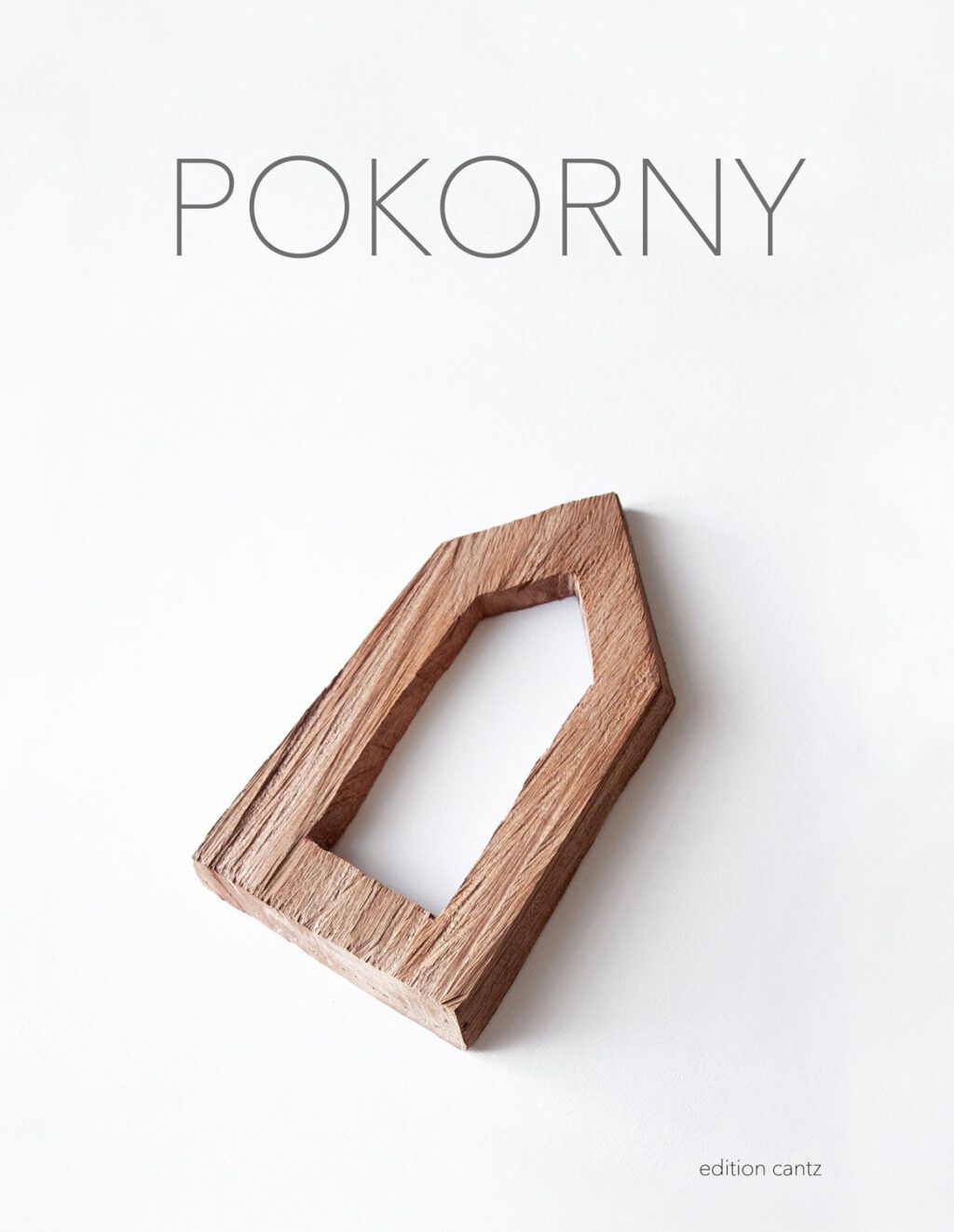
Pokorny
25€ Add to cart“Abstraction means the omission of the irrelevant and the unnecessary in order to find more substantial content and form.”—Werner Pokorny
His often monumental sculptures can be found in many places in Germany and abroad, including Aachen, Berlin, Busan (South Korea), Frankfurt am Main, Freiburg, Karlsruhe, Riehen, Saarbrücken, and Stuttgart. Werner Pokorny works (b. 1949, Mosbach; lives and works in Ettlingen) exclusively with Corten steel for his outdoor sculptures and with wood, steel, and bronze for his indoor works. Well-known basic forms such as bowls, spheres, cuboids, and houses serve as points of departure and reference, which are abstracted by reduction, rotation, tilting, or combination with other elements. The artistic field of tension characteristic of Pokorny’s impressive sculptural oeuvre is due to the oscillation between form and abstraction, figure and reduction, hard edges and soft curves.
- Out of stock

Eva Jospin
Wald(t)räume22€ Read moreThe Forest as a Place of Longing: Eva Jospin’s Magical Corrugated Cardboard Sculptures
The French artist Eva Jospin (b. 1975, Paris; lives and works in Paris) cuts and layers corrugated cardboard to create sculptures and reliefs. Handcraft and precision are essential aspects of her work. The artist retains the original color of the cardboard, since, for her, the material itself already contains sufficient color variations and nuances. The recurring motif is the forest — consisting of numerous trunks, branches, and twigs in extreme density and interspersed with black shadows. They suggest depth and stimulate the viewer’s imagination. Eva Jospin does not reproduce nature one to one, but conveys the feelings of fear, anarchy, or freedom that it triggers: The forest as a universal place of longing.
-

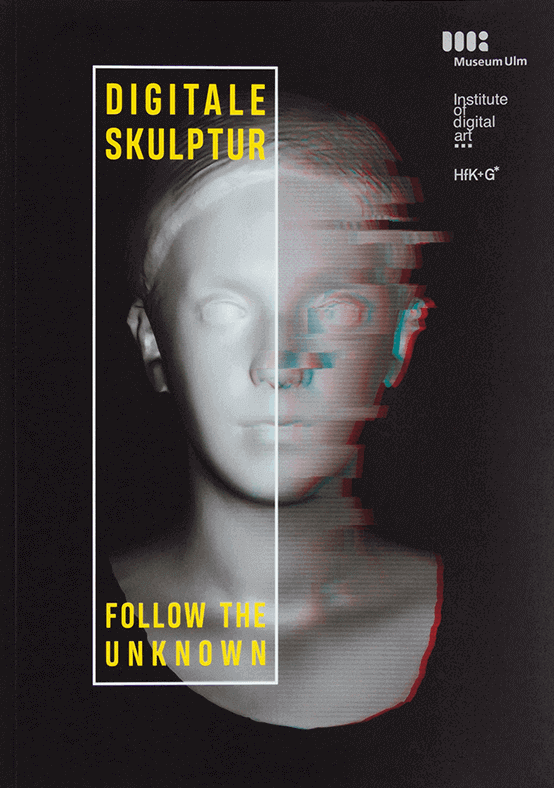
Digitale Skulptur
Follow the unknown19,80€ Add to cartCrossing the BNorders of the Tangible
For the first time in art history a competition for the Digital Sculpture Award was announced. What is a digital sculpture anyway? Where are the boundaries between real and virtual worlds? With the advent of digitally generated images, the conditions for our perception and the parameters of our viewing habits are changed. Through the interactive involvement of the viewer, software-controlled image phenomena such as virtual environments lead to an exploring vision. The book presents and documents innovative works, which were conceived for the international competition, initiated by the Museum Ulm.
With works by Morehshin Allahyari, Giulia Bowinkel & Friedemann Banz, Jörg Brinkmann, George Crîngaşu, Nieves de la Fuente Gutiérrez, Marcel Karnapke, Leonard Kern, Nicolò Krättli + Jann Erhard, Martina Menegona and Marjan Moghaddam.
-

Roland Schappert & Wolfgang Ullrich
Aktualitätsjetzt16€ Add to cartPhilistinism, climate change, legitimation discourses—in a tour de force sustained by profound knowledge of the phenomena in question, AKTUALITÄTSJETZT blazes trails through the jungle of contemporary art and its current debates. Over the course of two years, the art scholar and author Wolfgang Ullrich initiated 14 dialogues on Schappert’s word paintings, murals, and interventions. Their distinctive formal features and conceptual and substantial dimensions inspired illuminating conversations that range far beyond the specific works to explore today’s art world and questions of the philosophy of art and the sociology of culture. The best volume of dialogues on art since David Sylvester’s interviews with Francis Bacon.
- Out of stock

Idee – Entwurf – Konzept
48€ Read moreArt in the Preliminary and Provisional Stage
In this sumptuous volume, Künstlerbund Baden-Württemberg, the association of visual artists in Baden-Württemberg, puts the focus on visualizations of inchoate impulses, spontaneous flashes of inspiration, and the euphoria of that first spark rather than the painstaking process of hammering out a work. Structured as a complex compendium comprising contributions by more than 240 artists, the book highlights the experimental circumstances in which the individual creative mind experiences the nascency of ideas—without regard for the specialized skills and technical accomplishment that distinguish the finished work. Perfunctory sketches, doodles, drawings, notes and material collages, photographs and other media images provide insight into very intimate stages of the creative process that are not usually revealed to visitors to an exhibition of contemporary art.
-
Simone Haack
HAIR30€ Add to cartSimone Haack (b. 1978 in Rotenburg/Wümme, lives and works in Berlin) has always made the inwards legible in the outer appearance of her figures in her painting. This is also the case in her block of works in the exhibition of the same name, Hair. Already in the late 17th century, magic and superstition were attributed to hair. In it one suspected the whole power of the soul. The artist, who was formed in the painting class of Katharina Grosse and Karin Kneffel, symbolically reveals the fragility of the DNA of human beings through her hair landscapes, which are sometimes placed macroscopically in the picture in the spirit of a New Magic Realism. At the same time, her accompanying exhibition publication always also tells of the triangle of tension of physical as well as psychological existence, which in her case runs through the painterly psychoanalysis.
-

Cornelia Baltes
Dingbats44€ Add to cartCornelia Baltes’s (b. Mönchengladbach, 1978; lives and works in Berlin) paintings and installation straddle the divide between abstraction and figuration. Her pictures are inspired by observations of mundane details—apparel, body parts, or facial expressions—that she pares down to simple lines and shapes. Rendered in vibrant colors and gestural fields, they hint at a narrative in the pictorial space. Baltes works with steadily modulated color gradients, on which she places thick and assertive marks. She often interrogates the painted picture’s function, by painting on the wall beyond the rectangle of the canvas, by hanging a picture in the middle of the room as an object in its own right or laying it out on the floor. Her works blend Pop Art and minimalism with an intensity and dynamic energy—and, sometimes, unmistakable flashes of humor—that cannot fail to captivate the beholder.
This book is the first comprehensive monograph on the artist’s oeuvre.
Cornelia Baltes studied at Bergische Universität Wuppertal in 2000–2003 and at Folkwang Universität der Künste, Essen, in 2003–2006, before rounding out her education at the Slade School of Fine Art, London, in 2009–2011.