Kai Schiemenz
Priel
 | |
|---|---|
| Editor(s) | Galerie EIGEN + ART Leipzig/Berlin, Gerd Harry Lybke, Kerstin Wahala |
| Author(s) | Stefan Klein, Knut Ebeling |
| Design | Huelsenberg Studio with Niklas Sagebiel |
| Cover | Hardcover |
| Size | 18 x 29,7 cm |
| Pages | 144 |
| Illustrations | 86 |
| Language(s) | German, English |
| ISBN | 978-3-96912-120-7 |
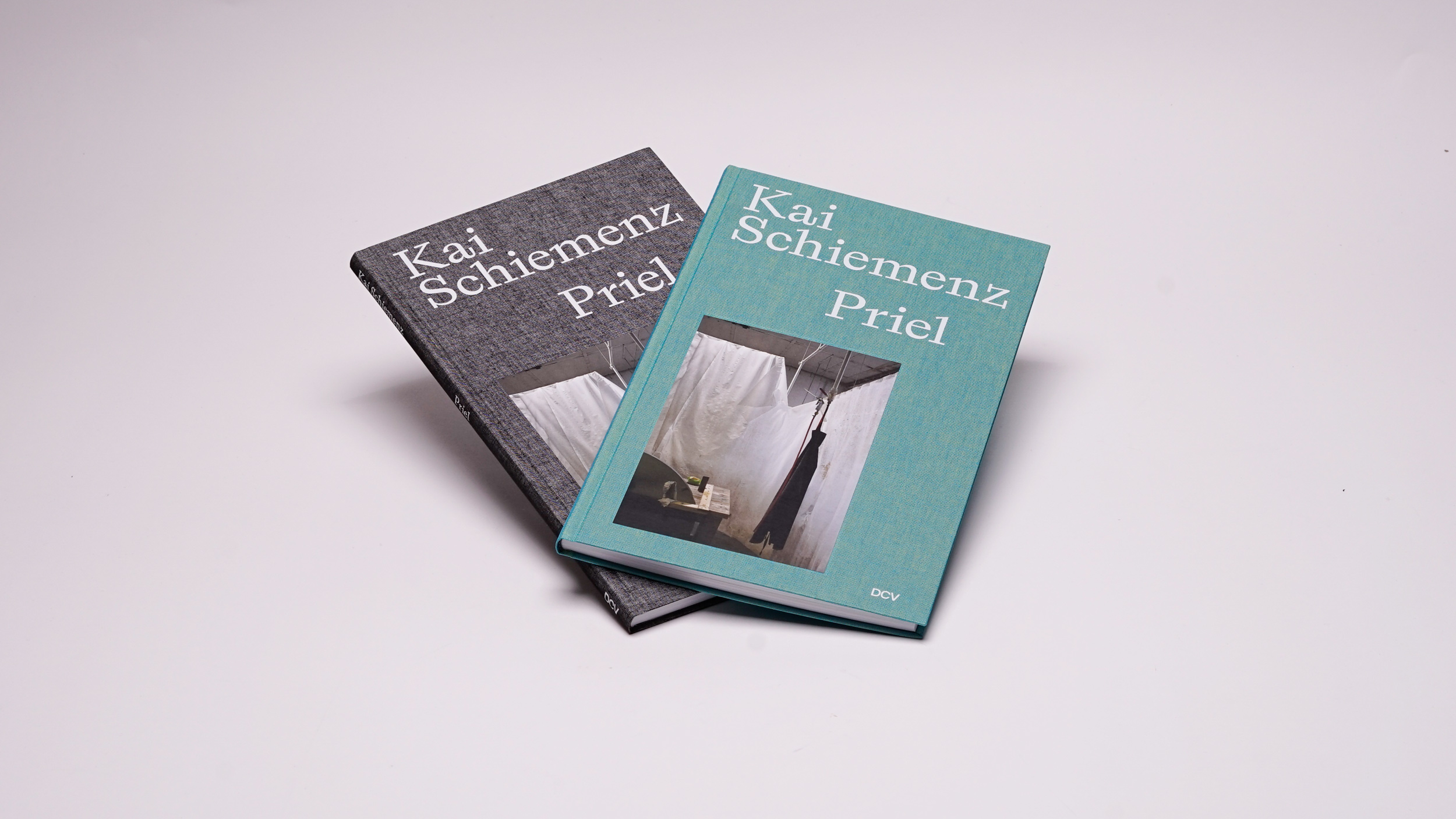
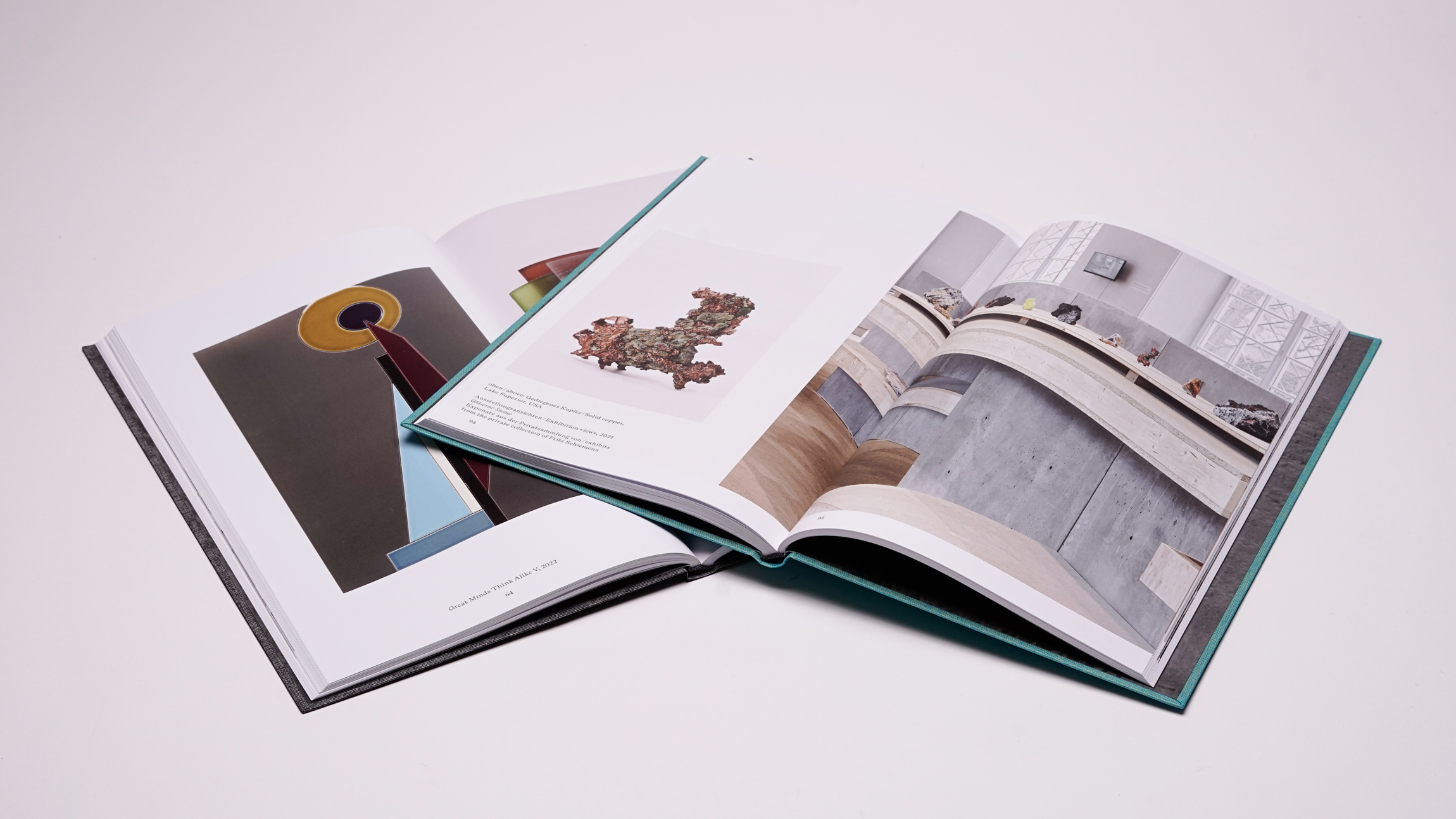
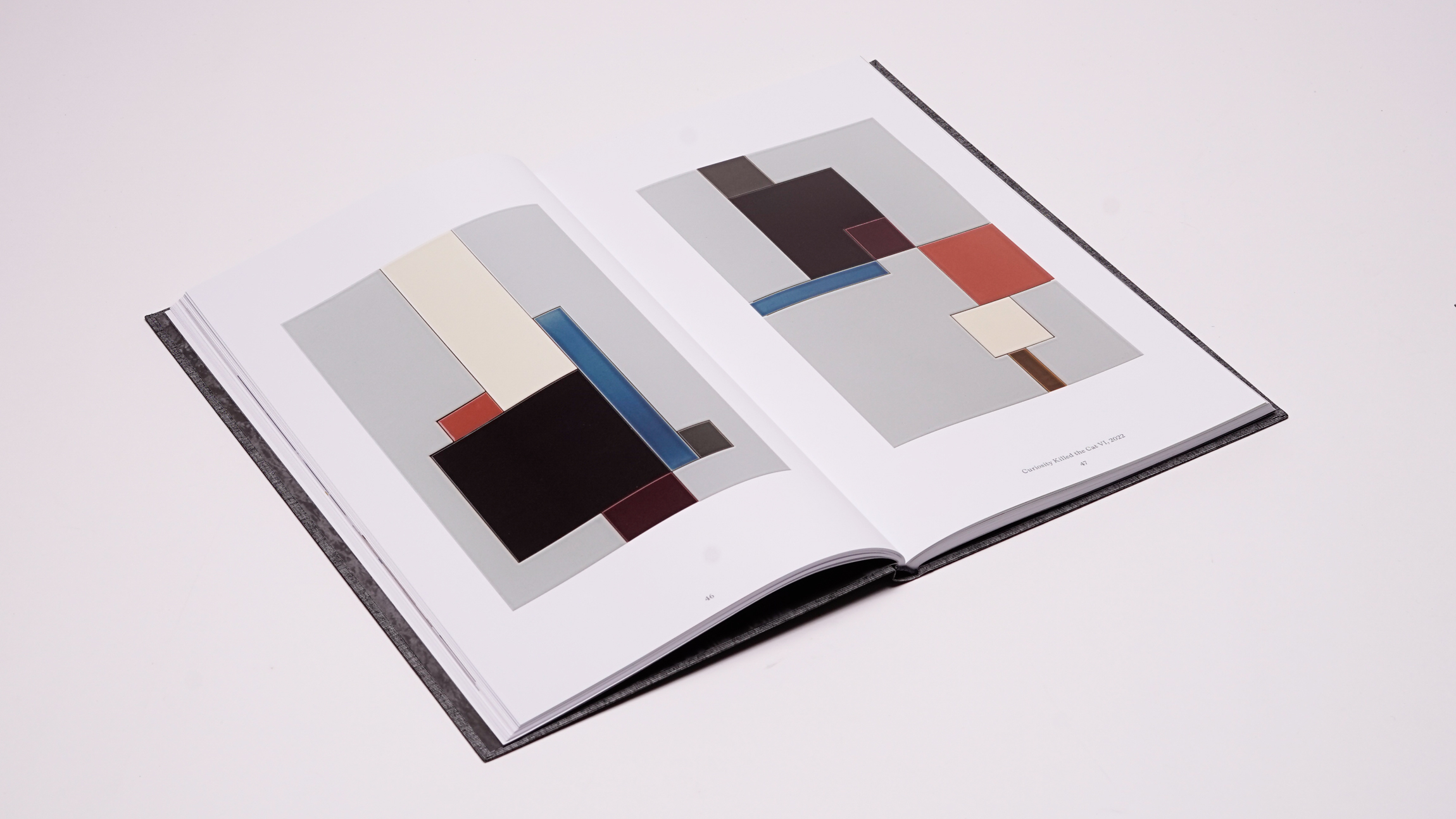
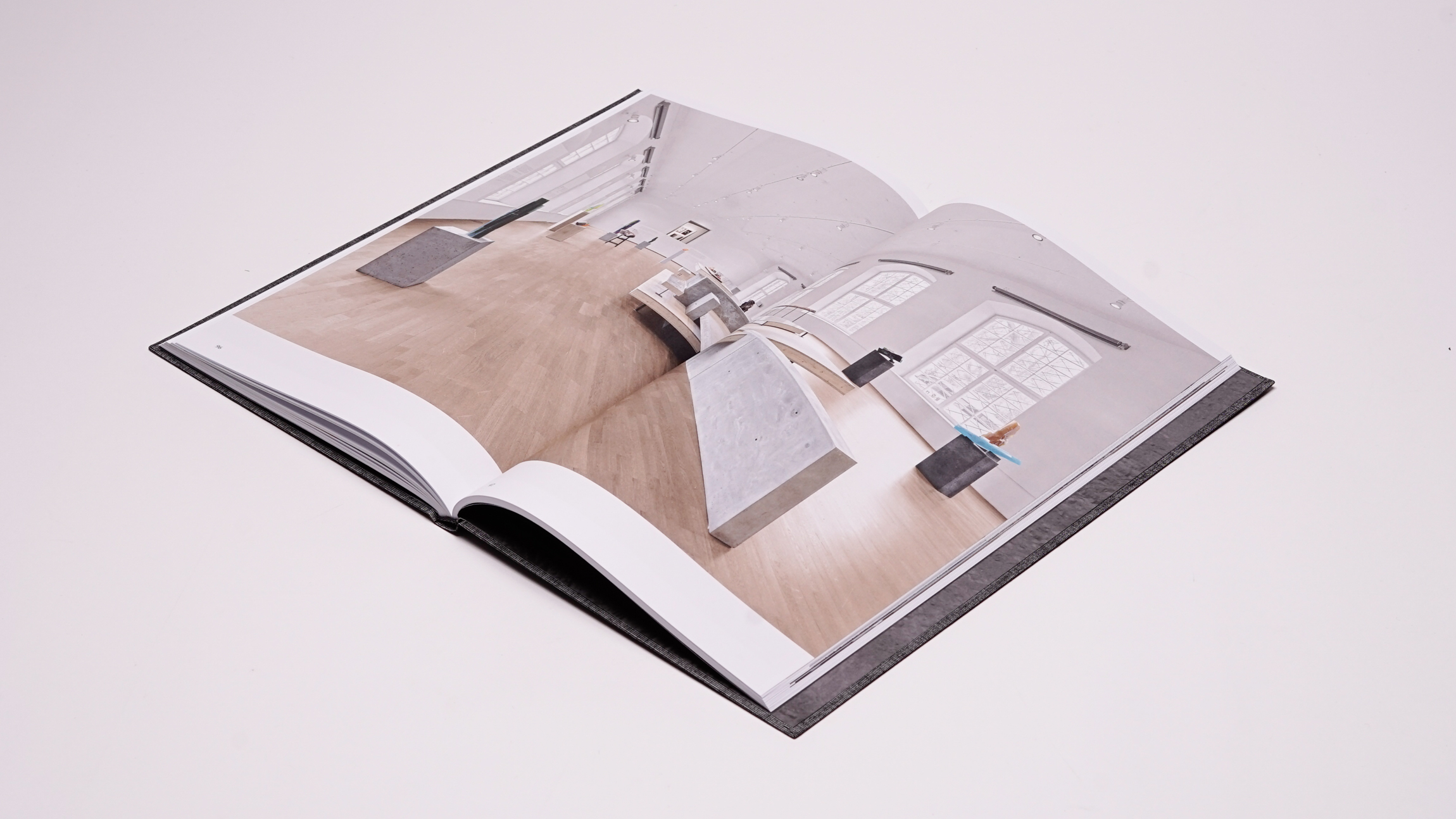
Tidal creeks are watercourses that crisscross coastal mudflats. Running between sandbars, they flush deposits out into the sea with the falling tide, and when the tide rises, the water flows back in. In other works, tidal creeks are effectively rivers in the sea. Delving into the implications of this idea, the book presents Kai Schiemenz’s (b. Erfurt, 1966; lives and works in Berlin) major works and projects of the past four years. The publication offers insight into the provenance of selected bodies of work and their genesis. Kai Schiemenz’s art examines the city, spaces, and architecture. His small-format sculptures are self-contained creations that combine digital technologies with natural materials like wood or paper. At the same time, they function as models for expansive installations and outdoor and indoor architectures in which Schiemenz orchestrates sight lines to construct spaces whose permeability makes the audience an integral aspect of the work. If his sculptures are architecture, his exhibitions are landscapes in which the visitors encounter one another as they would in a park. Their central question, time and again, concerns the impact of the built environment and urban landscapes on their inhabitants.
More books
-

Mihai Olos
42€ Add to cartMihai Olos (b. Ariniș, Romania, 1940; d. Endingen am Kaiserstuhl, 2015) ranks among the most fascinating artists of the second half of the twentieth century. His adaptations of the formal vocabulary pioneered by Constantin Brâncuși are unrivaled in their creative originality. His works evince an utterly novel approach to the combination of materials from the culture of rural Romania with the visual strategies of modernism. His formidable oeuvre engages with conceptual and minimal art and comprises paintings, drawings, and sculptures, sometimes in the dimensions of land-art projects, as well as performances and poetry. Despite the constraints imposed by the communist system, his art and travels—during which he also met his kindred spirit Joseph Beuys—were dedicated to the unerring pursuit of his vision of social sculpture and radical utopian architecture.
-

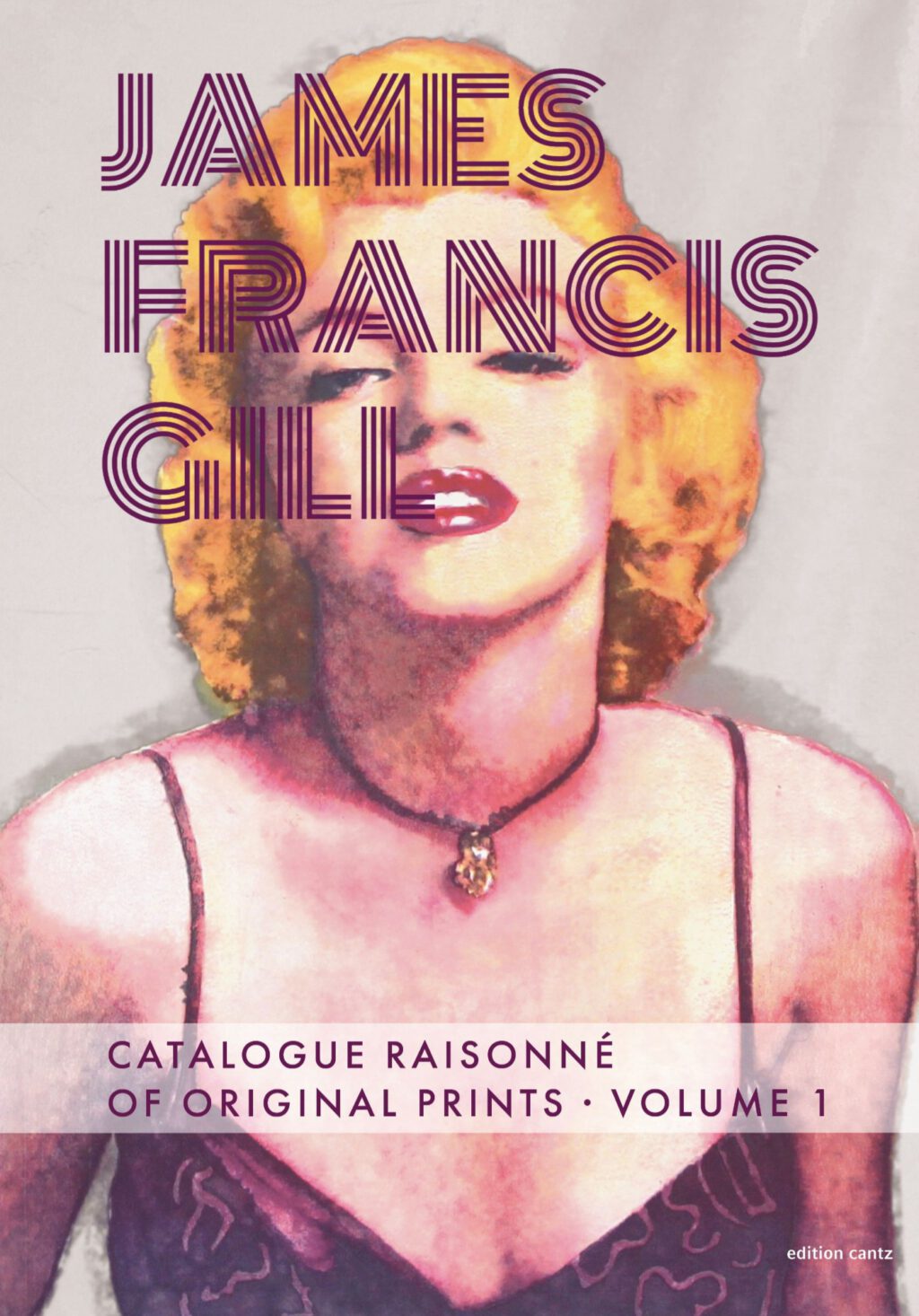
James Francis Gill
Catalogue Raisonné of Original Prints, Vol. 139€ Add to cartThe Catalogue Raisonné of the Co-Founder of American Pop Art
James Francis Gill (b. 1935, Tahoka; lives and works in Texas) is one of the most important artists of American Pop Art. His paintings, often based on photographs, provide an unusually personal approach to the icons of the 1950s and 60s. Gill suddenly became Hollywood’s most celebrated artist when his Marilyn Triptych was added to the permanent collection of The Museum of Modern Art in New York in 1962 – even before the works of Andy Warhol. Through friendships with celebrities such as John Wayne, Martin Luther King, and Marlon Brando, Gill became the contemporary artist-witness of an entire generation. Nevertheless, he kept his distance from the exuberant Hollywood of the time and surprisingly withdrew in 1972, only to reappear on the art market thirty years later. This catalogue raisonné in two volumes impressively documents his work from the early political motifs to the Pop Art icons of his late work.
-

FLATZ
Hitler. Ein Hundeleben18€ Add to cartAn Attempt to Break a Taboo – Trivial and Provocative
A black, pure-bred Great Dane named Hitler accompanied the Austrian performance artist and documenta participant FLATZ (b. 1952, Dornbirn; lives and works in Munich and London) like a shadow through the 1990s. The naming—as well as the subtitles of the photographs created—relates the banal everyday life of the dog to the inglorious life of its namesake, thus opening up an extremely provocative range of possible associations. “Hitler is always with me,” says the artist, “just as we always carry the historical Hitler around with us, because he is part of our history, which—as long as it is suppressed, transfigured, or tabooed—is not overcome.”
With more than 350 illustrations, Hitler. Ein Hundeleben is an extended and revised reprint of the book published in 1992, which has been out of print for a long time.
-

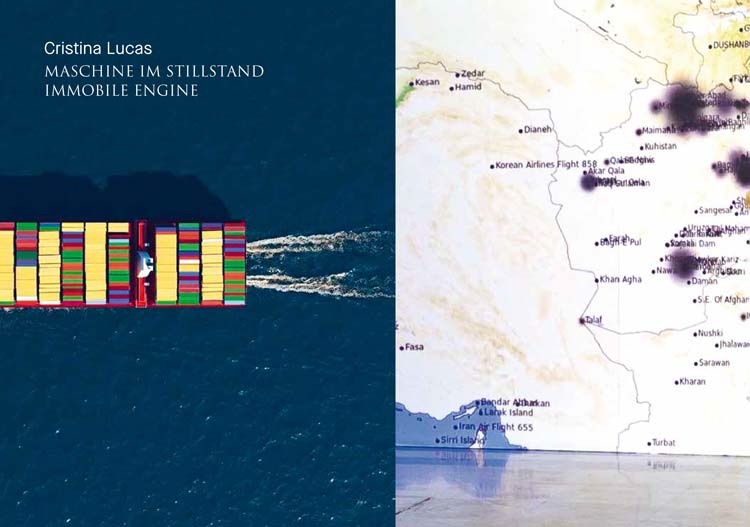
Cristina Lucas
Immobile Engine29€ Add to cartMechanisms of Power
The Spanish artist Cristina Lucas (b. Jaén, 1973; lives and works in Madrid) works in a wide range of media and genres. Central concerns include the confrontation of subjective and political historiographies and a critical examination of cultural stereotypes. The publication’s point of departure is the multichannel video installation Unending Lightning, begun in 2013, in which Lucas undertakes a painstaking study of the history of aerial warfare. The book also showcases works that limn a contemporary perspective on value chains and the capitalization of time and landscape. Moreover, the artist has developed a corpus of critical cartographic models that offer algorithmic, philosophical, poetic, or, in some instances, humorous visualizations of unexpected nexuses. The first German-language publication on Cristina Lucas’s art, it offers a comprehensive survey of her oeuvre to date.
Cristina Lucas studied fine arts at the University of California and the Universidad Complutense, Madrid. She has had residencies in Paris, Amsterdam, and New York. Her work has been exhibited at MUDAM, Luxembourg; the Museo de Arte Contemporaneo, Santiago de Chile, and the Museo Nacional Thyssen-Bornemisza, Madrid; Kiasma, Helsinki; and the Centre Pompidou, Paris, among others.
-

Nam Kim
10€ Add to cartThe large-format paintings of Nam Kim (born 1991 in the US, lives in Vienna) are inhabited by chunky androgynous, naked figures, which gently blend with the vegetation, light and shadows, or ornaments around them. “The figures resonate with fluid grace, caught in the intimate moment between thought and touch.” (R. Grunenberg) Here, the human body is equal to its natural environs and not separate. Kim begins her paintings with zones of gestural abstraction, from which the characters grow like plants into her compositions. Kim grew up in Korea and her painting practice combines elements of Asian traditions (in art and theater) with Western art history and virtuality. This book presents her works of the last three years and includes an insightful essay by Robert Grunenberg.
-

Gabriel Vormstein
40€ Add to cartGabriel Vormstein (b. Konstanz, 1974; lives and works in Berlin) explores themes of impermanence, temporality, and futility through a unique visual language. He paints using newspapers as a canvas, and creates installations out of tree branches and other organic matter. These “poor” materials subvert a prevailing notion in Western culture that an artwork should be eternally preserved. Through the adaptation of various styles and symbols, Vormstein’s paintings likewise speak to the transience of art historical and cultural trends. Over 300 pages, this richly illustrated book provides an overview of Vormstein’s oeuvre over the past two decades, while also offering an atmospheric glimpse into the artist’s source material and working methods. The publication is enriched by an essay by Gean Moreno, who characterizes Vormstein’s work as follows: “Gabriel Vormstein’s paintings and sculptures (…) announce their condition as withering artifacts, as if no other manner of existing was available to them (and maybe to us, as well).”
-

Plastique Fantastique
A Journey through an ephemeral Realm32€ Add to cartIn the wake of Frank Lloyd Wright’s pioneering work, visionary architects including Frei Otto and Buckminster Fuller established bubbles as a recognized artistic and architectonic form. The Berlin-based art duo Plastique Fantastique (Marco Canevacci and Yena Young) go one step further and harness them as a medium of temporary social interactions. The philosopher Vilém Flusser conceived of space in the digital universe as a network of relational settings in which humans can be in multiple places at one, as a “bubble that extends into the future.” Plastique Fantastique transform our urban and rural environments into laboratories for such spaces in which urgent social, political, and aesthetic questions are negotiated. Oversized translucent bubbles, traffic islands ringed by diaphanous tubes, giant lifebelts, air-filled sausages that the audience at a Peaches concert pass over their heads: Plastique Fantastique’s installations fuse art, performance, people, and architecture in a multisensory experience that blurs the conventional boundaries of art and focuses our attention on the larger bubble in which human existence is contained. Richly illustrated with exceptional photographs, this monograph is the first to document a representative selection from the duo’s projects of the past two decades.
-

GETA BRĂTESCU
Film and Video 1977–201842€ Add to cartGeta Brătescu (b. Ploiești, 1926; d. Bucharest, 2018) is now widely regarded as one of Eastern Europe’s most important avant-gardists. In the Western art world, however, she was largely obscure until her participation in documenta 14 in 2017 and the Venice Biennale of the same year. Questions of abstraction, the political potential of the image, and the subjective experience of self, memory, and history inform her stylistically diverse oeuvre in a wide range of media, which evolved under the repressive conditions of the Ceaușescu regime yet kept pace with the discourses of the Western avant-gardes. This richly illustrated volume focuses on her collages and drawings as well as her works on film and video from the late 1970s until her death.
-

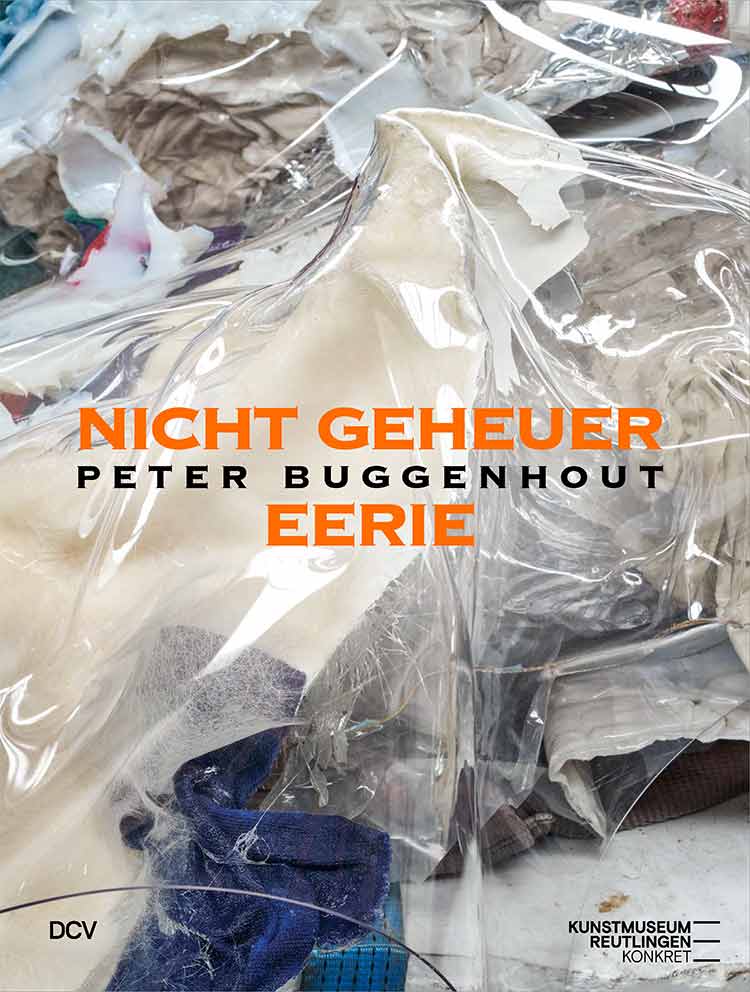
Peter Buggenhout
Eerie28€ Add to cartAn Autonomous Counterpart
The renowned sculptor Peter Buggenhout (b. 1963, Dendermonde, Belgium; lives and works in Ghent) describes his hybrid pieces as “abject things” that defy classification and even the label “work of art.” He aggregates and manipulates found and discarded objects as well as both technical and organic materials including pig blood, cow stomachs, and horsehair until he achieves a certain degree of abstraction. Buggenhout’s sculptures confront the beholder as creatures that are somehow “off,” exuding an eerie atmosphere by allowing something sinister to rise to the surface that, it appears, lurks just behind the façades of the physical world: vestiges of humanity, society’s sedimented refuse. The book presents a comprehensive survey of his growing oeuvre; it is the first publication to cover his most recent creations in marble.
Peter Buggenhout’s art has been featured at the Palais de Tokyo, Paris; the MoMA PS1, New York; the 2014 Taipei Biennial; and elsewhere.
-

Laura Schawelka
Double Issues24€ Add to cartSales Spaces without Merchandise
In her installations, Laura Schawelka (b. 1988, Munich; lives and works in Berlin) makes use of photography, video, and sculpture in a multilayered dialogue. In her latest works, the artist focuses on the role of photography in the development of modern consumer society. What does it mean if goods are only communicated through other goods, such as computers, cell phones, tablets? If this withholding of the genuine object is precisely what prompts the desire for it? The artist creates sales spaces without merchandise, in which images, photographs, and videos have replaced consumer goods of any kind.
Laura Schawelka studied at the Städelschule in Frankfurt am Main as a student of Tobias Rehberger master-class. In 2015, she was awarded the Master of Fine Arts at the California Institute of the Arts in Los Angeles, and in 2017 she moved to Paris as the recipient of a studio bursary of Hessische Kulturstiftung.
-

René Holm
Let me be your everlasting light25€ Add to cartLight is the theme of the new paintings by René Holm (b. Esbjerg, 1967). Faceless protagonists traversing symbolic forests with leafless trees occurred already in previous works, stripping them of individual or local signifiers and moving them into a spiritual and universal realm. Skulls with burning candles in Still lifes symbolize the fragility of life and unavoidability of death. Holm goes a step further and makes his figures carry the symbols in their hands or even has them become themselves live “still lifes” with burning candles on their backs. The presence of death is not a picture to behold from afar but a truth to be aware of and carry with us every day. The burning candles also mean that we’re here with our sorrow as well as our light. We must burn to shine. This book accompanies the artist’s gallery exhibition Let me be your everlasting light in Horsens, Denmark.
-

Cahier #1
Heinz Gappmayr22€ Add to cartDo we think in images or in language? Can writing visualize time? Heinz Gappmayr (1925-2010) was interested in text as a spatial event and in letters as architecture. Although his works were often presented in the context of Visual Poetry, Gappmayr himself preferred the more neutral term text to lyricism. His understanding of written language as a conceptual medium and typography as an indicator of physicality was closer to Lawrence Weiner’s approach than to that of the Concrete Poets. This volume accompanies an exhibition at the Tiroler Landesmuseum and includes Gappmayer’s most important art-in-architecture projects, as well as a complete notebook from 1961, with commentary by Gaby Gappmayr, the artist’s daughter. A conversation with her provides valuable philosophical insights into her father’s work.
-
Sevina Tzanou
10€ Add to cartSevina Tzanou’s (b. Athens, 1994; lives and works in Bonn and Athens) large-format paintings show ecstatic bodies on the verge of abstraction that refuse to submit to categorization, cooptation, or control. They arise from the affect-laden situations the artist sets out to render in her paintings. She begins by priming the canvas with a monochrome coat of paint, on which she then sets down informal, expressive gestures, sometimes working with a mop or so-called “octopus brushes” that recall BDSM whips. The bodies depicted in the works are Tzanou’s painterly response to the abstract forms accreted on the canvas. Everything about her art is performative, the painterly process no less than the creation of bodies, gender, and sexual identity. Her subjects are drawn from ancient myths and motifs in the history of painting as well as contemporary debates.
-
The Scharf Collection.
Goya – Monet – Cézanne – Bonnard – Grosse48€ Add to cartThe Scharf Collection is a German private collection of French art from the nineteenth and twentieth centuries and international contemporary art. Now in its fourth generation, it continues a branch of the renowned Otto Gerstenberg Collection in Berlin, which encompasses everything from the beginnings of modernism, represented by Francisco de Goya, to the French avant-garde of the second half of the nineteenth century with Gustave Courbet, Edgar Degas and the entire graphic oeuvre of Henri de Toulouse-Lautrec. The richly illustrated catalog accompanies the collection’s first comprehensive exhibition at the Alte Nationalgalerie – Staatliche Museen zu Berlin and the Kunstpalast in Düsseldorf.
-
DAWN OF HUMANITY – ART IN PERIODS OF UPHEAVAL
37€ Add to cartThe book and exhibition present works from the first two decades of the twentieth century from the Kunstmuseum Bonn’s collection in dialogue with contemporary creative positions. What the works have in common across the distance of a century is their genesis in, and reflection on, a time of major social and political crisis. Back then, life had been profoundly changed by the industrial revolution; nowadays, climate change, wars, and the rising political power of right-wing ideologies are transforming the life of our communities. The presentation conceives art as a tool that lets us interrogate the world and imparts fresh intellectual impulses, and so also plays an active part in our societies. The title Menschheitsdämmerung – Dawn of Humanity – is borrowed from the poetry anthology of the same title released by Kurt Pinthus in 1919, which samples the Expressionist lyric poetry of the young century in four chapters: “Downfall and Outcry”; “Love Human Beings”; “Awakening of the Heart”; “Entreaty and Indignation.” Florian Illies, who already wrote an afterword for the 2019 centenary edition of Menschheitsdämmerung – the bestselling poetry anthology in the history of German literature – contributed the keynote essay in the book.
Artists: Nevin Aladağ, Francis Alÿs, Kader Attia, Yael Bartana, Rebekka Benzenberg, Monica Bonvicini, Andrea Bowers, Heinrich Campendonk, Louisa Clement, Max Ernst, Georg Herold, Franz M. Jansen, Alexej von Jawlensky, Käthe Kollwitz, Wilhelm Lehmbruck, Max Liebermann, August Macke, Helmuth Macke, Goshka Macuga, Marie von Malachowski-Nauen, Carlo Mense, Zanele Muholi, Heinrich Nauen, Grace Ndiritu, Anys Reimann, Deborah Roberts, Daniel Scislowski, Paul Adolf Seehaus, Tschabalala Self, Monika Sosnowska, William Straube, Emma Talbot, Hans Thuar, Lawrence Weiner
- Release January 2026
PULS 22
36€ Add to cartPULS, an initiative of Bukarest’s National Museum for Contemporary Art (MNAC) began during the COVID-crisis. Since then, the museum supports Romanian artists by biennially purchasing more than 100 relevant creative works, carefully selected from a large pool of submissions by a democratic jury of artists and art professionals. PULS22 showcases in book-form MNAC’s most recent acquisitions and their subsequent exhibition. This volume, like the former PULS20, is an exciting panoramic snapshot of the country’s dynamic multigenerational art scene. The installation shots speak of an outstanding exhibition and the potential for future loans to curated shows elsewhere.
- Release January 2026
Stefan Reiterer
Inflection Point38€ Add to cartThe Austrian artist Stefan Reiterer (born 1988, lives in Vienna) transfers digital maps and satellite images into analog physical space through abstract painting. He manipulates data from sources such as Google Earth or NASA, transforming them into illusory topologies and pseudo-cartographies to challenge our perception. What is recognized, discovered, rejected? Where is the viewer’s location? Andrea Kopranovic writes of Reiterer’s painted emptiness as a “pitting” and projection surface “for glitches, black holes, and abysses” and a metaphor for potential “interpretations, enrichments, and yet unimagined spaces of possibility.” This richly illustrated book documents Reiterer’s 2025 exhibition at the Museum Gegenstandsfreier Kunst in Otterndorf.
-

René Holm
45€ Add to cartRené Holm goes for the big picture, painting the ambivalence of human existence and our relationship with nature. Some of his protagonists are physically naked, and all embody an interior life through their poses. The faceless figures function as screens onto which the beholders can project their own feelings, as symbols of universal human experiences. That is why, Holm notes, people very often recognize themselves in his protagonists. The effect is in part due to the forest, the setting of all pictures in this catalogue, which has been Holm’s studio and preferred backdrop for decades. It is where he finds the twilight that glows in all of our souls: woodlands nourish and menace us, they are home to helpful fairies and nasty demons, one can find life and death alike in them. He translates the sublime of the forest—a central motif in the Romantics—into a contemporary visual idiom. In his pursuit of this endeavor, he has recently ventured a radical aesthetic change: instead of using thick paints as before, he now applies the pigments to the canvas in thinner and drier layers. The book illustrates this spectacular fresh start, carrying us off into the depths of the soul and mysterious woodlands.
-

Kai Schiemenz
Priel38€ Add to cartTidal creeks are watercourses that crisscross coastal mudflats. Running between sandbars, they flush deposits out into the sea with the falling tide, and when the tide rises, the water flows back in. In other works, tidal creeks are effectively rivers in the sea. Delving into the implications of this idea, the book presents Kai Schiemenz’s (b. Erfurt, 1966; lives and works in Berlin) major works and projects of the past four years. The publication offers insight into the provenance of selected bodies of work and their genesis. Kai Schiemenz’s art examines the city, spaces, and architecture. His small-format sculptures are self-contained creations that combine digital technologies with natural materials like wood or paper. At the same time, they function as models for expansive installations and outdoor and indoor architectures in which Schiemenz orchestrates sight lines to construct spaces whose permeability makes the audience an integral aspect of the work. If his sculptures are architecture, his exhibitions are landscapes in which the visitors encounter one another as they would in a park. Their central question, time and again, concerns the impact of the built environment and urban landscapes on their inhabitants.
-
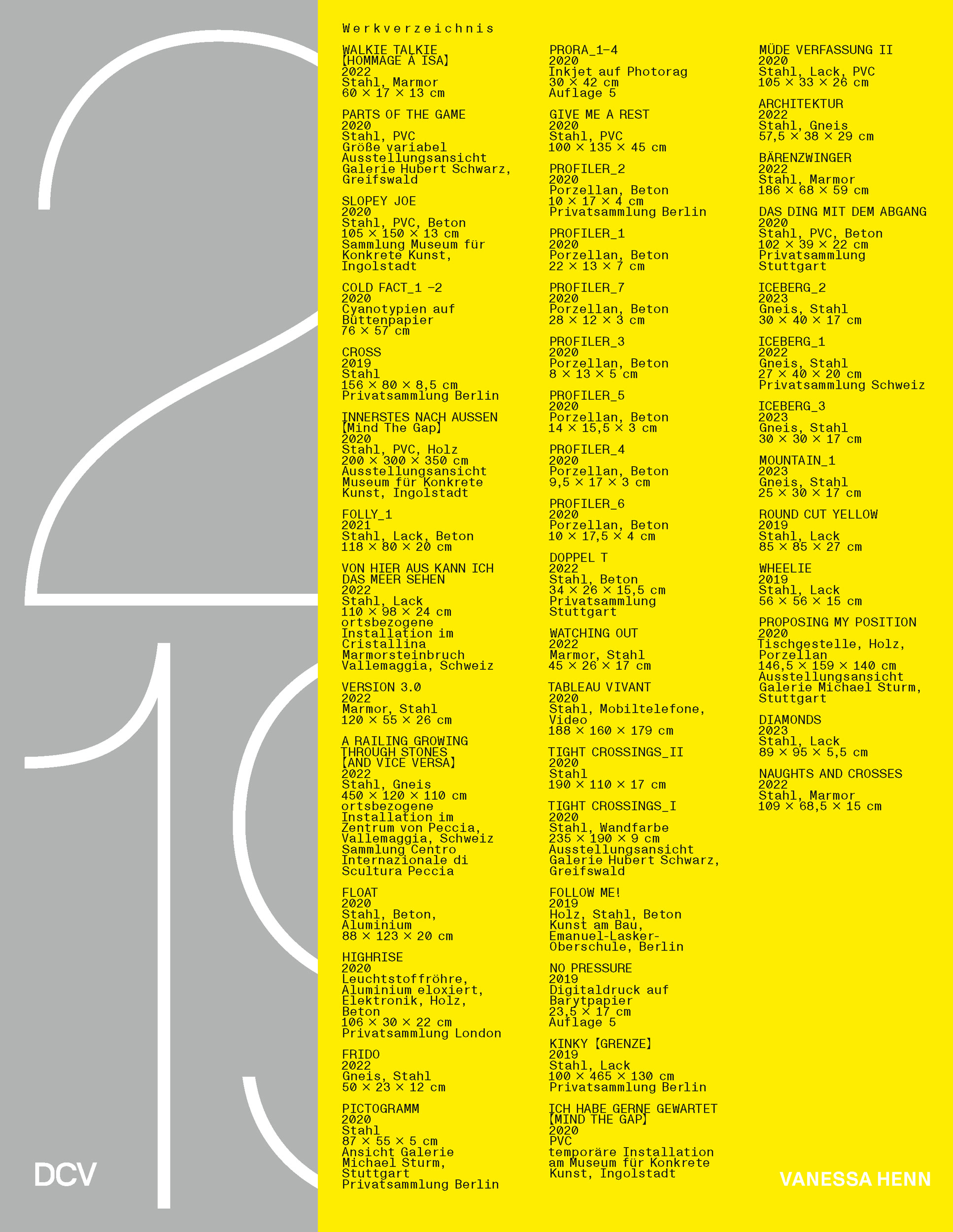
Vanessa Henn
Same Same35€ Add to cartVanessa Henn’s (b. Stuttgart, 1970; lives and works in Berlin) objects and installations blend formal reduction with playful comedy. The handrails she makes out of a wide variety of materials run along walls, project into rooms, trace spirals, mark lines or arcs, and often solicit our active engagement. Besides banisters, her oeuvre, which straddles the line between architecture and sculpture, also comprises bridges, stairs, and fences. All her creations are energized by the tension between the static work of art and its dynamic environment, which the artist resolves by integrating her works into the goings-on of everyday life. A guardrail that runs perpendicular to a flight of stairs or abruptly ends in the ceiling or floor is relieved of its function; rather than helping us go where we are going, it is a companion who invites us on a stroll into the imaginary and uncertain. And that is what makes Vanessa Henn’s art so alluring.
The book presents Vanessa Henn’s latest works from the years 2019-2023.
Vanessa Henn studied sculpture at the State Academy of Fine Arts Stuttgart (1992–2001) and at Edinburgh College of Art (1995–1996) and completed a Master of Fine Art at the University of Canterbury School of Fine Art in Christchurch, New Zealand (1999–2000).