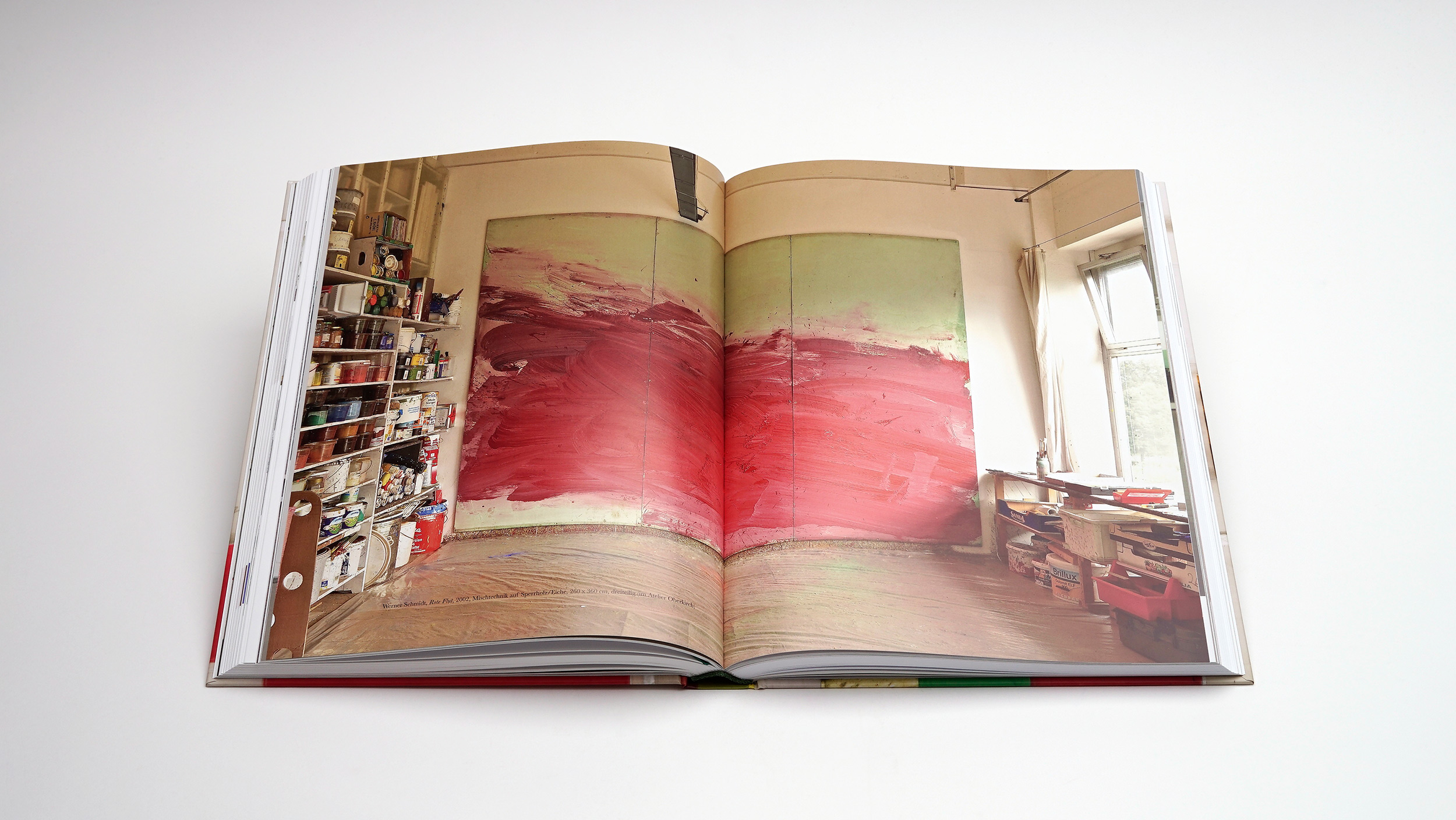
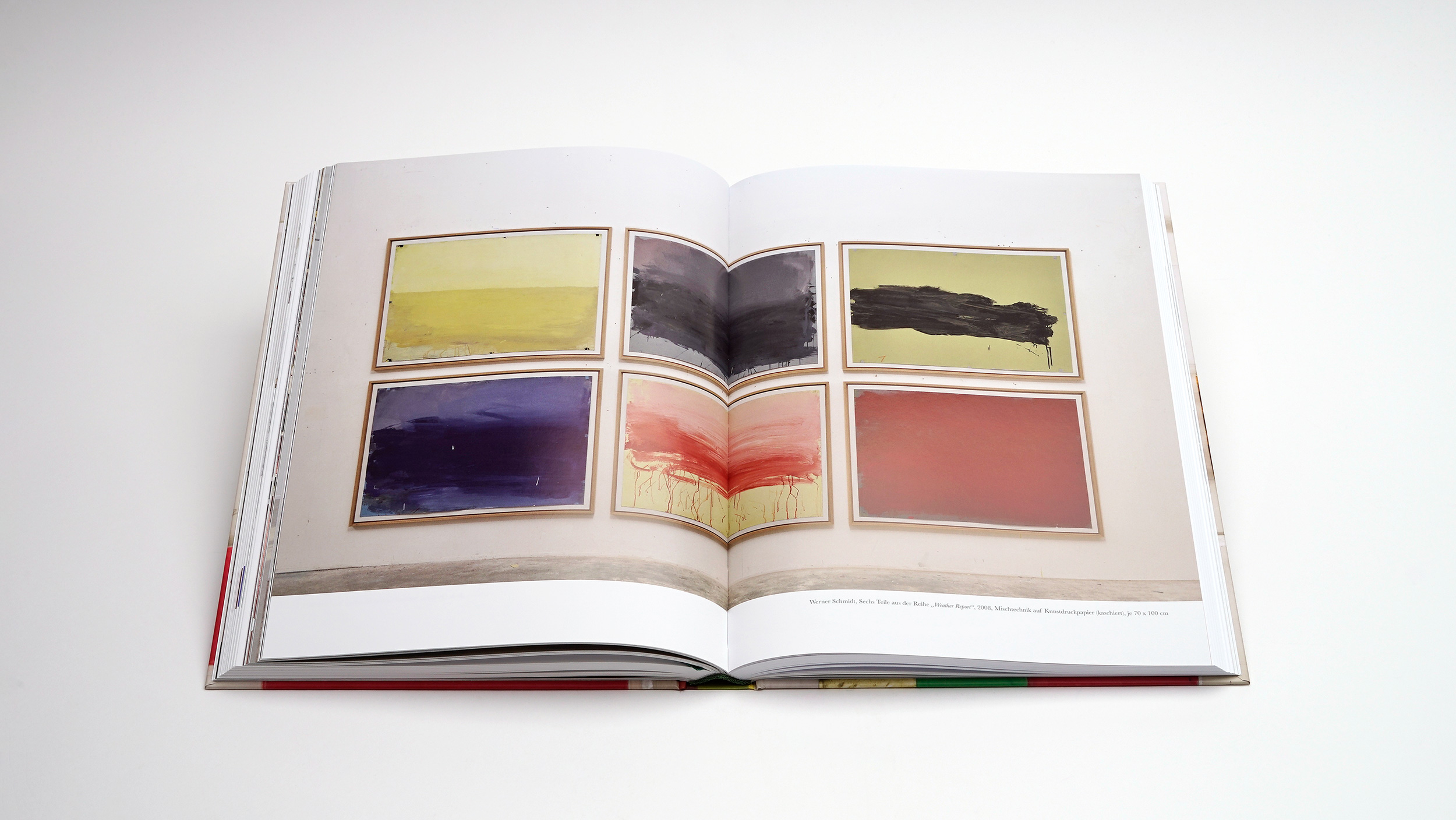
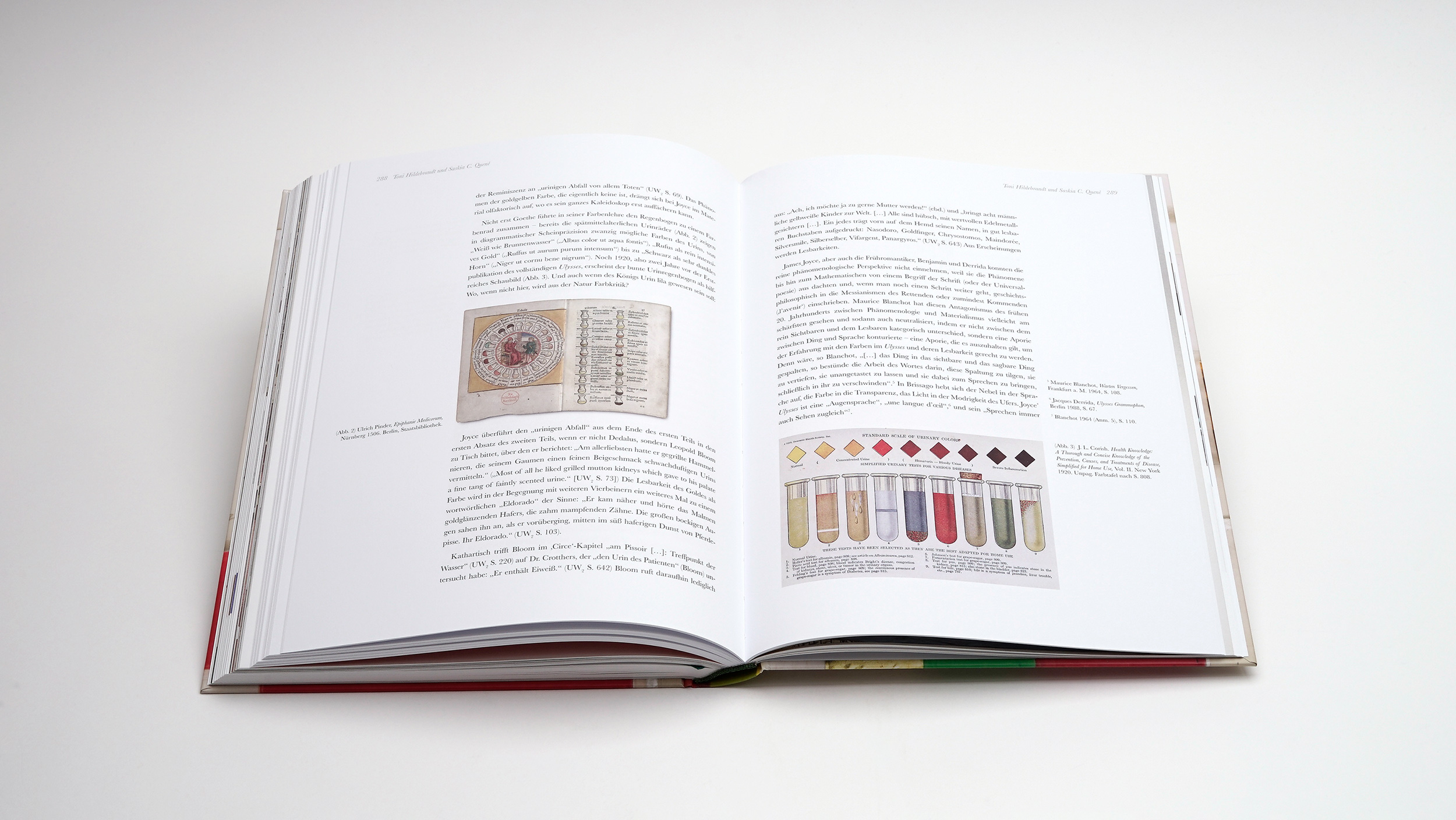
Werner Schmidt
James Joyce und die Farben des Ulysses
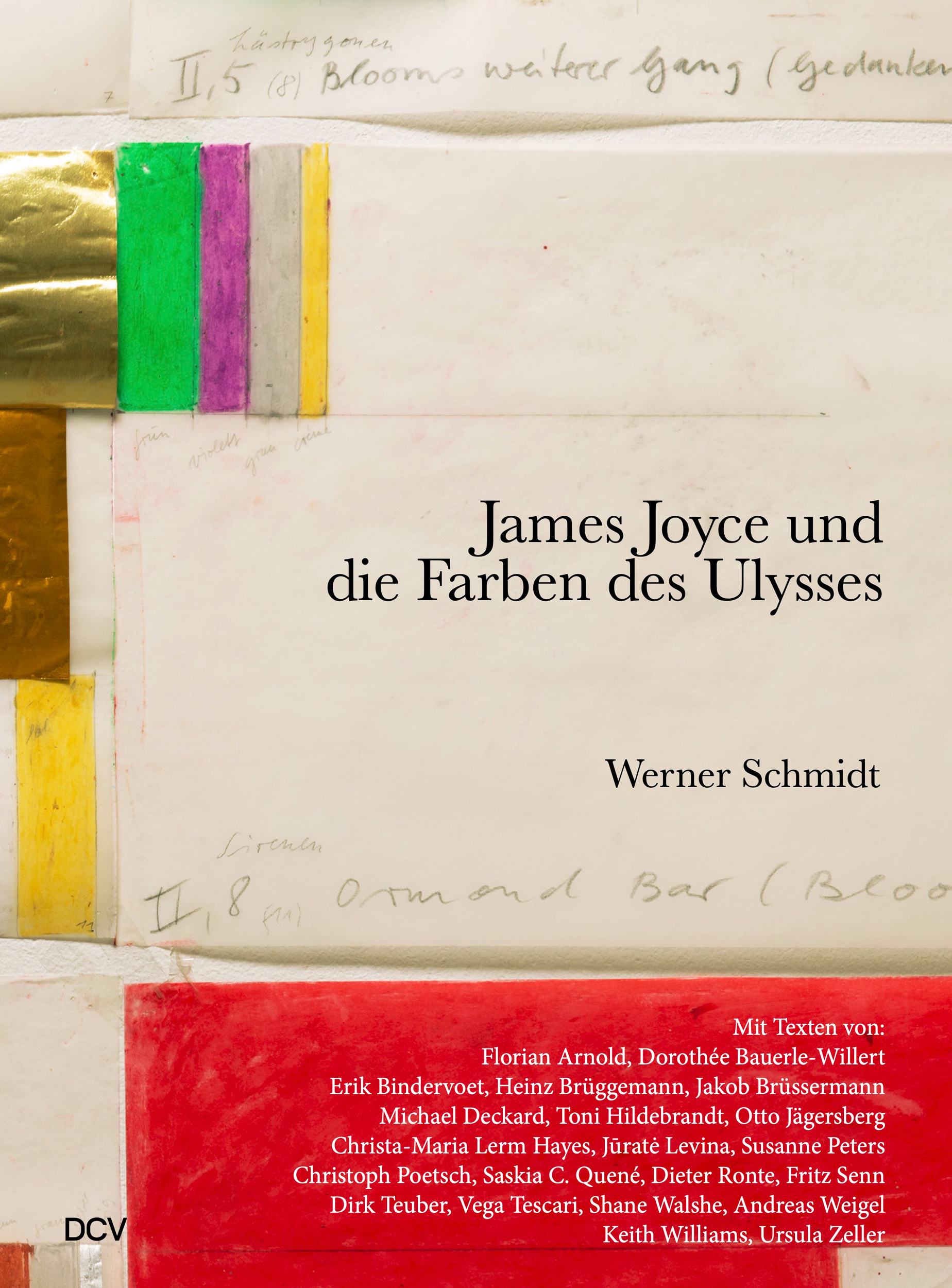 | |
|---|---|
| Design | Werner Schmidt and Frederik Zecheus |
| Size | 20 x 27 cm |
| Cover | Hardcover with debossing, bookmark ribbon and poster |
| Pages | 328 |
| Illustrations | ca. 243 |
| Language(s) | German, partly English |
| ISBN | 978-3-96912-242-6 |
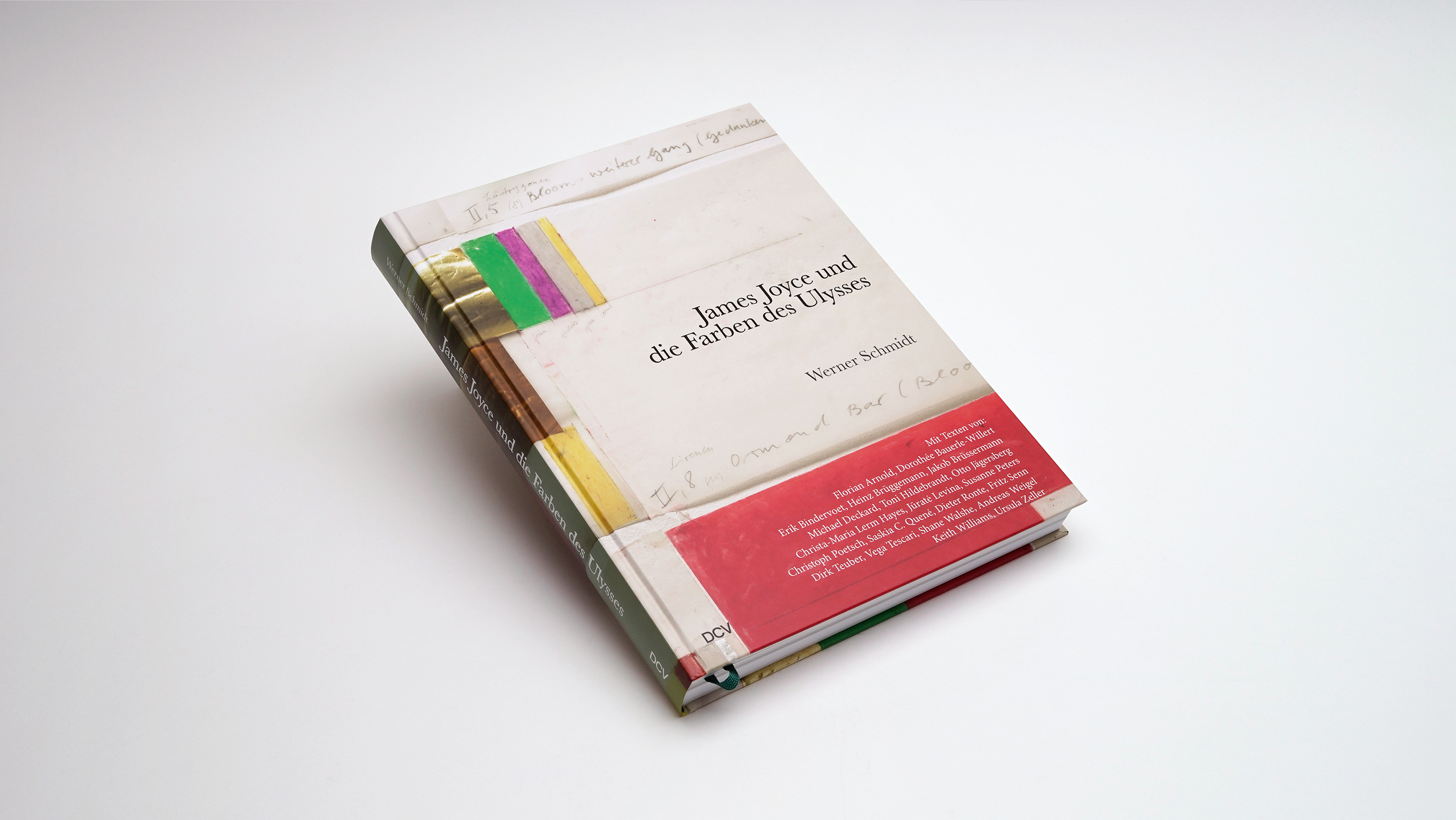
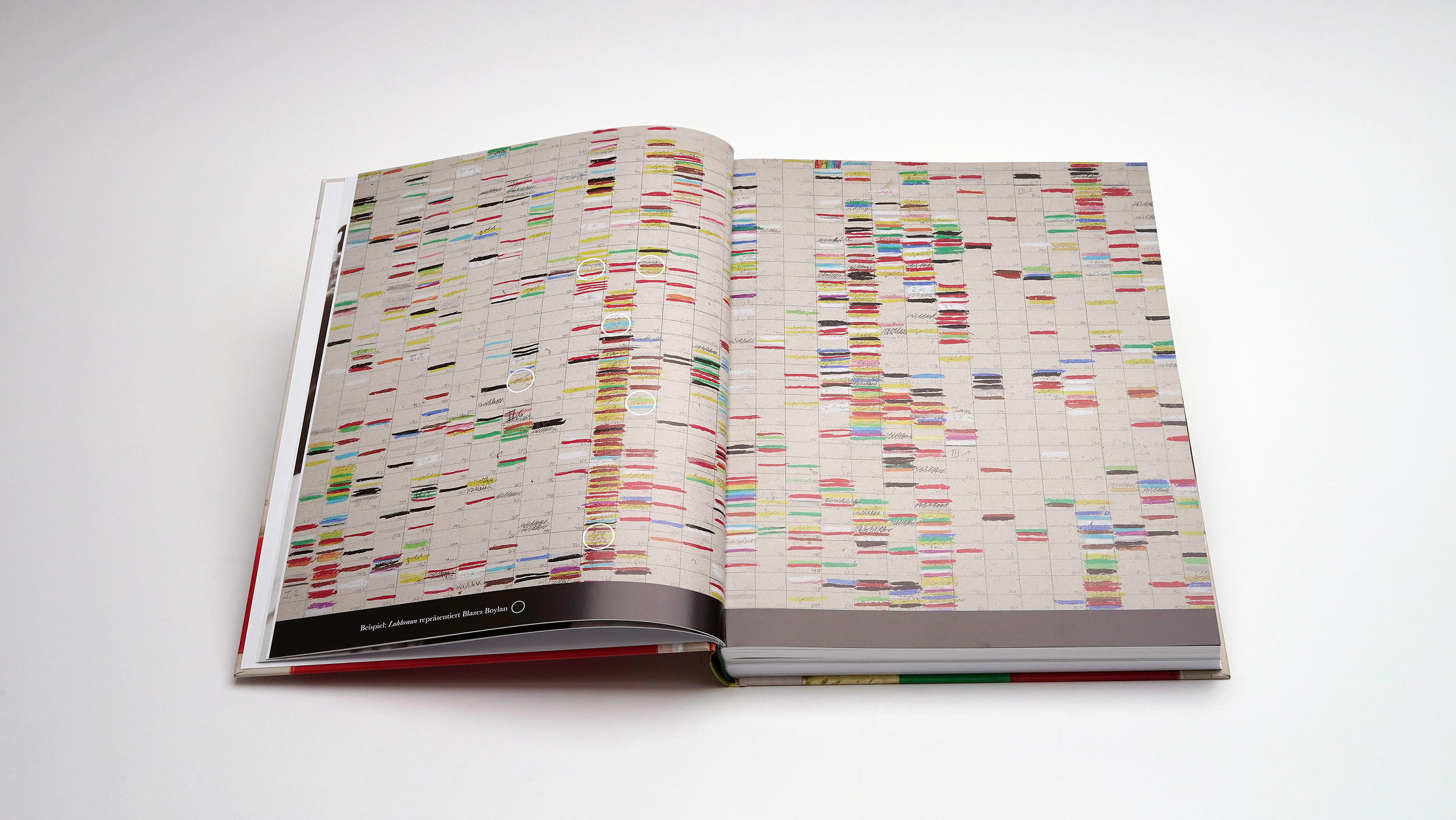
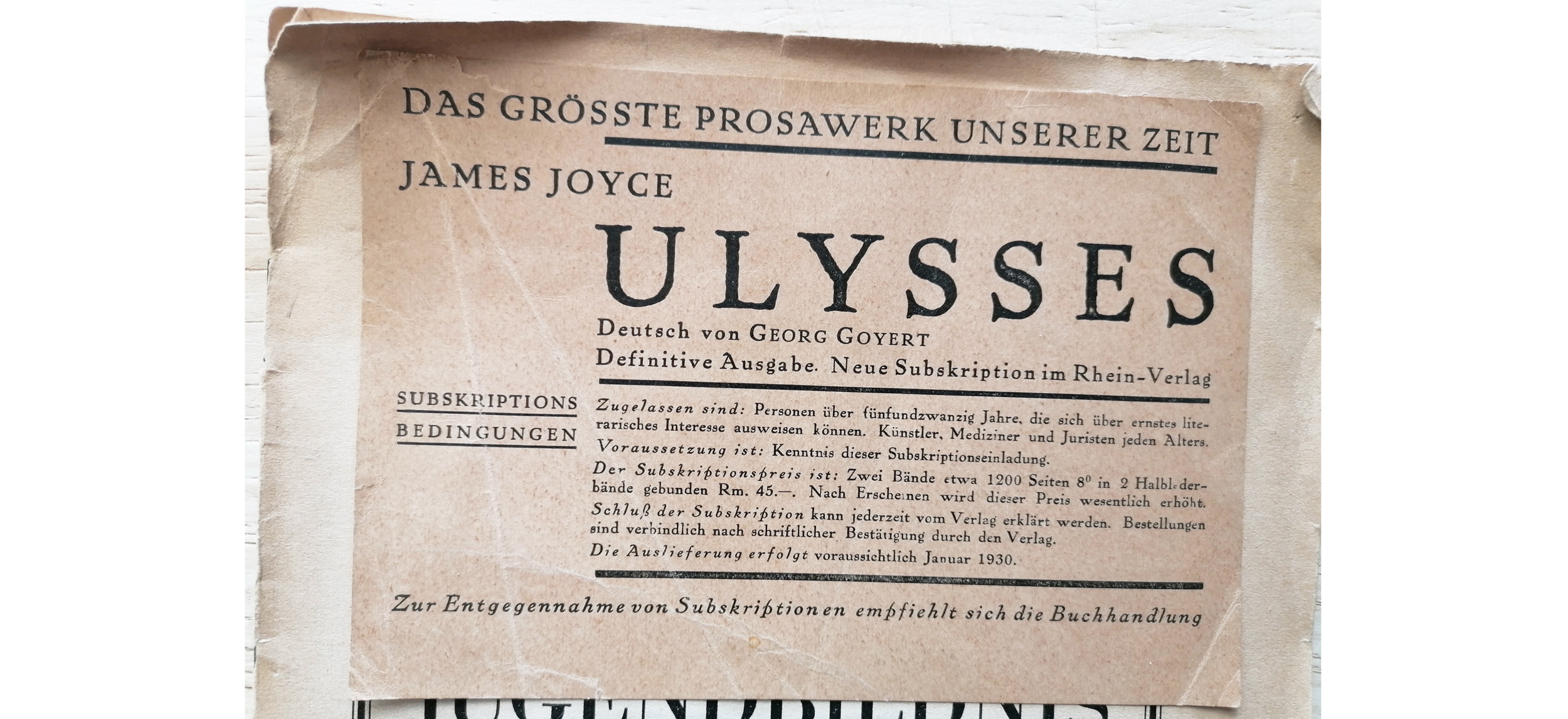
This imposing volume is the fruit of the artist Werner Schmidt’s decades-long immersion in the preeminent literary monument of the twentieth century: James Joyce’s Ulysses.
What began as a personal reader’s voyage now attains definite form in an eloquently colorful, interdisciplinary and polyphonic tribute—a work between literary study, theory of color, visual art, and reflection on language.
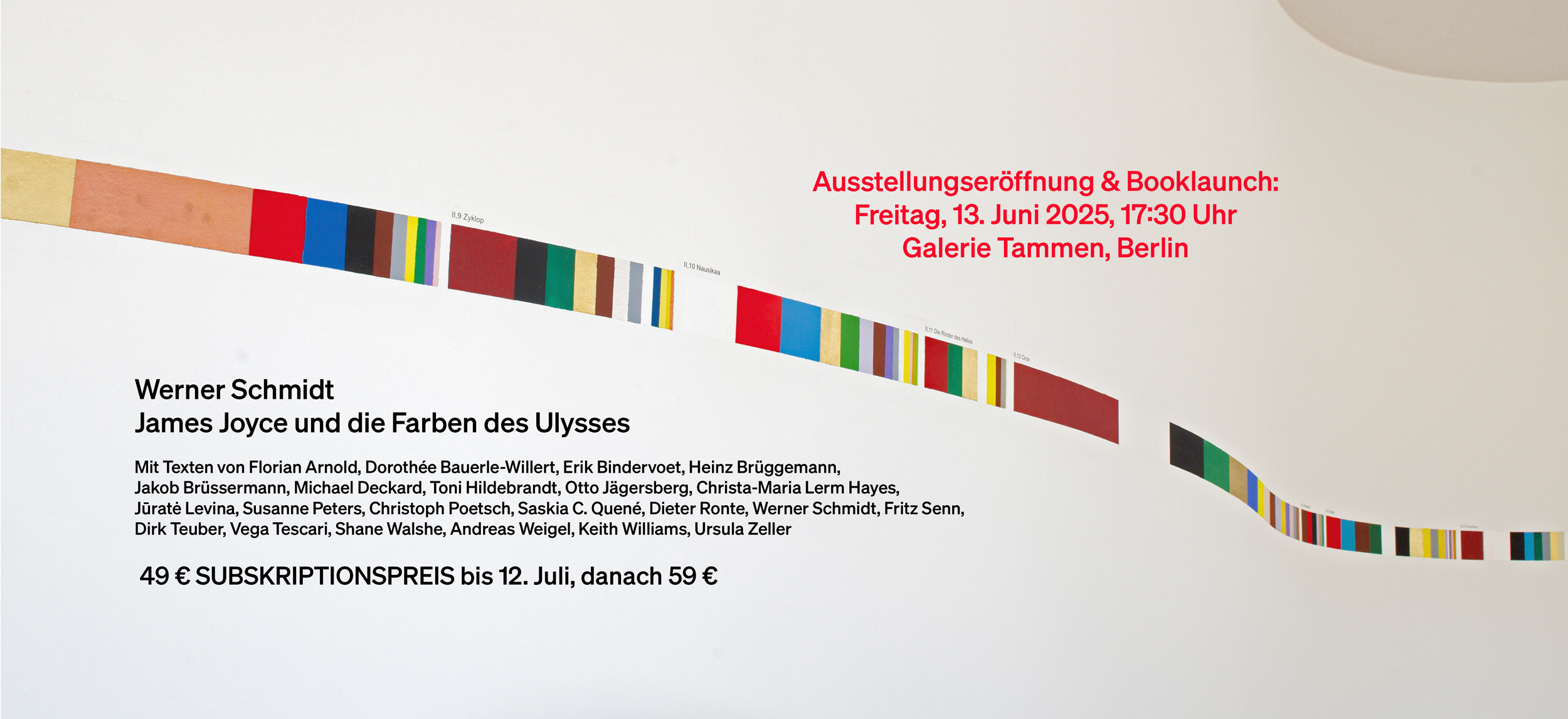
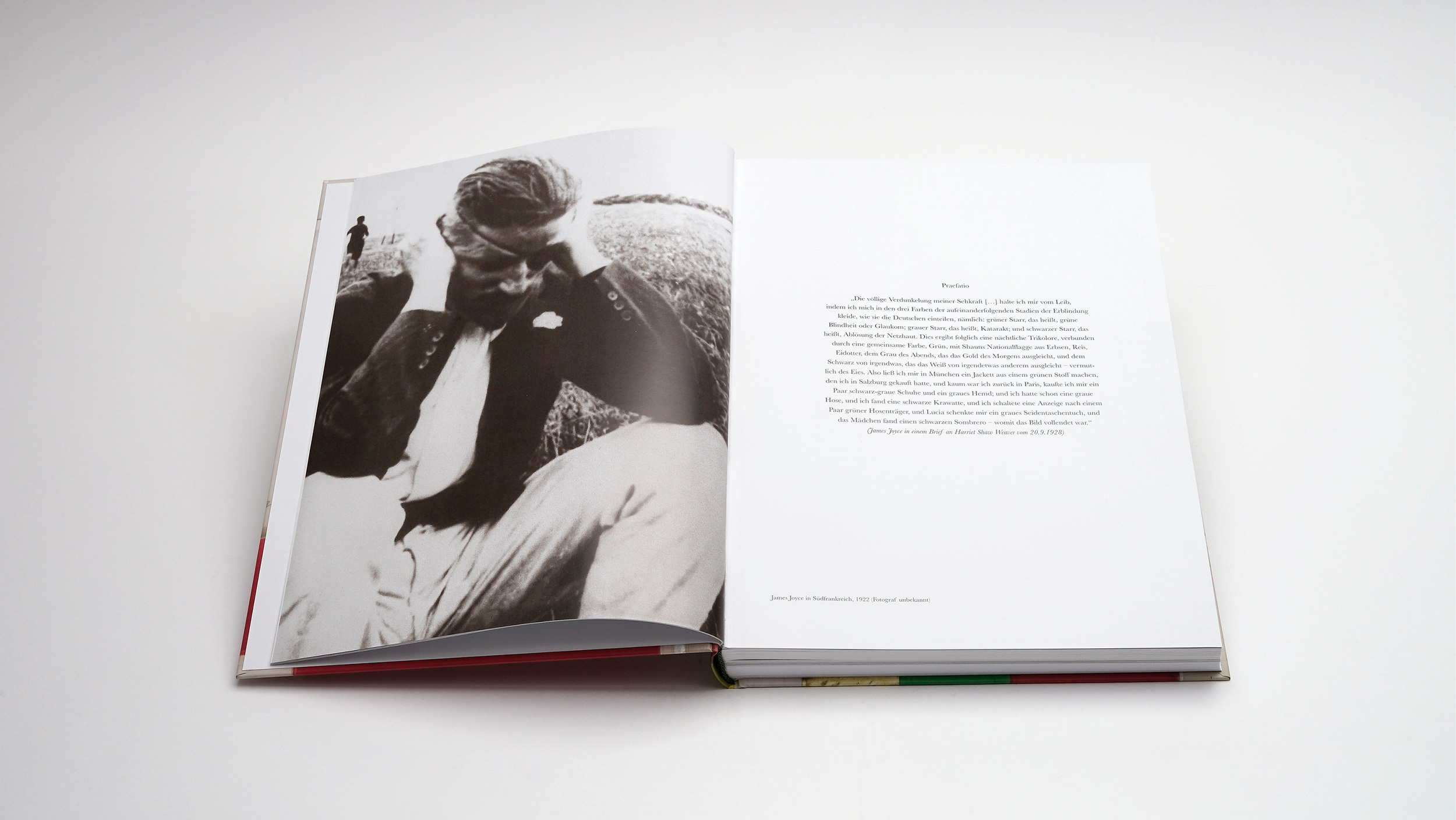
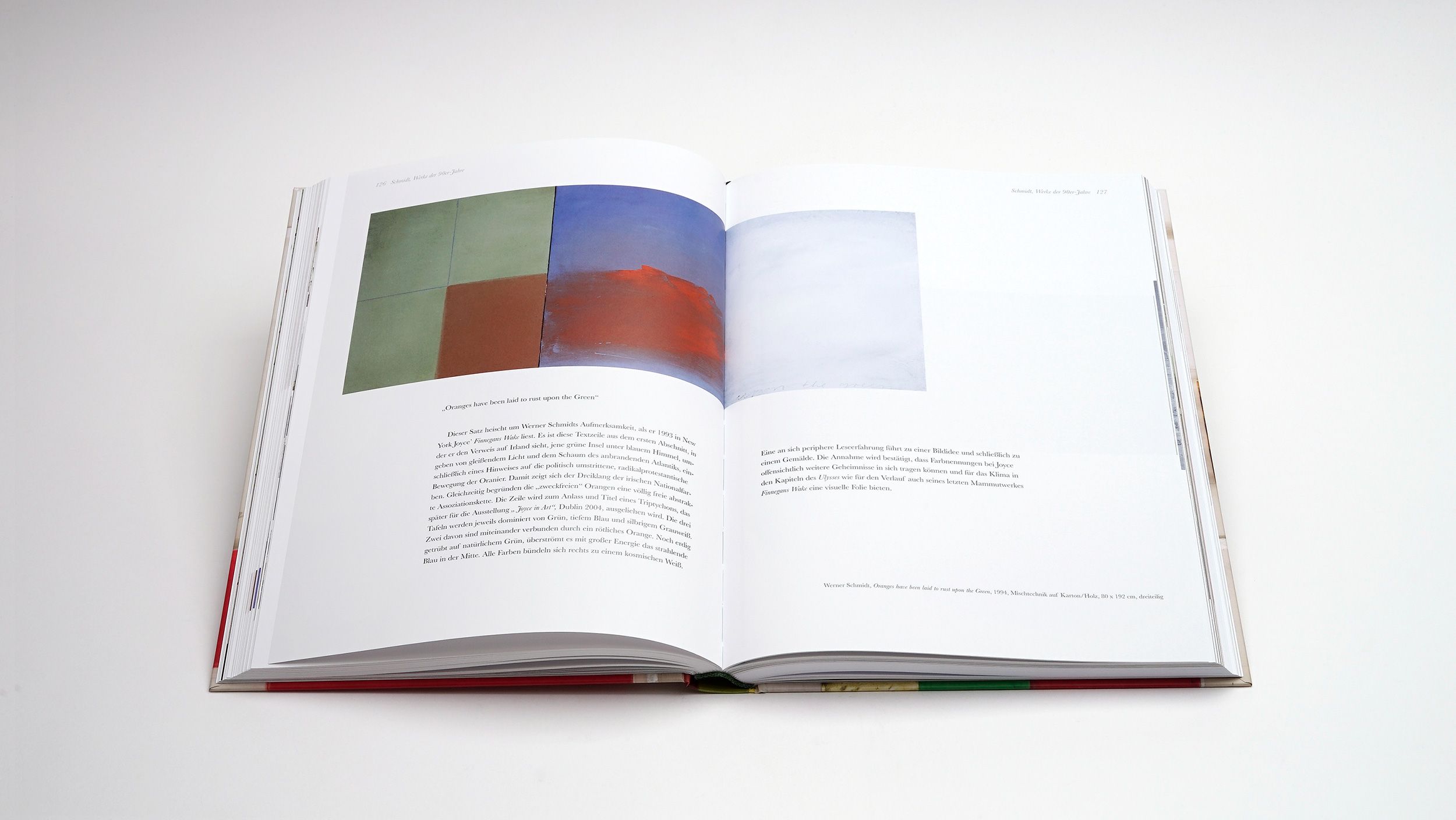
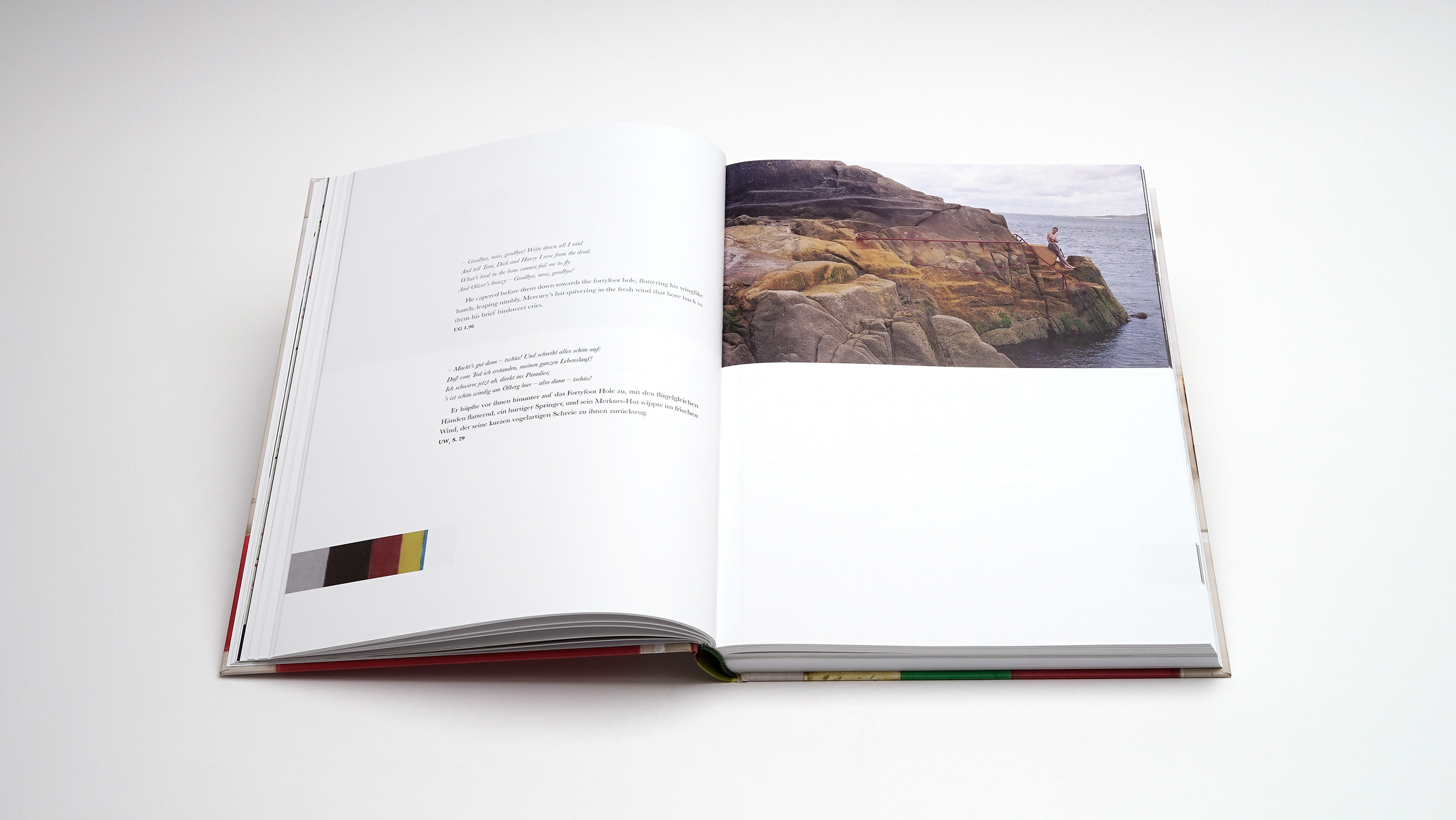
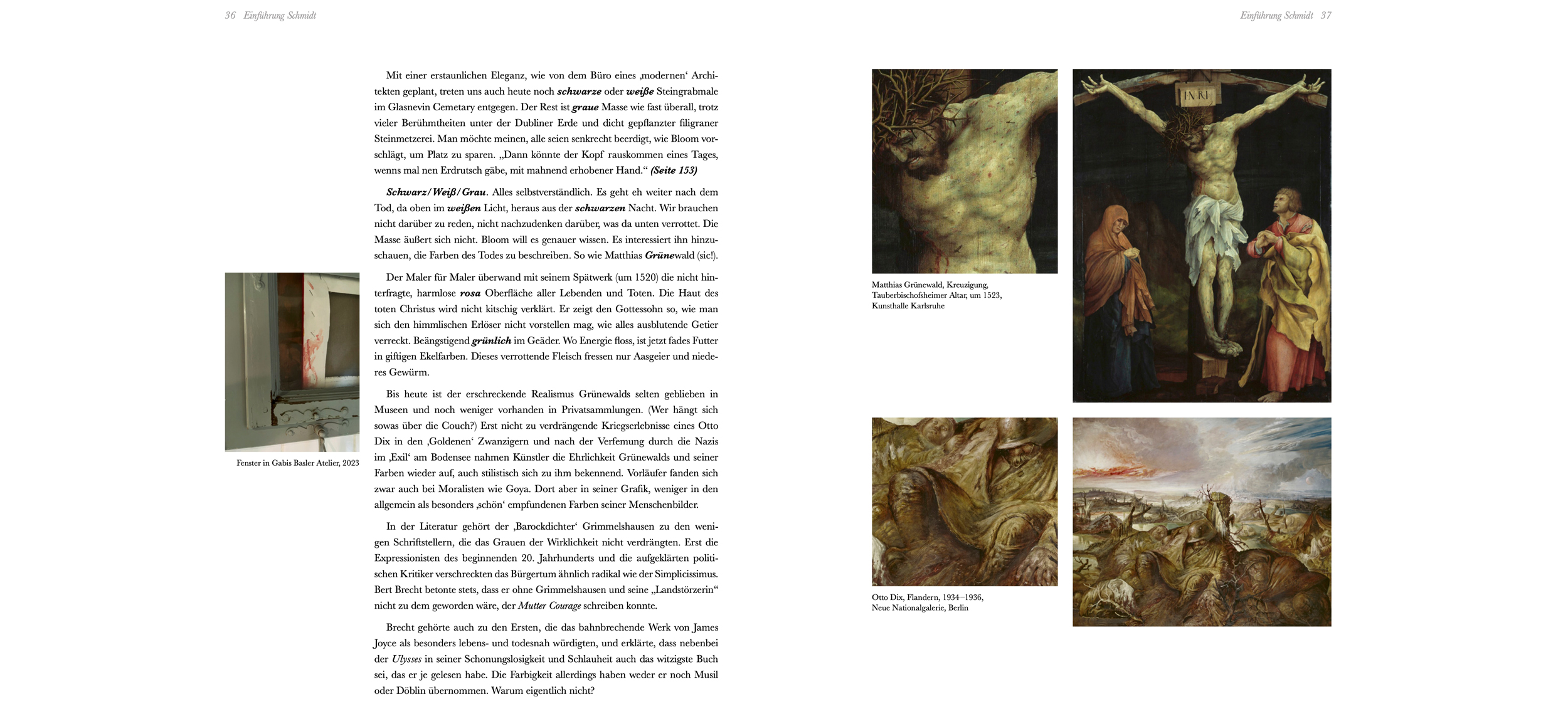
In the book’s first part, Schmidt analyzes and visualizes the use of colors in Ulysses in unique chromatic diagrams and coded color stripes that were literally painted on the walls in exhibitions. They are complemented by a series of photographs taken in Dublin, the novel’s setting, and accompanied by probing meditations on literary and linguistic facets and aspects of politics and the history of religion in the Joycean universe.
The second part gathers the voices of twenty renowned Joyce scholars, who, in five thematically organized chapters, share their perspectives on the color, texture, structure, and effect of Ulysses.
A feast for all who revere Joyce—and a gift of anyone who would not just read but truly wrap their mind around literature in its boldest and most luminous incarnation.
With texts by Florian Arnold, Dorothée Bauerle-Willert, Erik Bindervoet, Heinz Brüggemann, Jakob Brüssermann, Michael Deckard, Toni Hildebrandt, Otto Jägersberg, Christa-Maria Lerm Hayes, Jūratė Levina, Susanne Peters, Christoph Poetsch, Saskia C. Quené, Dieter Ronte, Werner Schmidt, Fritz Senn, Dirk Teuber, Vega Tescari, Shane Walshe, Andreas Weigel, Keith Williams, Ursula Zeller
More books
-

Fahar Al-Salih
Beyond Fairy Tales39€ Add to cartBridges between East and West
The protection and sense of belonging one feels where one is at home, and what it is like to lose both of them: these are central concerns in the art of Fahar Al-Salih (b. Belgrade, 1964; lives and works in Karlsruhe). Having grown up in Kuwait, where a classical education in visual art was inconceivable, Al-Salih came late to his métier; Markus Lüpertz was among his teachers, and he completed his education in Hermann Nitsch’s master class. Seeing himself as a “bridge-builder” between the cultures of the Arab world and Europe, Al-Salih probes the different lived realities in which his itinerant biography has been set. No more linear than his path through life, his oeuvre is defined by subjects to which he keeps returning in a kind of cyclical motion. This publication offers unprecedented insight into Al-Salih’s creative approach and his articulations of individual yearnings, the comforts of safety, and political and social upheavals. His work achieves a deft interweaving of global perspectives and migrant realities.
-

Margret Eicher
Lob der Malkunst38€ Add to cartContemporary Visual Communication in a Historic Weaving Technique
Margret Eicher’s (b. Viersen, Germany, 1955; lives and works in Berlin) large-format tapestries combine the baroque form of the woven picture with familiar motifs excerpted from contemporary media images. She digitizes her sources and then assembles them in painstaking editing work on the computer. The resulting ‘media tapestries’ occupy the interface between the traditional work of art as a physical object and the electronic noise of the digital realm: two worlds that at first glance would seem to be incompatible yet find themselves in harmonious union in Eicher’s art. In Göttliche Liebe (Divine Love), for example, Caravaggio’s Crowning with Thorns meets a kissing gay couple from a pro-tolerance campaign in Berlin, while Botticelli’s Birth of Venus is sampled together with a subway station in Frankfurt. In conceptual art production, the creative idea is central and its realization becomes secondary; in a final twist, Lob der Malkunst (Praise of Painting) elects this practice as its artistic lodestar. Eicher installs the painter Martin Kippenberger in the interior of Berlin’s Paris Bar, where he poses as a dandy and presides over a clash between the different tendencies in the art of the twentieth and twenty-first centuries.
-

Fabian Treiber
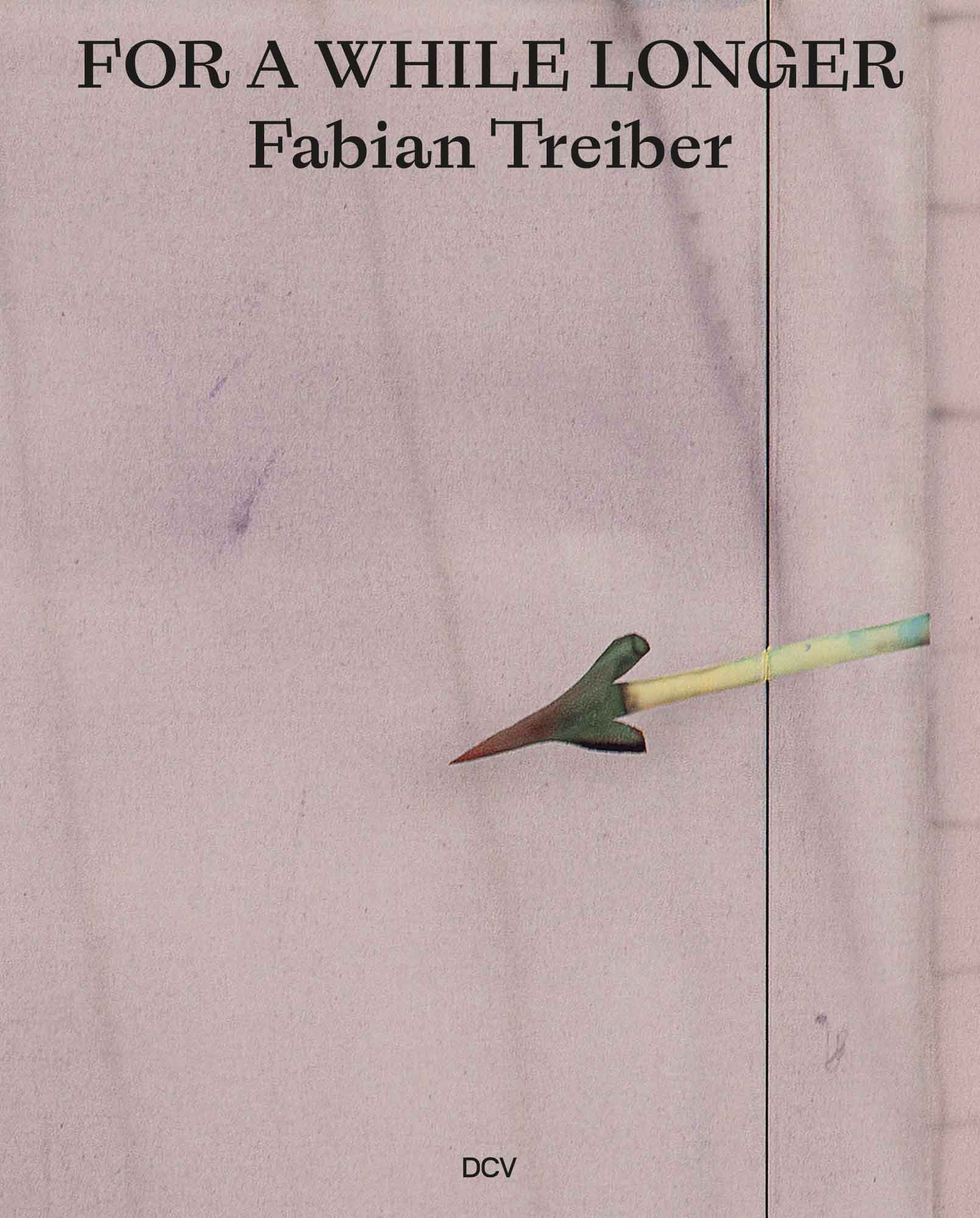
For a While Longer34€ Add to cartUnstable Prototypes of a Reality We Know
Fabian Treiber’s (b. Ludwigsburg, 1986; lives and works in Stuttgart) paintings show what appear to be interiors while interrogating subjective projections and our perceptions of reality. The artificial spaces bear witness to human existence even though there are no people to be seen. In his still lifes, Treiber negotiates classical questions of painting: form and structure, color and composition, representation of space and organization of the surface. His paintings primarily implement formal rather than narrative decisions. This lets the artist provoke a deliberate breach in which the ostensibly fallacious emerges as the essential quality of painting—the effect is that of works that seem somehow off but are actually just right.
Fabian Treiber studied painting and intermedia design at the Stuttgart State Academy of Art and Design (ABK Stuttgart). His works have won him a Karl Schmidt Rottluff Fellowship; he was also a finalist for the 2021 Hans Purrmann Grand Prize. He has had numerous solo shows, including at Kunsthalle Nürnberg, Nuremberg; Kunstverein Ludwigsburg; and Galerie Ruttkowski;68, Cologne; and contributed to group exhibitions at Kunsthalle Düsseldorf; Villa Merkel—Galerien der Stadt Esslingen a.N.; and Staatliche Kunsthalle Baden-Baden. For a while longer is published on occasion of his first solo exhibition at Haverkampf Galerie.
-

Museum Brot und Kunst
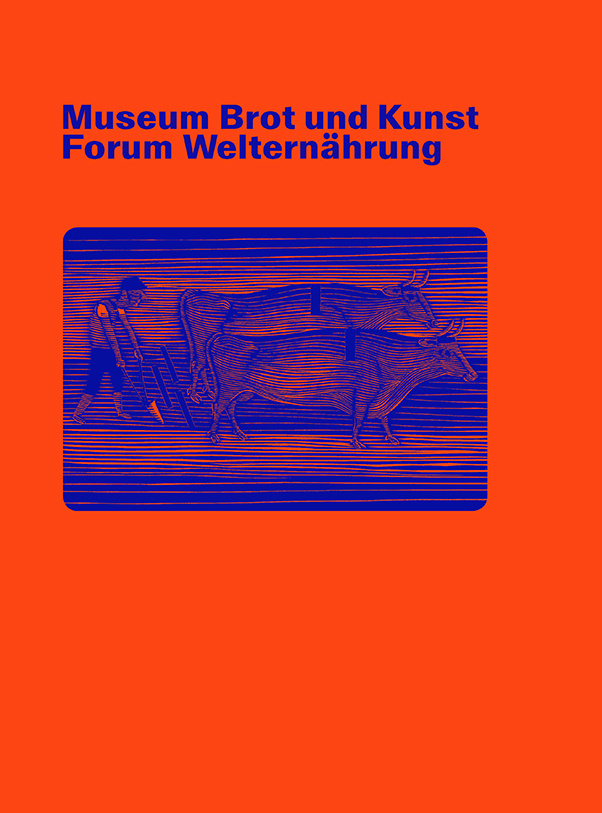
Forum Welternährung24€ Add to cartFood, Art, and Consumption
The craving for food and the desire to avoid being hungry have been among humanity’s central concerns for millennia. Economic activity, science, politics, culture—our basic need for sustenance informs and influences every domain of our lives. The catalogue accompanying the permanent exhibition at the Museum Brot und Kunst—Forum Welternährung sheds light on nineteen thematic foci around the significance of bread as the quintessential food. Founded in 1955, the Museum of Bread and Art was the first institution of its kind in the world dedicated to this subject; its collection comprises a large number of artifacts from across several centuries that speak to the histories of culture, society, and technology. The generously illustrated publication presents a panorama of the wide field of human nourishment in dialogue with art, helping the reader grasp the complexities of the world in which we live.
With works by Ernst Barlach, Bernhard Johannes Blume, Pieter Brueghel, Marc Chagall, Salvador Dalí, Simone Demandt, Agnes Denes, Frans Francken, Georg Flegel, Erich Heckel, Christian Jankowski, Markus Lüpertz, Gerhard Marcks, Max Pechstein, Pablo Picasso, Claire Pentecost, Thomas Rentmeister, Daniel Spoerri, Andy Warhol and others.
The book was included in the shortlist of the competition “Schönste Deutsche Bücher 2021”.
-

Rooted
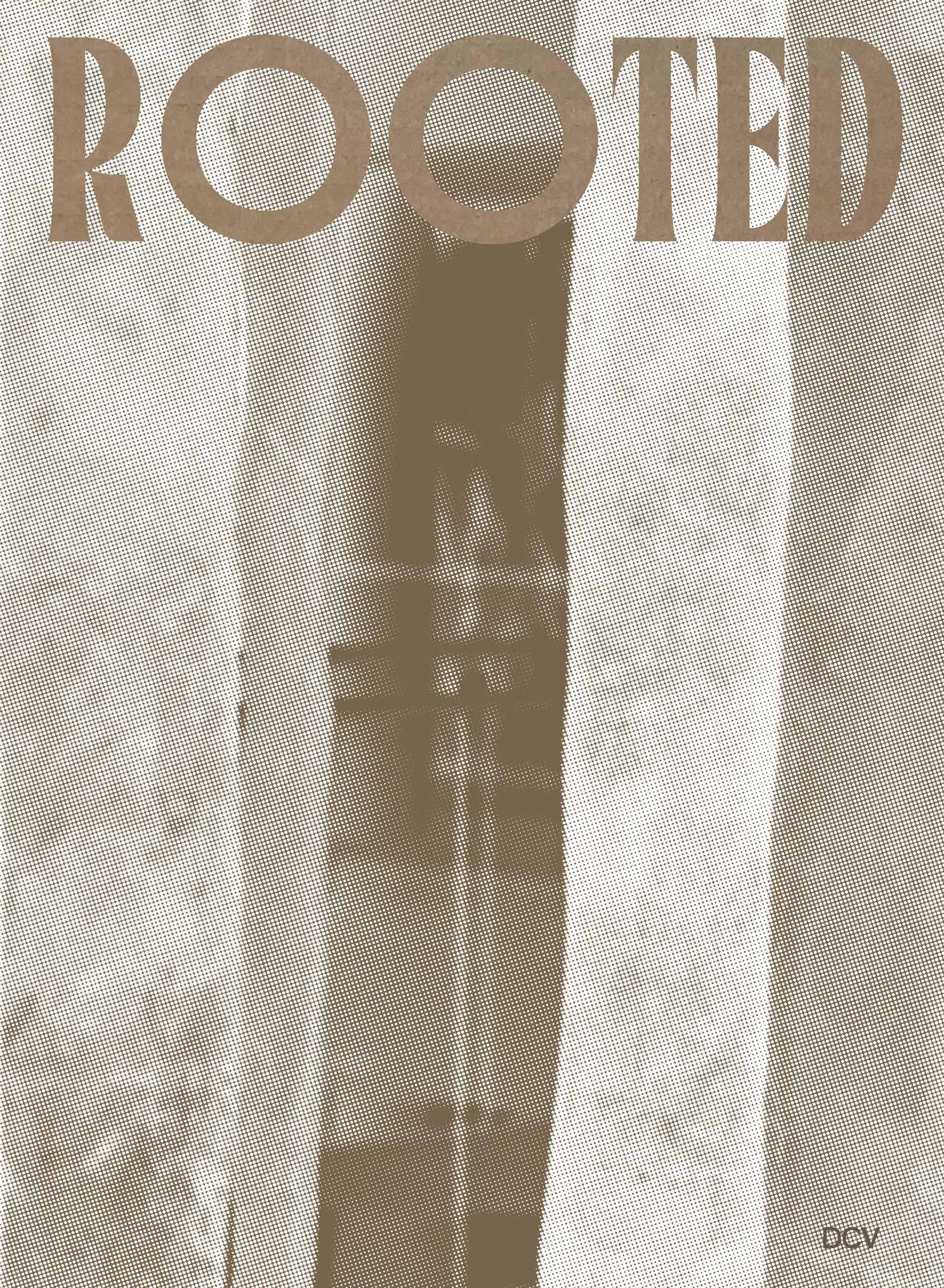
Female Brazilian Artists28€ Add to cartThe book Rooted. Female Brazilian Artists, accompanies the eponymous exhibition at Brainlab/Munich, which is open until the end of September 2025. The works of the 16 artists come from the collection of Sergio Linhares and Stefan Vilsmeier. The collectors present this selection hoping to illuminate important and difficult themes such as, among others, discrimination, displacement, and violence but also to remind of our shared rootedness in nature. “Art has no obligation to comfort us; it can challenge, disrupt and remind us that our coexistence is fragile.” The volume shows installation views along with close-ups of the individual works and it includes short texts for each artist along with an essay by curator Tereza de Arruda.
Artists: Marlene Almeida, Azuhli (Luiza Diogo Veras), Tarsila do Amaral, Beatrice Arraes, Carmezia Emiliano, Sonia Gomes, Iêda Jardim, Lucia Laguna, Laura Lima, Rosilene Luduvico, Rosana Paulino, Solange Pessoa, Paula Siebra, Luzia Simons, Nádia Taquary, Alexsandra Ribeiro, Larissa de Souza
-

Lovis Corinth
Maestro del colore – Maestro della grafica35€ Add to cartLovis Corinth (b. Tapiau, East Prussia, 1858; d. Zandvoort, Netherlands, 1925) ranks among the leading German Impressionists. But he has also been described as a precursor of Expressionism for his impulsive and passionate style in painting and graphic art as well his liberal handling of form, which vividly conveys agitated states of mind and powerful emotions. In addition to an eminent body of paintings and numerous drawings and watercolors, he left a graphic oeuvre encompassing over a thousand prints. In his paintings as in his etchings and lithographs, Corinth dedicates himself to a set of recurring themes: mythological and religious motifs, nudes, still lifes, landscapes, and portraits of his family and close friends. His graphic work also shows him engaging with the challenges of self-portraiture.
-

Bottrop, Breunig, Schröder
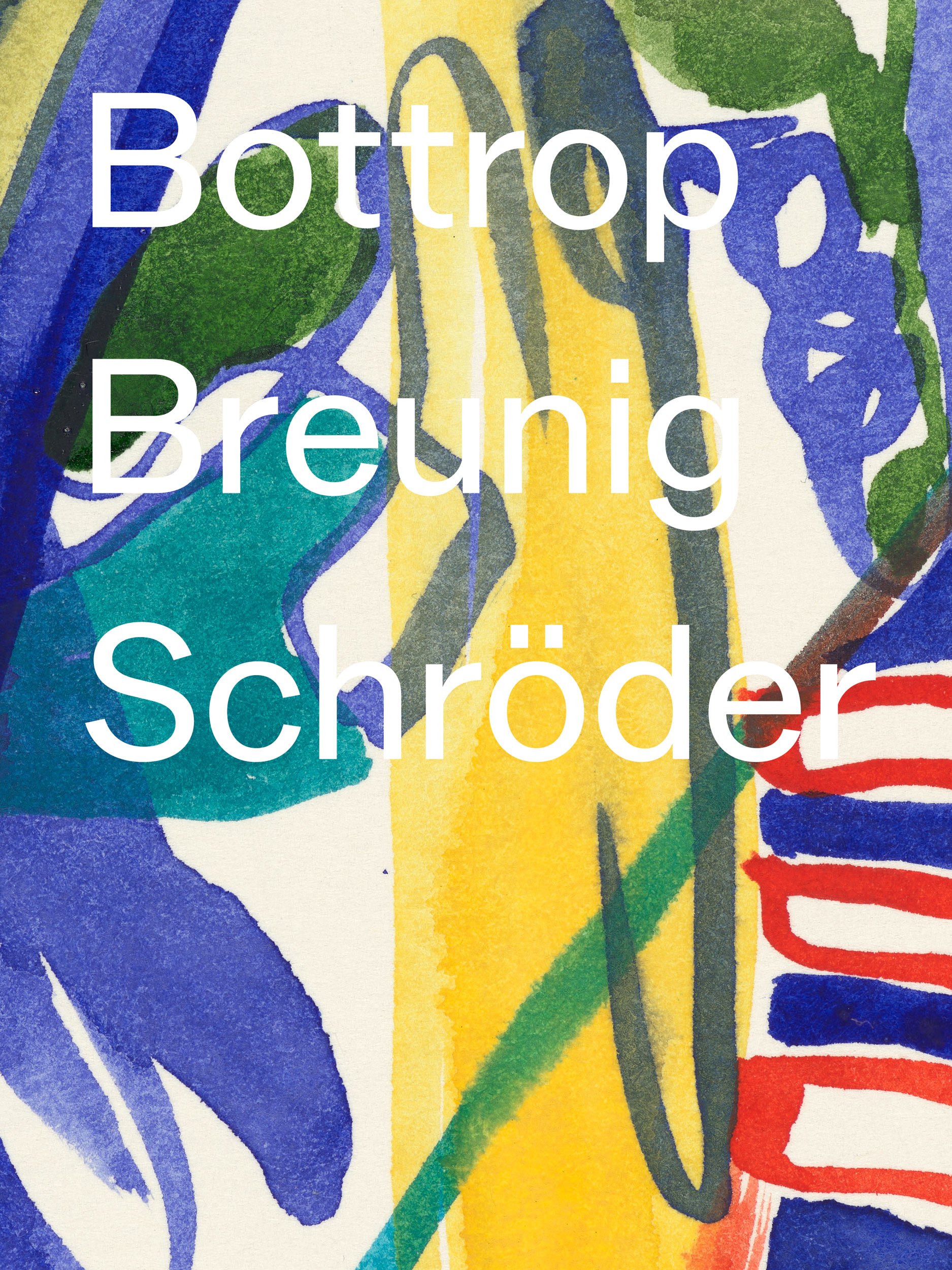
20:1528€ Add to cartRapidly growing floods of images and artificial intelligence have made art almost inevitably into a commentary on the illusion of actuality. Three painters—Jana Schröder, Peppi Bottrop und Andreas Breunig—present drawings in the Gesellschaft für Gegenwartskunst in Augsburg. 20:15 is the title of the exhibition and this accompanying book. All three artists have studied with Albert Oehlen at the Kunstakademie Düsseldorf and share a philosophical approach to painting. “Our painting is a response to the given conditions of pictoriality. We are here to deconstruct and question what images really are.” (Schröder) The art historian Christian Malycha interviews the three artists, together regarding the exhibition concept, and individually about the evolution of their works. The conversations in this book, which are supplemented by reproductions of all exhibited drawings, provide illuminating glimpses into the ongoing discourse about painting’s relevance.
-

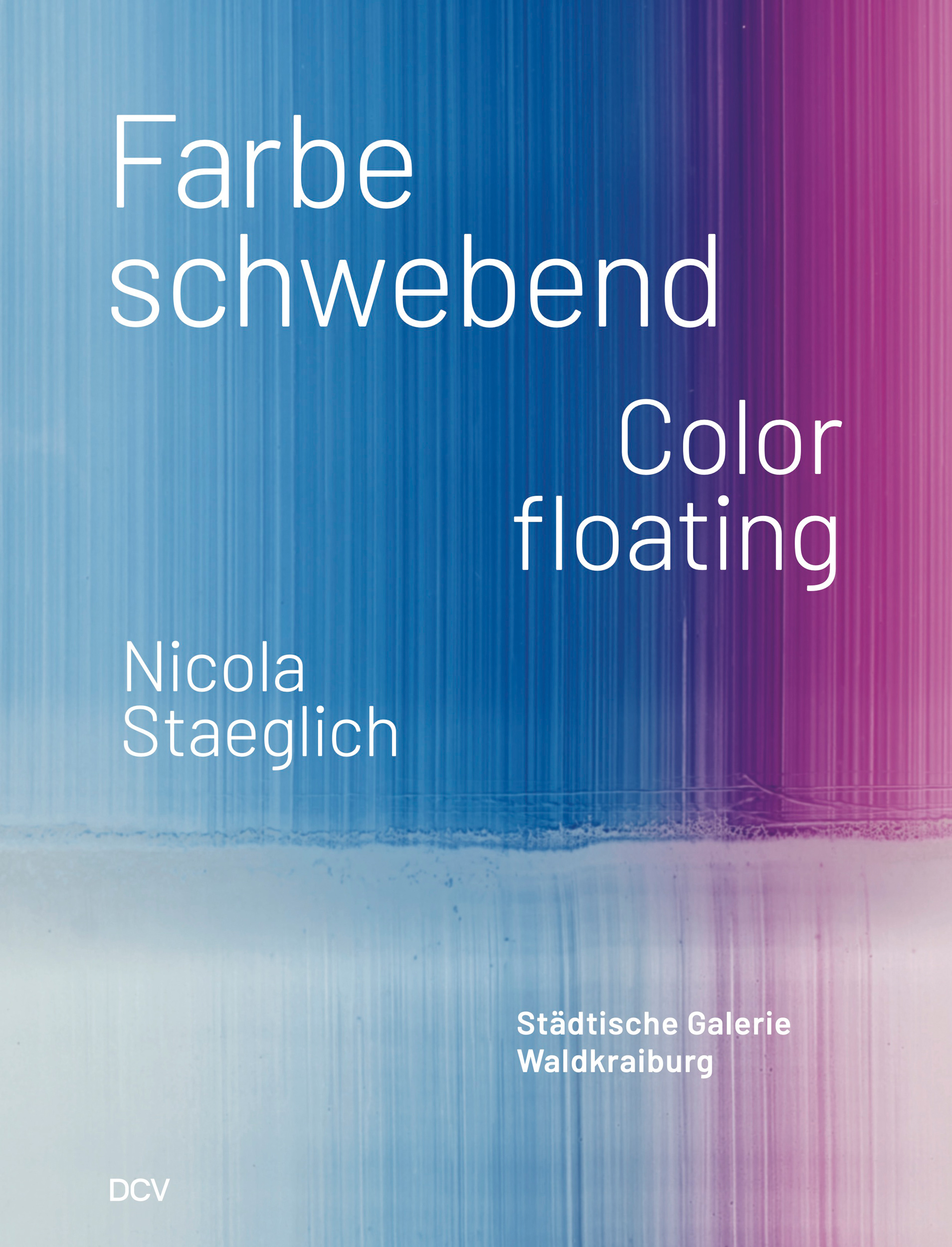
Nicola Staeglich – Farbe schwebend / Color floating
22€ Add to cart“The more slowly one approaches Staeglich’s works, the more they reveal.” Stephan Berg
Nicola Staeglich transforms color and traces of the act of painting into complex pictorial spaces that exude light and make time visible. Using an extra-wide brush, she applies luminous oil paints to (semi-) transparent foils and solid support media made from acrylic glass. Each movement of her body leaves a distinct mark on the paintings. Once the works are placed in the exhibition space, they absorb their environment and ambient light as well as the eye. The artist’s experimental approach generates a rich dynamic: paint hovers in mid-air, disembodied, while a constant oscillation between color and surface, between pictorial body and setting unlocks novel dimensions in space and time. The picture continually coalesces in the eye of the beholder, metamorphosing as the angle of incidence shifts and the mind parses the traces and strata of paint. Even in printed form, Staeglich’s works convey a rousing vitality.
The catalogue accompanies Staeglich’s solo exhibition at Städtische Galerie Waldkraiburg.
-

Konkrete Progressionen
François Morellet & Vera Molnar, Manfred Mohr & Hartmut Böhm15€ Add to cartThanks to a generous donor, the Kunstmuseum Reutlingen | konkret welcomed a number of outstanding works to its collection in 2022. Titled Konkrete Progressionen, the first exhibition to showcase a selection from the gift features four internationally renowned artists whose works are derived from mathematical or geometric procedures: the concrete systematists Hartmut Böhm (1938–2021) and François Morellet (1926–2016) and the pioneers of computer-generated art Manfred Mohr (1938–) and Vera Molnar (1924–).
The book documents the serial paintings, drawings, collages, wall objects, and monumental installations and environments of steel beams or concrete blocks. The works play concrete games with the beholder’s ability to recognize patterns in binary contrasts or layered grids. They show sine waves, vector series, hypercubes, and markings derived from the circular constant π or the Fibonacci sequence—and in each instance demonstrate primarily how the basis of calculation takes on a life of its own.
The exhibition at the Kunstmuseum Reutlingen runs until April 14, 2024.
- Release September 2021

Paul Uwe Dreyer
Werkverzeichnis der Gemälde, Zeichnungen und Druckgrafiken68€ Add to cartA Painter, Draftsman, and Draftsman of Concrete Art
Paul Uwe Dreyer (b. 1939, Osnabrück; d. 2008, Stuttgart) taught painting as a professor at the Staatliche Akademie der Bildenden Künste Stuttgart for more than three decades. His oeuvre shows the hallmarks of geometric constructive art: inspired by subjective experiences of reality, Dreyer’s compositions visualize the dialectics of organizing principles and their potentials for variation, a guiding interest that is already evident in his early work since the 1960s and especially in the pairs and series of pictures he begins creating in the early 1970s. His art unfolds a fascinatingly dynamic yet nonhierarchical dialogue between colors, surfaces, and lines. The chronological catalogue raisonné reveals the consistency with which motifs evolve from his early to his late oeuvre, from architectural, figural, and ornamental tokens through elements resembling symbols and icons to complex penetrations of spaces.
-

Steven Shearer
Working from Life58€ Add to cart“Today’s images are echoes of how people have always been depicted.”
Steven Shearer (b. New Westminster, BC, 1968; lives and works in Vancouver) works in a range of media including printmaking, sculpture, painting, drawing, and collages of found photographs. His portraits of individuals in decorated settings earned Shearer international acclaim. They show heroes from the past—protagonists of musical subcultures or the history of art. The archetypal creative minds in their studios appear together with their works; the interiors surrounding them reflect their psychological constitution. Shearer paints them in the style of Symbolism, the German Romantics, or the Fauves. Imitating the perspective painting of the Renaissance, he virtually pulls the beholder into his pictures.
Steven Shearer participated in the Nova Scotia College of Art and Design New York Summer Studio Programme in 1992 and studied at the Emily Carr College of Art, Vancouver, in 1992. In 2011, he represented Canada at the 54th Venice Biennale.
-

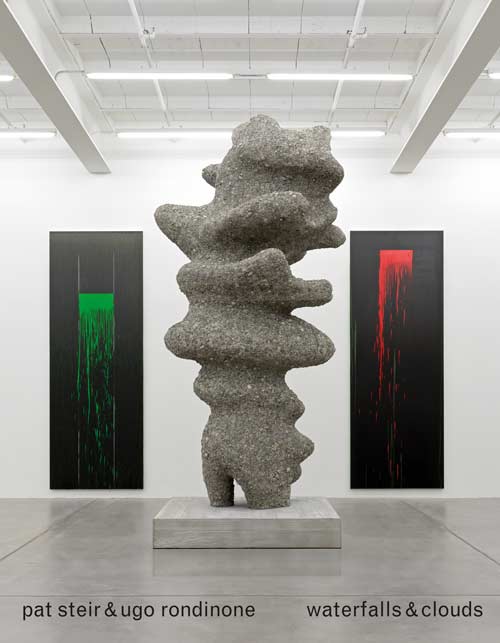
Pat Steir & Ugo Rondinone
Waterfalls & Clouds20€ Add to cartThe imposing installation Waterfalls & Clouds consists of three sculptures by the Swiss artist Ugo Rondinone (b. Brunnen, Switzerland, 1964; lives and works in New York) and nineteen paintings by the American Pat Steir (b. Newark, NJ, 1940; lives and works in New York). The three large gray monoliths of concrete, sand, and gravel bear the titles Faces, Look, and Twisted and are part of a series of twenty works created in 2018. They are surrounded by nineteen tall and narrow black oil paintings titled Flags for Ugo #1 through #19 (2021); with colorful or white paint streaming down the canvases, they hark back to Steir’s Waterfall series from the 1980s. A symbiotic relationship connects the works: the sculptures, in which erosion is integral to the art, embody time, while the pictures symbolize gravity and hence nature as such.
-

Thomas Lehnerer
Freies Spiel44€ Add to cartThe function of art in human existence
Throughout his short life, the Munich-based theologian and artist Thomas Lehnerer (1955–1995) did not take the existence of art for granted. In his writings, above all in Methode der Kunst (Methods of Art), he developed a concept of art in the continuation of key texts from the fields of aesthetics, cultural theory, and art history, which can also be found in his own artistic work. The small-format figurative sculptures by Lehnerer, as well as his drawings, watercolors, and early installations, follow theoretical premises and address comprehensive themes of human existence. The present volume documents his examination of human existence, which is deepened by the inclusion of cultural historical figures and idols.
- temporarily not available

Norbert Bisky
Im FreienRead moreThe beauty of male bodies, hedonism, bold colors—Norbert Bisky (b. Leipzig, 1970; lives and works in Berlin) is widely regarded as the most successful exponent of contemporary figurative painting in Germany. Now the artist has created a series of seventeen works on canvas and paper based on associations sparked by the oeuvre of the Expressionist Max Pechstein (1881–1955). The title “Im Freien” not only refers to the scenes they depict, which play out under the open sky; Bisky—who grew up in East Germany, which is to say, in what he calls “circumstances that were not free”—also grapples with the question of what liberty means to us today and what we do with it. The preoccupation with freedom led both painters to a quest for a personal utopia. Pechstein found it in the South Seas, where he had visited Palau, then a German colony, in 1914; the archipelago seemed paradisiacal to him, an idyll far removed from political and social reality. Bisky, by contrast, focuses less on the exotic landscape than on its residents, whom he stages as individual members of a globalized society.
Norbert Bisky enrolled at Humboldt-Universität in Berlin in 1994 to read German literature and art history but switched to the Berlin University of the Arts before year’s end; he studied painting with Georg Baselitz and entered Baselitz’s master class in 1999. He was a visiting professor at the Haute école d’art et de design, Geneva, in 2008–2010 and at the Braunschweig University of Art (HBK) in 2016–2018.
-

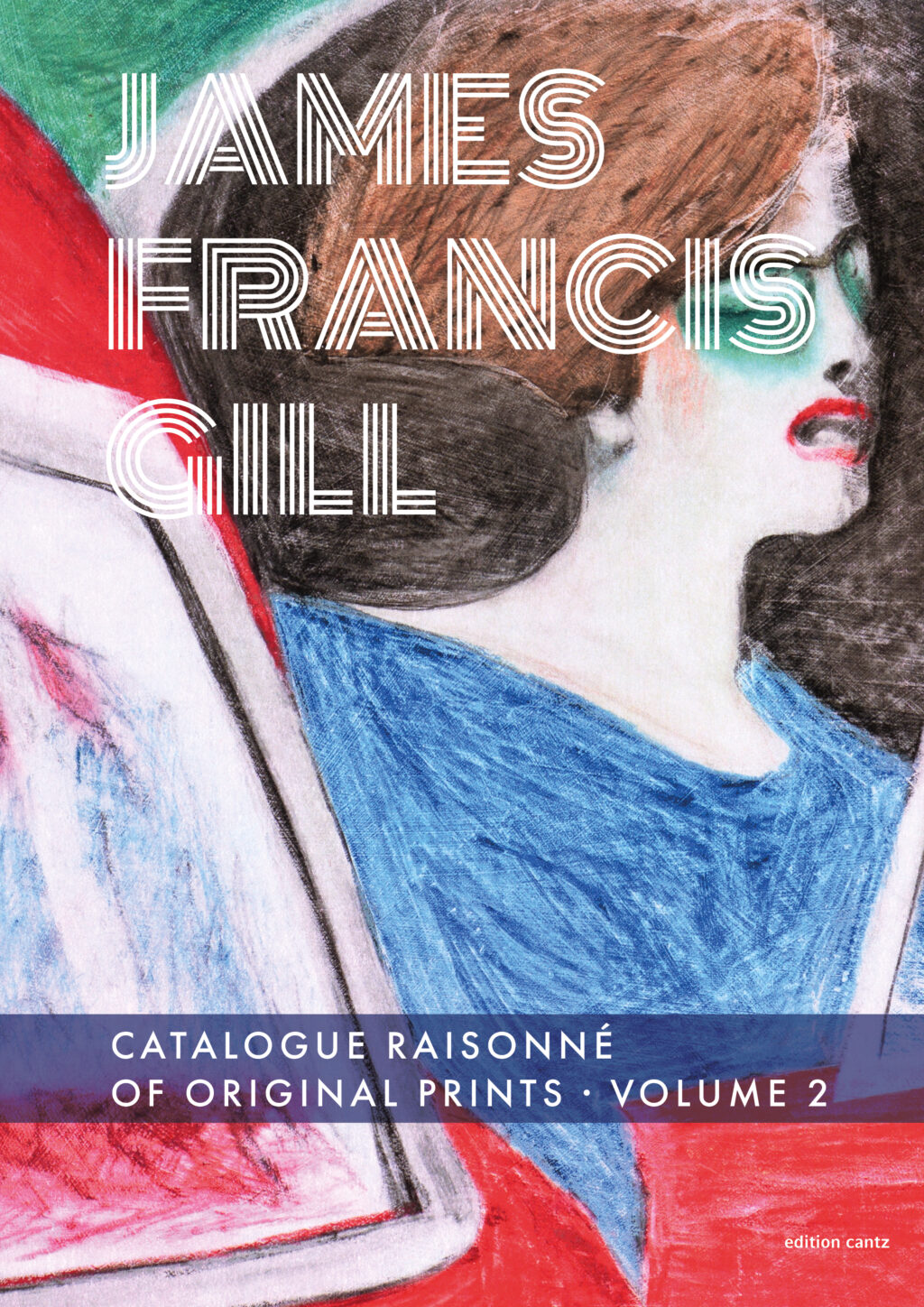
James Francis Gill
Catalogue Raisonné of Original Prints, Vol. 239€ Add to cartThe Catalogue Raisonné of the Co-Founder of American Pop Art
James Francis Gill (b. 1935, Tahoka; lives and works in Texas) is one of the most important artists of American Pop Art. His paintings, often based on photographs, provide an unusually personal approach to the icons of the 1950s and 60s. Gill suddenly became Hollywood’s most celebrated artist when his Marilyn Triptych was added to the permanent collection of The Museum of Modern Art in New York in 1962 – even before the works of Andy Warhol. Through friendships with celebrities such as John Wayne, Martin Luther King, and Marlon Brando, Gill became the contemporary artist-witness of an entire generation. Nevertheless, he kept his distance from the exuberant Hollywood of the time and surprisingly withdrew in 1972, only to reappear on the art market thirty years later. This catalogue raisonné in two volumes impressively documents his work from the early political motifs to the Pop Art icons of his late work.
-

Marion Anna Simon
Gemaltes Kaddisch14€ Add to cartAn artist paints the Kaddish
In roughly 330 self-portraits, Marion Anna Simon (b. 1972, Bitburg; lives and works in Cologne) dares to undertake an unusual transcription of Jewish prayer as a sign of mourning. On January 7, 2017, one day after the death of her mother, Marion Anna Simon began work on her painted Kaddish. What initially began as a very personal process of grieving quickly developed into an artistic concept: Roughly 330 painted and drawn self-portraits were created within eleven months—in daily notes, with acrylic and watercolor, pencil and ballpoint pen, oil crayon and pastel, on paper and canvas, wallpaper and cardboard, in lined exercise books and cheap notepads. Marion Anna Simon’s cycle explores her own face as a place of mourning and self-affirmation, documenting an artistic ritual beyond the Jewish prohibition of images and patriarchal attributions to sons in the tradition of the sanctification prayer for the memory of the dead.
-

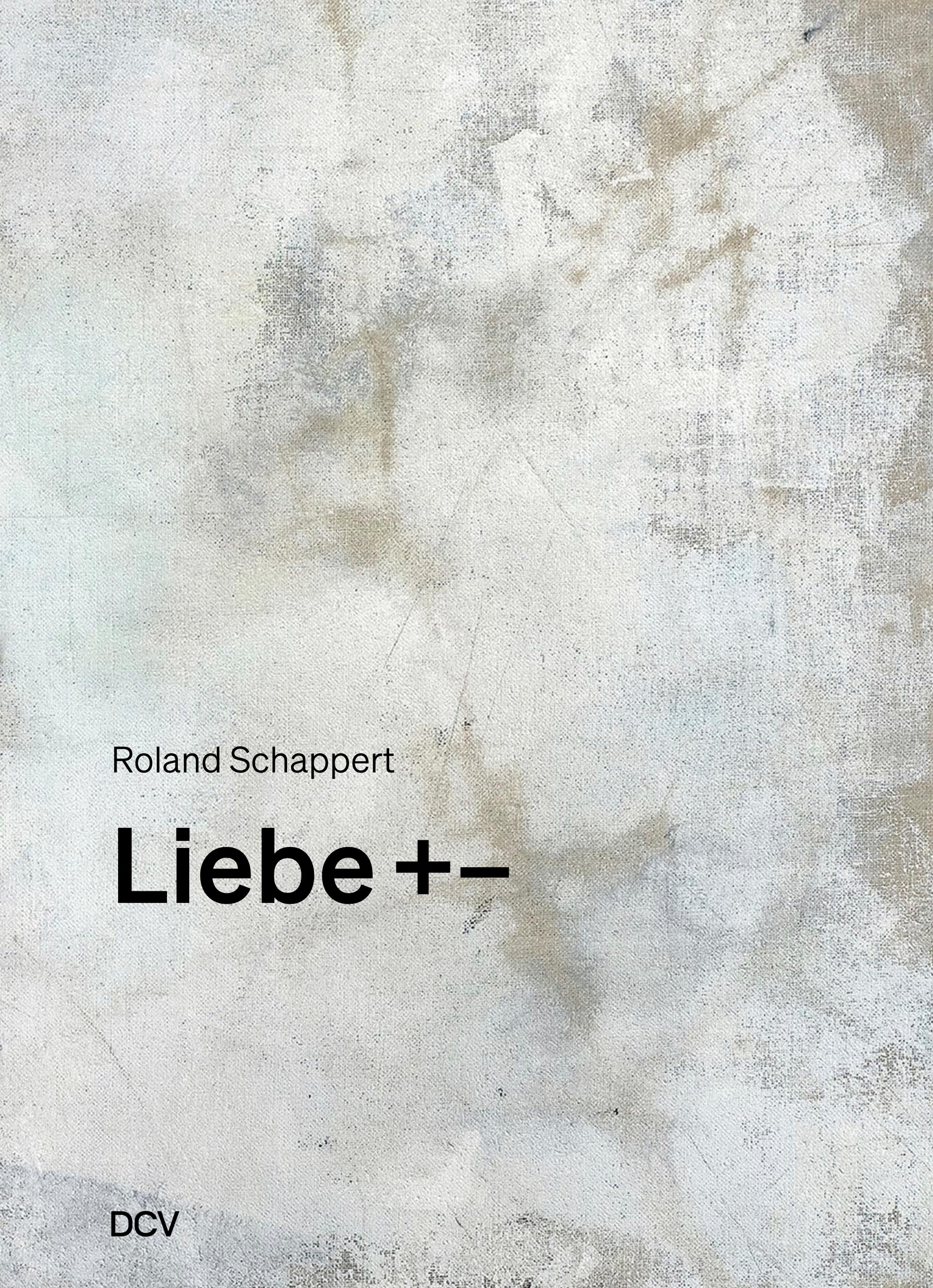
Roland Schappert
Liebe +–24€ Add to cartRoland Schappert’s Liebe+– is a poetic voyage into the mysterious and paradoxical landscapes of love. Combining an unrelenting eye with lyrical precision, Schappert captures the fragile equilibrium between intimacy and distance, between the longing for union and the need for detachment. The +– in the title is a symbolic shorthand for the ambivalence of love: attraction and repulsion, delight and pain, their constant interplay defining the dynamic of love.
The terse and sometimes aphoristic writings enter into a dialogue with the author’s artful and enigmatic pictures and sculptures—text images sewn out of strings of beads or painted in Champagne chalk that subtly mirror and refract the emotional tension of the poems. Nimbly balancing on the fine line between devotion and disaffection, Schappert’s verses are interspersed with ironic allusions to our digital and urban contemporary world.
By forging a symbiosis of poetry and image, this artist’s book charts a world unto itself in which the boundaries between I and you blur and subject and object are fused in a collective we. It invites us to contemplate love with a fresh eye—as tender touch and fractious idea, as a play of expectation and disappointment that we begin anew every day.
‘Love in the age of social media and dating apps, but not from a Gen Z perspective – but from someone who has known this feeling for much longer. And who brings his experiences – which are certainly representative of many – in ever new combinations of text and images into a form that makes reading and viewing a memorable experience.’ – Wolfgang Ullrich
-

Stephan Kaluza
Fragmente eines Ängstlichen28€ Add to cartA Novel on Coping with Guilt or the Feeling of Having Violated Life
The filmmaker Castner and the anthropologist Pollock not only share the similarity of their names with those of Castor and Pollux, the fabled twins of Greek myth, but also a hard fate: an irreparable guilt whose motifs run through the entire novel. Pollock is forced to admit to himself that, in his role as a scientist, he was involved in a genocide against indigenous people in Panama; Castner, meanwhile, tries to get a handle on his bouts of excessive hypochondria. In episodic flashbacks and an interview that gradually turns into an emotional dispute between them, the two characters analyze the minutiae of their life stories and arrive at a surreal insight.
Castor and Pollux were known in antiquity as the patrons of sailors, who took their bearings from the twins’ constellation. That is why water figures in this novel as the element that unites all narrative planes. Water—like life—will fill any vacant space regardless of shape and adapt to all circumstances.
Stephan Kaluza (b. Bad Iburg, 1964; lives and works in Düsseldorf) is a visual artist, working in the media of photography and painting, and a writer whose output includes plays, novels, and nonfiction books. The philosophy of nature is a central theme in both Kaluza’s art and his fiction.
-

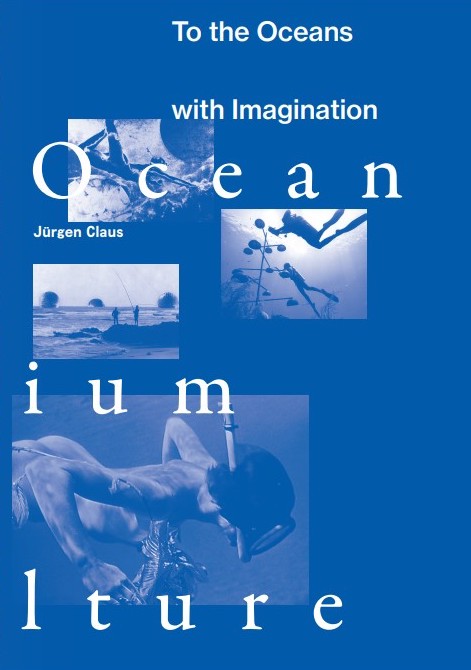
Jürgen Claus
To the Oceans with Imagination18€ Add to cartThe Sea as a Space of Artistic Experience
Jürgen Claus’s (b. 1935, Berlin; lives and works in Aachen and Baelen, Belgium) oeuvre encompasses paintings, films, light and solar installations, and underwater art. He is also a prolific writer on art, with theoretical works that have sold over 100,000 copies. “Jürgen Claus is the first one to see the ocean through an artist’s rather than a scientist’s lens,” Michel Ragon writes. In this book, Claus intertwines his experiences working on the fascinating underwater installations with a pressing contemporary concern: the global efforts to restore the seas to health. The publication combines visual art, architecture, poetry, and music for a multifaceted engagement with the world’s oceans.
Jürgen Claus majored in theater studies at the Universität München and was a research associate at the Massachusetts Institute of Technology (MIT) and professor of media art at the Kunsthochschule für Medien Köln, Cologne.
- Out of stock

Soulages
Malerei 1946–201942€ Read more“I paint not with black but with light.”
Pierre Soulages (b. Rodez, France, 1919; lives and works in Paris and Sète, France) is an eminent figure in abstract painting. A member of the Nouvelle École de Paris, he developed his first nonobjective pictures early on, in 1946, putting bars of bold color, typically black, on white grounds. His embrace of total non-representationality, an art that depicts nothing, that stands for nothing but itself, amounted to a radical challenge to the traditional values of painting. In 1979, his work entered a new phase, a painting he calls “outrenoir” or “beyond black.” Soulages now occupies a singular position, and not only by virtue of his choice of materials such as walnut stain and tar and implements like scrubbers, iron hooks, and spatulas. The book documents the arc of his oeuvre from his beginnings after World War II to the present. Illustrating the evolution of his art, it shows how he remained true to his creative vision, a consistency that is doubly imposing given the extraordinary length of his career.
Pierre Soulages studied at the École Régionale des Beaux-Arts, Montpellier, before moving to Paris in 1946. He contributed work to documentas I, II, and III and the 26th Biennale di Venezia. His work has been shown at the Museum of Fine Arts, Houston; the Hermitage Museum, Saint Petersburg; the Musée du Louvre and the Centre Pompidou, Paris; and the Musée Fabre, Montpellier. The Musée Soulages in his native Rodez opened in 2014.