Louise Hindsgavl
Conversation Pieces
 | |
|---|---|
| Editor(s) | Nicolai Bejder, Louise Hindsgavl |
| Author(s) | Lisbeth Bonde, Maibritt Borgen, Birgit Petersson, Merete Sanderhof |
| Design | Nicolai Bejder Studio |
| Size | 24.5 x 32 cm |
| Cover | Hardcover |
| Pages | 320 |
| Illustrations | 200 |
| Language(s) | English, Danish |
| ISBN | 978-3-96912-275-4 |
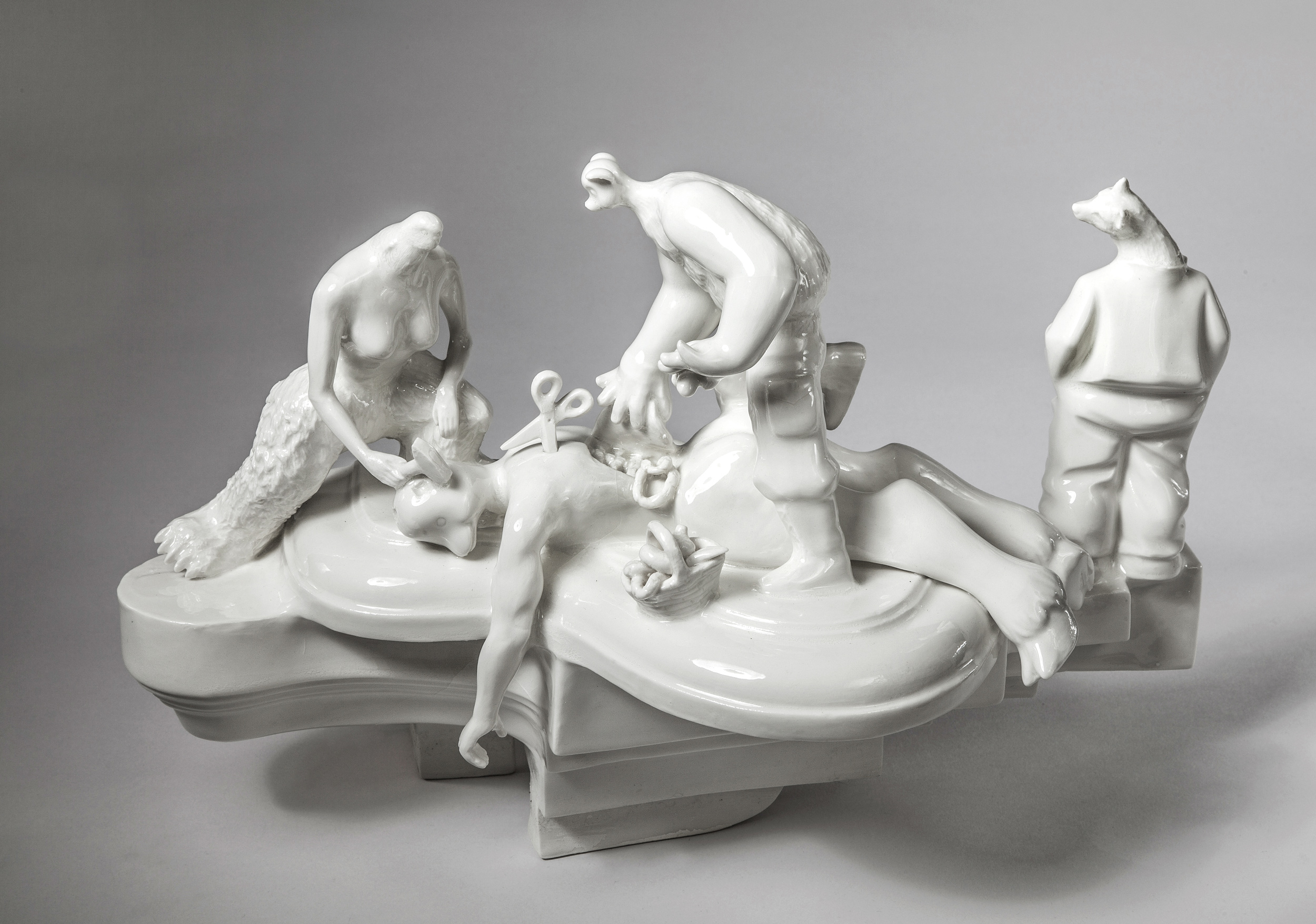
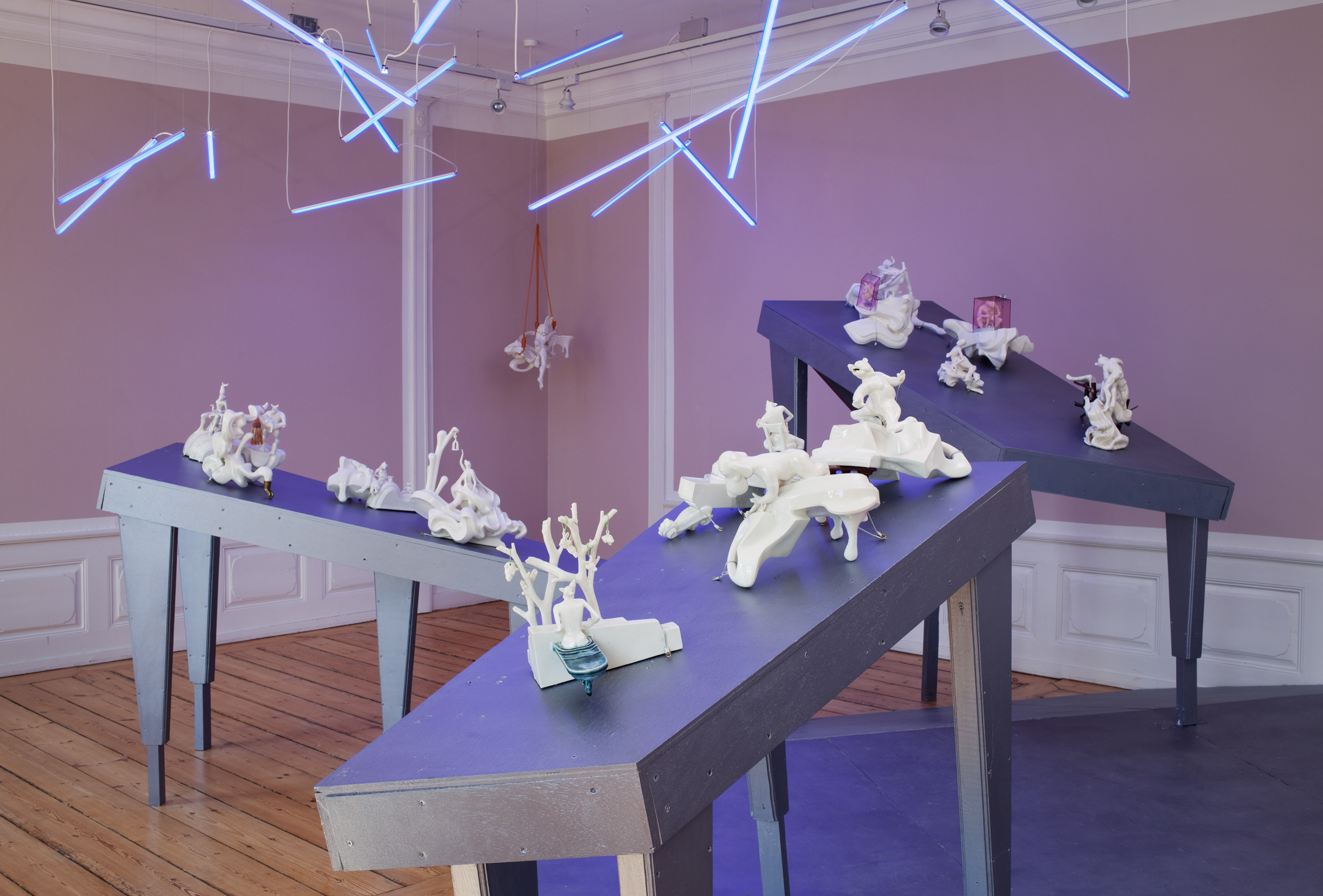
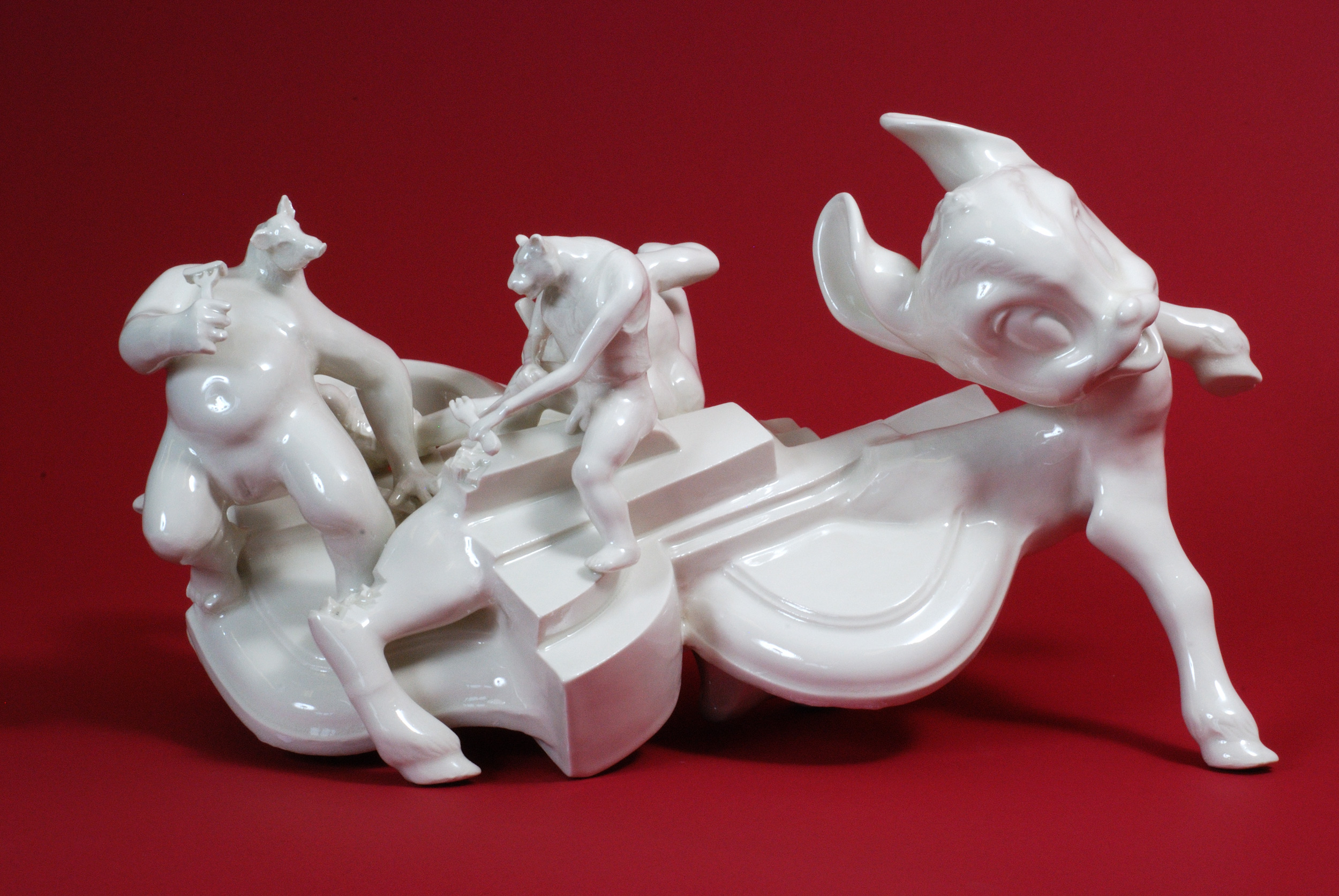
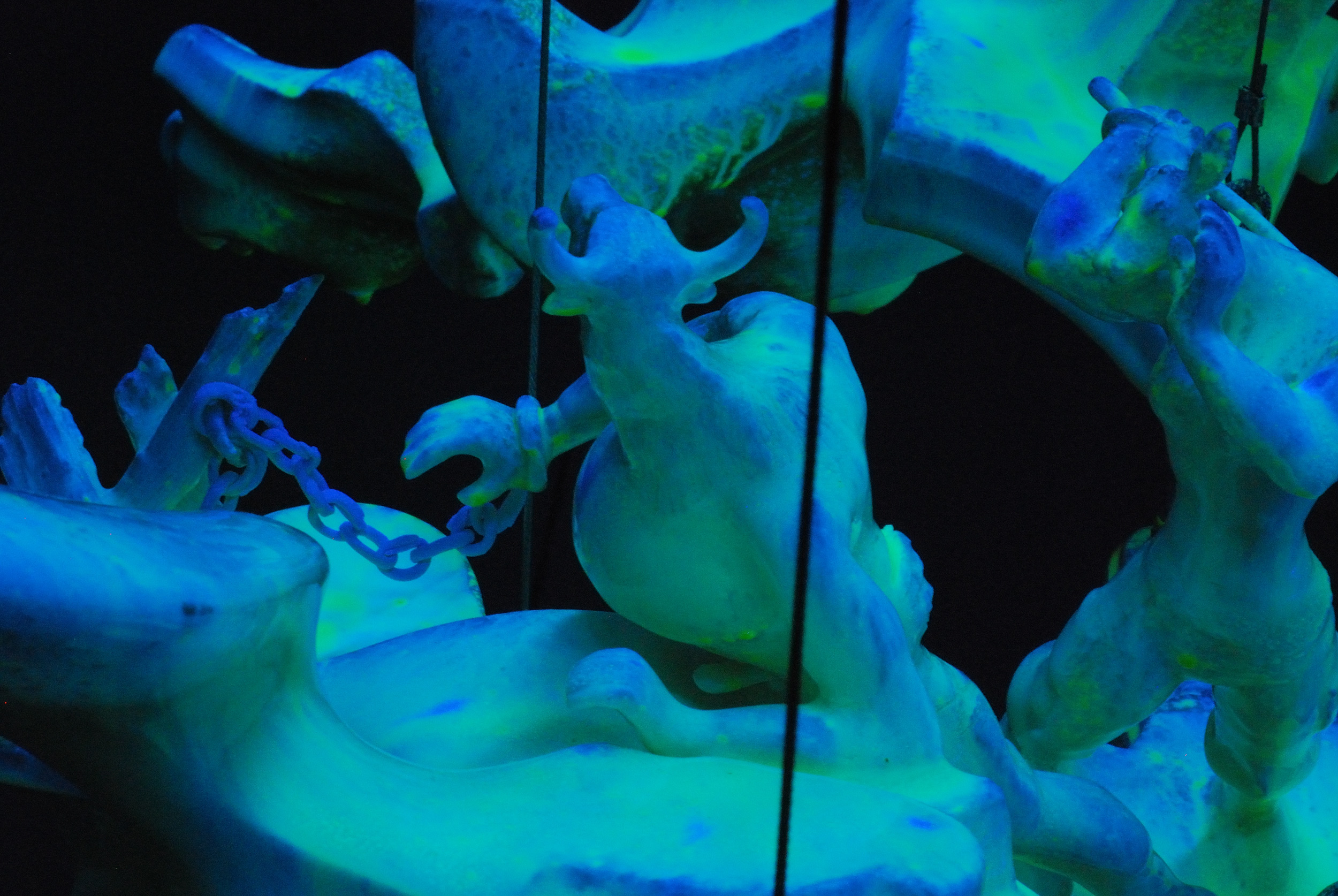
The Danish sculptor Louise Hindsgavl (born 1973, lives in Copenhagen) is known for hybrid figurines made of porcelain and glazed stoneware: half animal, half human. Only their material evokes the idealized and kitschy scenes traditionally rendered in porcelain; however, Hindsgavl’s “sculptural collisions” tell of disturbing encounters between tormented beast-like people. For that she draws from brutal folktales of the past as much as from the ubiquitous “fairytales” of today’s social media that normalize violence, sexual abuse, and self-harm. Using one of the most fragile materials, she brings these trends into focus for discussion, calling her sculptures Conversation Pieces—which is also the title of this interesting and provocative book.
You may also like…
-

Sebastian Stöhrer
Residents40€ Add to cartIf there’s an artist whose oeuvre merits the title “creation,” it is Sebastian Stöhrer. Shaping clay—essentially, soil—he molds his “residents”: colorful and friendly-looking sculptural beings, some of them enhanced with sticks or branches reminiscent of limbs. Despite their air of levity and humor, they are not the products of mere momentary inspiration or a whim. It takes decades of dedicated experimentation with the kiln based on the millennia-old art of ceramics as well as expert knowledge of chemistry and physics to create such colors and shapes. Stöhrer has been called an alchemist, and indeed he has made it his mission to vindicate this researcher’s craft, an ancestor of the natural sciences. Alchemy, like Stöhrer’s oeuvre, combines pure rationality with coincidence and a scintilla of magic. The artist plays an intuitive and sensual game with his clay and the virtually incalculable chromaticity of the glazes—chaos, anarchy, and irrepressible urges being an integral dimension of all creation. In Stöhrer’s “residents,” we encounter the embodiments of that creation: likenesses of ourselves and perhaps also heralds of a future more good-natured version.
-

René Holm
45€ Add to cartRené Holm goes for the big picture, painting the ambivalence of human existence and our relationship with nature. Some of his protagonists are physically naked, and all embody an interior life through their poses. The faceless figures function as screens onto which the beholders can project their own feelings, as symbols of universal human experiences. That is why, Holm notes, people very often recognize themselves in his protagonists. The effect is in part due to the forest, the setting of all pictures in this catalogue, which has been Holm’s studio and preferred backdrop for decades. It is where he finds the twilight that glows in all of our souls: woodlands nourish and menace us, they are home to helpful fairies and nasty demons, one can find life and death alike in them. He translates the sublime of the forest—a central motif in the Romantics—into a contemporary visual idiom. In his pursuit of this endeavor, he has recently ventured a radical aesthetic change: instead of using thick paints as before, he now applies the pigments to the canvas in thinner and drier layers. The book illustrates this spectacular fresh start, carrying us off into the depths of the soul and mysterious woodlands.


More books
-

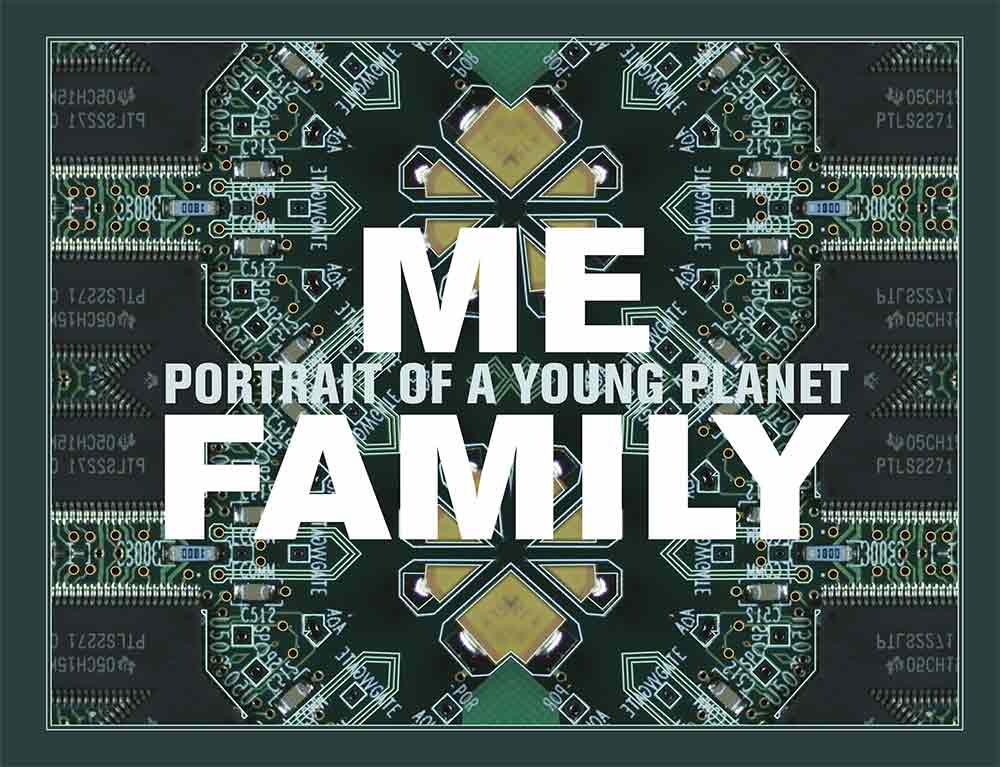
Me, Family
Portrait of a Young Planet40€ Add to cartA Journey Through Many Worlds
In these times of great uncertainty, the themes that surface in the works of the thirty-six international artists gathered in Me, Family are more relevant than ever. Compiled by Francesco Bonami with a nod to Edward Steichen’s historic exhibition The Family of Man, the volume paints a multifaceted portrait of humanity in the early decades of the twenty-first century. The original installation of photographs and excerpts from writers opened at the Museum of Modern Art in New York in 1955 and then went on a seven-year tour of one hundred and fifty museums all over the world. Matching the radicalism of Steichen’s conception, Me, Family presents works by contemporary artists who harness a wide range of media and genres to explore the ways in which humans today engage with their manifold coexistent histories and the diverse challenges they confront. Including reproductions of contemporary art as well as representations of social networks, fashions, information technologies, advertising, sound, music, and performances, the book captures a reality that is beautiful, dramatic, and intoxicating by turns. With writings by Roland Barthes, Francesco Bonami, Edward Steichen, and others.
With works by Lawrence Abu Hamdan, Doug Aitken, Sophia Al Maria, Yuri Ancarani, Darren Bader, Lara Baladi, Cao Fei, Cheng Ran, Clément Cogitore, István Csákány, Christian Falsnaes, Harun Farocki, Simon Fujiwara, Rainer Ganahl, Theaster Gates, Jack Goldstein, Andreas Gursky, Thomas Hirschhorn, Hassan Khan, Ga Ram Kim, Olia Lialina, Li Ming, Cristina Lucas, Karolina Markiewicz & Pascal Piron, Eva & Franco Mattes, Shirin Neshat, Philippe Parreno, Mario Pfeifer, Jon Rafman, Cindy Sherman, Marianna Simnett, Rudolf Stingel, Thomas Struth, Wolfgang Tillmans, Jordan Wolfson, Wong Ping, and Akram Zaatari.
-

Stefan Knauf
10€ Add to cartStefan Knauf (b. Munich, 1990; lives and works in Berlin) uses selected materials such as construction supplies or plants to investigate the histories of botany, migration, trade, science, and architecture and critique an idealized and anthropocentric conception of nature that is still prevalent. His sculptures, geometric-abstract pictures, and installations, with echoes of constructivism and minimal art, are contact zones in which everything is related to everything: human and non-human history, the natural and the artificial, ecology and ideology. Knauf’s works do not propose to unravel these entanglements. Rather, they suggest alternative perspectives and topographies guided by the idea of the “modified landscape” and devise material and alchemistic forms of knowledge and a novel and multiperspectival approach to the history and reality of the Anthropocene.
-

Silke Eva Kästner
Panta Rhei36€ Add to cartSilke Eva Kästner (lives and works in Berlin and Uckermark) developed her creative approach while traveling in India, New York, and Japan. She creates temporary on-site paintings as well as conceptual pieces in which the viewer comes upon prepared materials and becomes part of—or even alters—the picture. Kästner documents these encounters in photographs or filmic traces out of which she compiles films in the editing suite. Probing the potentials of painting as communication, she foregrounds the active intervention and process. In the gallery no less than the urban scene, Kästner places painting in relation to architecture in order to frame it in varying perspectives.
The monograph offers insight into the foci of Kästner’s art; the works are grouped in chapters rather than arranged in chronological sequence. This structure makes the book a space of experience that gives the reader a vivid sense of her ephemeral creations.
After studying with Katharina Grosse at the Weißensee School of Art and Design Berlin, Silke Eva Kästner won the Mart Stam Prize; she honed her craft in India on a NaFöG fellowship and in New York on a yearlong DAAD fellowship. Funding support from the Institut für Auslandsbeziehungen (ifa) enabled her to initiate an ongoing exchange project between Kashmir and Berlin. Her work has been on view at numerous institutions including the Schirn Kunsthalle Frankfurt; the Devi Art Foundation, Delhi; Berlinische Galerie, Berlin; the Queens Museum of Art, New York; Künstlerhaus Bethanien, Berlin; and the Haus der Kulturen der Welt, Berlin.
-

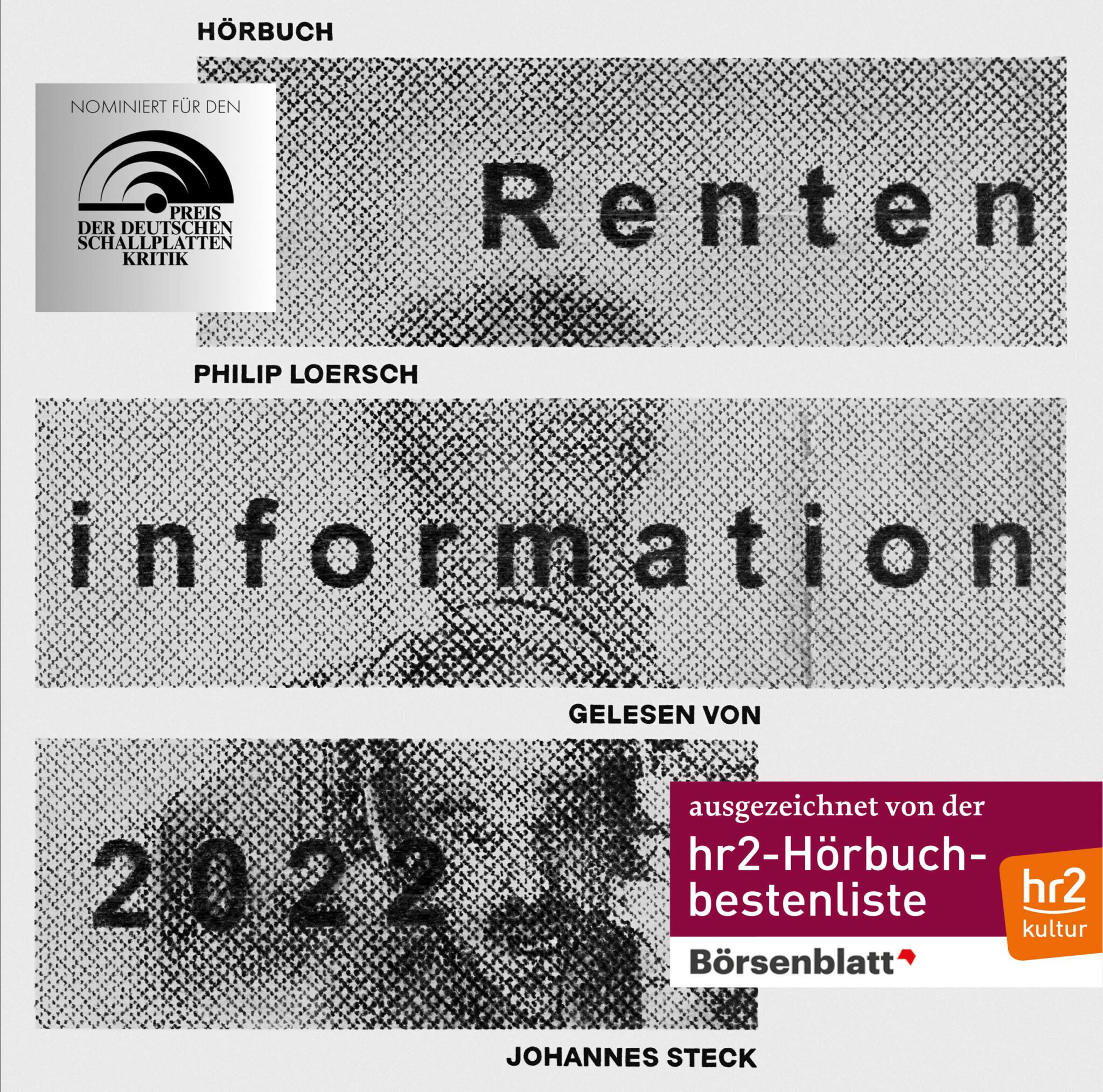
Philip Loersch
Renteninformation 202230€ Add to cartA satirical audiobook, read by Johannes Steck
with free download link on the inside
You’ve read right, and you’re going to hear it: a bureaucratic document—we’re all familiar with it, for a new one arrives every year—is the subject of this inspired collaboration between the graphic artist Philip Loersch and the virtuoso vocalist Johannes Steck.
The “Renteninformation”—an official letter on cheap paper informing the recipient about their expected future retirement benefits—makes many cultural workers, and others, crack up or break out in tears: arriving unexpectedly, it launches us on an emotional roller coaster between excitement, fascination, resignation, and sheer madness.
The manuscript for this audiobook is Loersch’s actual Renteninformation for 2022. Its intonation is the culmination of a series of works the artist has pursued since 2016. Every year, he has produced a naturalist colored-pencil drawing of his Renteninformation, embedding it in idyllic scenes—in the garden on a summer afternoon, amid autumn foliage, or on a frozen lake, delicately and accurately executed down to the smallest leaf of grass and the tiniest letter.
“Renteninformation 2022” is the ideal gift for all vinyl lovers who need to close a “pension gap” in their collections and a stunning audio experience that redefines what the satire of reality itself and conceptual art can do.
Philip Loersch (b. Aachen, 1980) is best known for his unconventional drawings. His works combine painstaking imitations of printed writing with hyperrealist colored-pencil drawings; for instance, he transfers pages from encyclopedias not only onto paper, but also onto three-dimensional objects such as soapstone. His art has been exhibited at renowned institutions such as Kunsthaus Zürich, Museum Kunstpalast Düsseldorf, and Hamburger Kunsthalle. He has won numerous fellowships and awards, including the Kunstpreis Berlin für Bildende Kunst, and helped initiate the exhibition series “Drawing Wow.”
Johannes Steck (b. Würzburg, 1966) is one of Germany’s best-known audiobook narrators, having sold over four million copies, including of books by Simon Beckett and Ken Follett, in a three-decade career. Television viewers also know his voice from trailers on Kabel 1 and DMAX and documentaries on ZDF, BR, and Sky. His work has garnered awards including the 2012 HörKules.
-

Martin Noël
The Retrospective38€ Add to cartThe Protagonist of the Modern Woodcut
The German painter, draftsman, and graphic artist Martin Noël (b. Berlin, 1956; d. Bonn, 2010) played a leading role in reviving the linocut and the woodcut, two techniques that had long been eclipsed by other media. In his large-format works on paper, he staked out a widely regarded and distinctive position in contemporary art. Noël was especially interested in the compositional relationship between line and surface. Released on occasion of the retrospective of his oeuvre at the Albertina, Vienna, this book presents an overview of the most important periods in the artist’s creative evolution, with an emphasis on the woodcut carved into the printing plate and the woodblock’s subsequent emancipation as an art object in its own right. Particular attention is paid to the application of ink to the surface and its painterly structure as well as the picture’s migration from object to canvas. The resulting paintings are exemplary of Noël’s late oeuvre.
Martin Noël studied graphic art and painting at what is now the Cologne University of Arts and Sciences. His art garnered numerous prizes and other honors, including fellowships from Kunststiftung NRW, Stiftung Kunstfonds, and Letter Stiftung. Works by Noël are in the German Federal Collection of Contemporary Art, Kunstsammlung Chemnitz, and the collection of Museum Pfalzgalerie Kaiserslautern.
-

Margret Eicher
Lob der Malkunst38€ Add to cartContemporary Visual Communication in a Historic Weaving Technique
Margret Eicher’s (b. Viersen, Germany, 1955; lives and works in Berlin) large-format tapestries combine the baroque form of the woven picture with familiar motifs excerpted from contemporary media images. She digitizes her sources and then assembles them in painstaking editing work on the computer. The resulting ‘media tapestries’ occupy the interface between the traditional work of art as a physical object and the electronic noise of the digital realm: two worlds that at first glance would seem to be incompatible yet find themselves in harmonious union in Eicher’s art. In Göttliche Liebe (Divine Love), for example, Caravaggio’s Crowning with Thorns meets a kissing gay couple from a pro-tolerance campaign in Berlin, while Botticelli’s Birth of Venus is sampled together with a subway station in Frankfurt. In conceptual art production, the creative idea is central and its realization becomes secondary; in a final twist, Lob der Malkunst (Praise of Painting) elects this practice as its artistic lodestar. Eicher installs the painter Martin Kippenberger in the interior of Berlin’s Paris Bar, where he poses as a dandy and presides over a clash between the different tendencies in the art of the twentieth and twenty-first centuries.
-
HALBwertsZeit
Zum Umgang mit ‚abgelaufenen‘ Sammlungen28€ Add to cartDo collections have an expiration date? Shifting interests, evolving social contexts, and discursive developments influence when a collection or its presentation is said to be outdated and what that implies for the constraints on, or options for, the actions to be taken in response. The revision or reorientation of a collection presuppose a critical engagement with the criteria regarded as valid at the time, which concern the origins, composition, objectives, and significance of a collection, among other aspects.
The contributions to this volume intertwine historical case studies with contemporary questions about the reasons and circumstances that give rise to the assessment that a collection has outlived its shelf life.
-

Martin Krumbholz
Alex, Martin und Ich14€ Add to cart“The Vocation of Saint Matthew”: that is the title that Martin Krug has chosen for his novella, after Caravaggio’s iconic painting at the Church of San Luigi degli Francesi in Rome. The irony is unmistakable—Martin, the protagonist of his narrative, hesitates to accept a promotion: he has been offered the job of his boss, for whose wife, Marion, he has fallen on a shared vacation. Yet Martin’s friend, whom he has asked for advice, proposes a different title: Ghost Story—a key element of the plot is the mysterious Alexander’s disappearance, seemingly forever, in the sea …
Martin’s friend and interlocutor, the novel’s first-person narrator, embeds the novella in a narrative framework that mirrors its motifs: love as passion, eros and sex, loyalty and betrayal, manliness and chivalry, art, film, and music. Alberto Moravia’s novel Contempt, glamorously adapted for the silver screen by Jean-Luc Godard, is reread and discussed as a MeToo story.
Martin Krumbholz (b. Wuppertal-Elberfeld, Germany, 1954; lives and works in Düsseldorf) is a writer and theater critic. His first novel, Eine kleine Passion, came out in 2013.
-

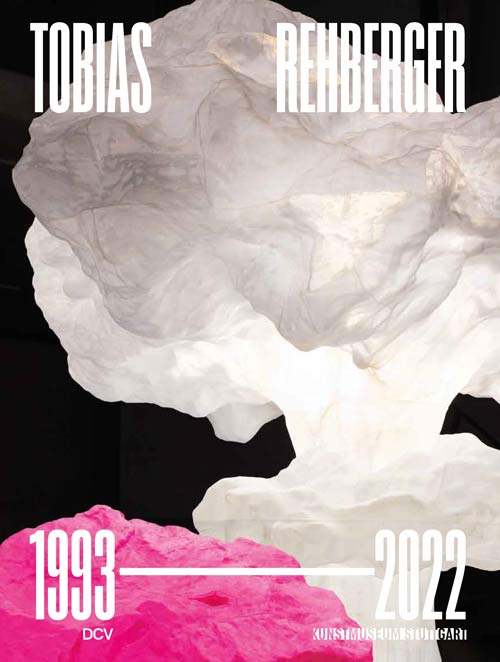
Tobias Rehberger
1993–202244€ Add to cartIn his sculptural work, Tobias Rehberger (b. Esslingen, 1966; lives and works in Frankfurt/Main) connects strategies from different, also non-art disciplines. His interiors meant to be taken into service have established him as one of the most influential artists of his generation. In 2022, the Kunstmuseum Stuttgart will honor Rehberger with a grand exhibition that will feature some of the most important bodies of work from the past three decades. The accompanying book makes a signal contribution to the ongoing critical engagement with his art.
Tobias Rehberger studied with Thomas Bayrle and Martin Kippenberger at the Städelschule in Frankfurt from 1987 until 1992 and later returned to his alma mater as a professor. He has had numerous solo shows in Germany and abroad and, in 2009, furnished the central cafeteria at the 53rd Venice Biennale, which won him a Golden Lion.
-

Ilit Azoulay
Facts and Tales. Truth be Told120€ Add to cartIn an era in which multiple perspectives and oral histories are increasingly vital, Facts and Tales—Truth Be Told delves into the haunting work of Ilit Azoulay. The artist, who was born in Jaffa in 1972, transforms objects, archives, and museum holdings into vessels, challenging traditional hierarchies of knowledge. In her most recent solo exhibition Mere Things at the Jewish Museum, New York, Azoulay presents works that probe the delicate balance between factual representation and nuanced storytelling.
The publication accompanying the exhibition includes archival pages, the artist’s notes, and depictions of the works as well as an introduction by curator Shira Backer and an essay by the art critic, curator, and writer Sarit Shapira, who passed away in 2018. Titled Houses of Junk and Specters: On Ilit Azoulay’s Early Works, it underscores the importance of honoring both factual accuracy and oral histories and invites readers to explore the complex interplay between concrete evidence and the rich and nuanced stories.
Azoulay has devised a singular method to shed light on the blanks in hegemonic narratives and expose them. As though to produce an extortion letter, she clips her pictures from archival materials and photographs of the walls of abandoned buildings and composes them in collages interweaving a multiplicity of views. The resulting works question the exclusive truth claim of museum expertise and reveal its constructed quality. The catalog of her works, designed as a box replete with texts and images, reflects this approach, aiming to dismantle established narratives and open up diverse perspectives.
Box containing 6 different standalone publications, limited edition of 500 copies
THIS PUBLICATION WAS MADE POSSIBLE BY THE GENEROUS SUPPORT OF THE GALLERY LOHAUS SOMINSKY, MUNICH
-
Felix Schramm
Things To Come44€ Add to cartFelix Schramm’s (b. Hamburg, 1970; lives and works in Düsseldorf) sculptural oeuvre reflects a probing engagement with space and the body. In works in a variety of media, including installations that intervene into a given setting, sculptures, and collages, the artist creates three-dimensional forms out of classical materials and industrial staples as well as detritus and dust. Deformations, rifts, cracks, or impurities undermine the existing order in his constructed formal ensembles, allowing novel correspondences in space and interconnections across time to emerge. The material and its subjection to form are held in a precarious balance; disintegration, which is an integral element of Schramm’s art, paves the way for artistic assertion and reformulation. The extensive publication gathers works and exhibitions of the past five years. It is Schramm’s first monograph, presenting a cross-section of his entire oeuvre with all bodies of work.
Felix Schramm studied at the Accademia di Belle Arti, Florence, from 1991 until 1993 and at the Academy of Fine Arts Düsseldorf, where he was in Jannis Kounellis’s master class, from 1994 until 1998. He rounded out his education with residencies in Tokyo in 2000 and at Villa Massimo in Rome in 2008.
-

FLATZ
Hitler. Ein Hundeleben18€ Add to cartAn Attempt to Break a Taboo – Trivial and Provocative
A black, pure-bred Great Dane named Hitler accompanied the Austrian performance artist and documenta participant FLATZ (b. 1952, Dornbirn; lives and works in Munich and London) like a shadow through the 1990s. The naming—as well as the subtitles of the photographs created—relates the banal everyday life of the dog to the inglorious life of its namesake, thus opening up an extremely provocative range of possible associations. “Hitler is always with me,” says the artist, “just as we always carry the historical Hitler around with us, because he is part of our history, which—as long as it is suppressed, transfigured, or tabooed—is not overcome.”
With more than 350 illustrations, Hitler. Ein Hundeleben is an extended and revised reprint of the book published in 1992, which has been out of print for a long time.
-
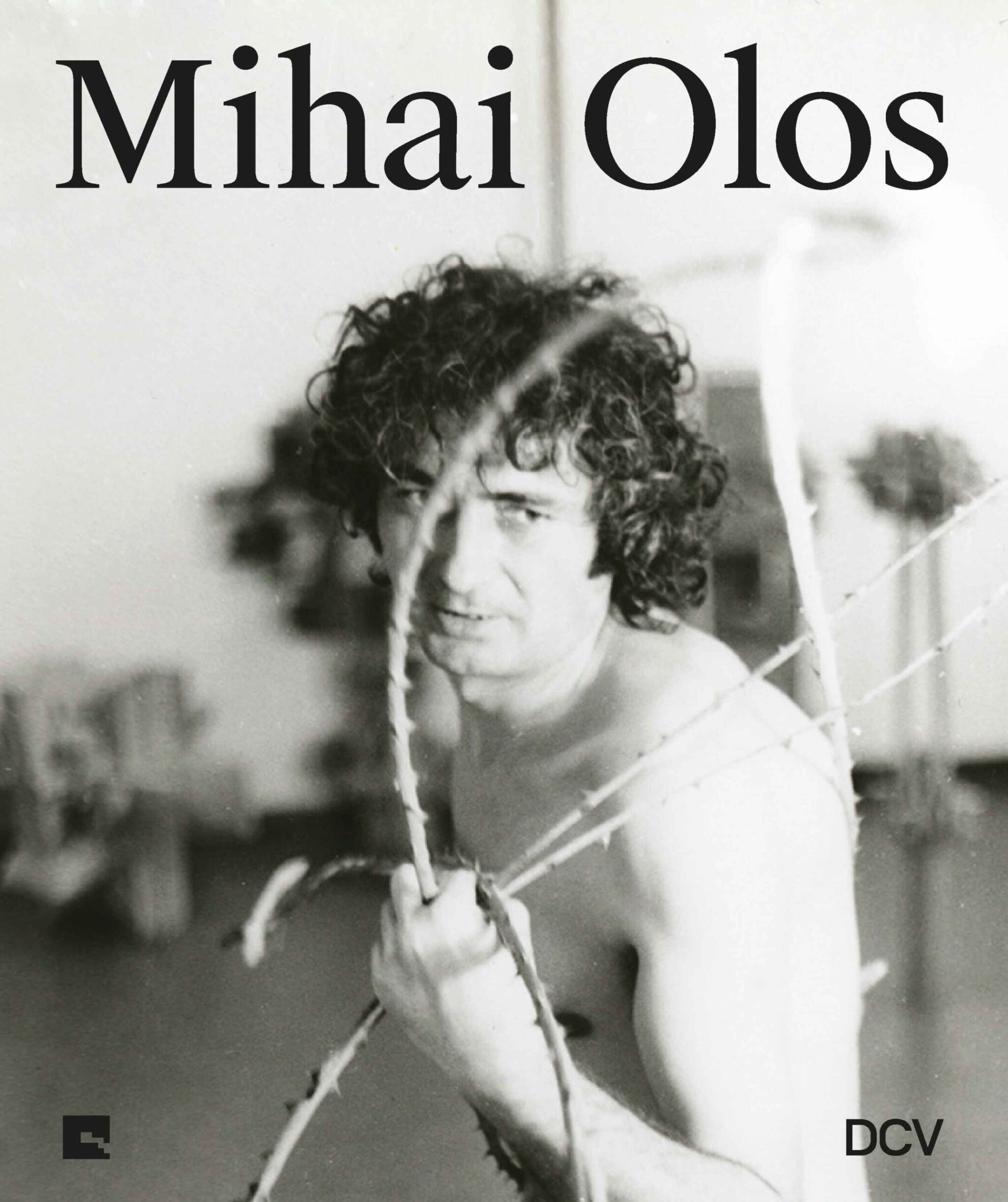
Mihai Olos
42€ Add to cartMihai Olos (b. Ariniș, Romania, 1940; d. Endingen am Kaiserstuhl, 2015) ranks among the most fascinating artists of the second half of the twentieth century. His adaptations of the formal vocabulary pioneered by Constantin Brâncuși are unrivaled in their creative originality. His works evince an utterly novel approach to the combination of materials from the culture of rural Romania with the visual strategies of modernism. His formidable oeuvre engages with conceptual and minimal art and comprises paintings, drawings, and sculptures, sometimes in the dimensions of land-art projects, as well as performances and poetry. Despite the constraints imposed by the communist system, his art and travels—during which he also met his kindred spirit Joseph Beuys—were dedicated to the unerring pursuit of his vision of social sculpture and radical utopian architecture.
-

Vera Mercer
New Works28€ Add to cartBeauty and Melancholy, Joie de Vivre and Vanity
The American photographer Vera Mercer’s (b. Berlin, 1936; lives and works in Omaha and Paris) oeuvre defies easy summary. She started taking pictures in Paris in the 1960s, making portraits of her then husband Daniel Spoerri—who, like she, was initially training as a dancer—and other members of the Fluxus group and Nouveaux Réalistes, including Emmett Williams and Robert Filiou, Jean Tinguely and Jacques Villeglé. Around the same time, she also photographed Andy Warhol and Marcel Duchamp for various magazines; her friends Eva Aeppli and Niki de Saint Phalle were among her favorite sitters.
In the 1970s, she took a long creative hiatus: after moving to Omaha, Nebraska, she poured all her energy into starting a number of restaurants and developing an entire downtown neighborhood. But then, in the early years of the new millennium, she returned to photography, capturing breathtaking neo-baroque still lifes featuring flowers, fruits, freshly killed game, antique glasses, and illuminating candles in large formats.
Vera Mercer’s fourth monograph presents her most recent opulent still lifes in color, as well as a novelty in her oeuvre: restrained black-and-white flower pictures and portraits realized as small-format platinum prints.
-
Mirror
Collaborative Pictures by Merrick d’Arcy–Irvine x Julia Bajanova40€ Add to cartWe humans are social creatures. Without others to reflect our behavior back to us, we lose what defines us—language, culture, the capacity for creative expression. That is why photographer Merrick d’Arcy-Irvine and fashion designer Julia Bajanova are invested in intense encounters: not only with the people who appear in their pictures, but also with each other, as artists and as humans, and between their media and the materials out of which they are made. The materiality and sensual experience of these media in the physical world are the focus of the pictures gathered in this volume, which is why d’Arcy-Irvine and Bajanova eschewed all digital technologies. Sensuality forges an emotional bond between their creative universes, whose boundaries become permeable, as do the dividing lines between genres. Colors and forms are fused in a shared language of visual art and fashion in which d’Arcy-Irvine and Bajanova write their messages in light on photographic paper. They speak to what makes us human: creative energies untrammelled by the necessities of everyday life. The pictures in Mirror, then, are reflections of our existence and portals of self-knowledge.
-

Peter Hermann
Skulpturen24€ Add to cartDefying the Classical Canon
The figures of Peter Hermann (b. 1962, Bietigheim; lives and works in Ludwigsburg) stand and gaze. Made of limewood or bronze, his sculptures are precisely crafted in the manner of the old masters and thus stand in opposition to other contemporary positions. Nevertheless, in their static severity, their shortened and slightly caricatured limbs, and with a certain irony that accompanies this, they also defy the classical canon of figurative sculpture. Peter Hermann finds his themes in everyday life and succeeds in letting this apparent everydayness vibrate further in the encounter between the artwork and the viewer.
-

Sinje Dillenkofer
Archives Vivantes34€ Add to cartSinje Dillenkofer’s (b. Neustadt a.d.W., 1959) body of work ARCHIVES VIVANTES inquires into the idea of the “archive,” harnessing the means of visual art to allow us to see and perceive what the archive does not reveal. With staged photographs that combine conceptual rigor with a wide spectrum of creative techniques and devices, Dillenkofer’s pictorial essay turns the spotlight on specimens, artifacts, graphic art, and writings compiled by the explorer and naturalist Alexander von Humboldt (1769–1859) and the ornithologist Carlo von Erlanger (1872–1904). Examining the archive as a model of nature and reality as well as a mirror of “human nature,” the artist develops compositional ideas inspired by the peculiar features of the objects in the collections in visual analogies, pictorial spaces, and spatial compositions. Animals and plants that died long ago “in the service of science” are vividly embodied through the distinctive use of light and shadow. The resulting pictures consider the archive in a new context, framed by our complex relationships with nature, humankind, society and its values and ideals, circumstances and constellations of power. The pictures were taken in six German collection archives: at the Museum bei der Kaiserpfalz Ingelheim, the Naturhistorisches Museum Mainz, the Senckenberg Forschungsinstitut und Naturmuseum Frankfurt, the Stadtmuseum Berlin, and the Stuttgart State Museum of Natural History. Dillenkofer was the first artist to be invited by the Berlin State Library—Prussian Cultural Heritage to translate Humboldt’s American travel diaries into art.
Sinje Dillenkofer studied at the Stuttgart State Academy of Art and Design and has taught at universities and art academies. Her work is held by the Victoria & Albert Museum in London, the ZKM | Center for Art and Media Karlsruhe, the Staatsgalerie Stuttgart, and the Berlinische Galerie, among others.
-

Was ist Wiener Aktionismus?
50€ Add to cartBlows were dealt. An artist exposed and cut himself, others urinated in glasses, daubed themselves with dirt, and masturbated over the Austrian flag. Meanwhile, music was playing, including the national anthem; someone read pornographic writings. Vienna in the late 1960s: what had started in the artists’ homes and studios was now brough out on the grand stage, and taboos were broken in full view of the public.
The Vienna Actionism Museum’s first publication is dedicated to the idea of Vienna Actionism in the dynamic context of abstract realism, Fluxus, and the international Happening scene. The book relates the story of one of art history’s most influential art movements, spearheaded by the Actionists Günter Brus and Otto Muehl, Hermann Nitsch and Rudolf Schwarzkogler.
-

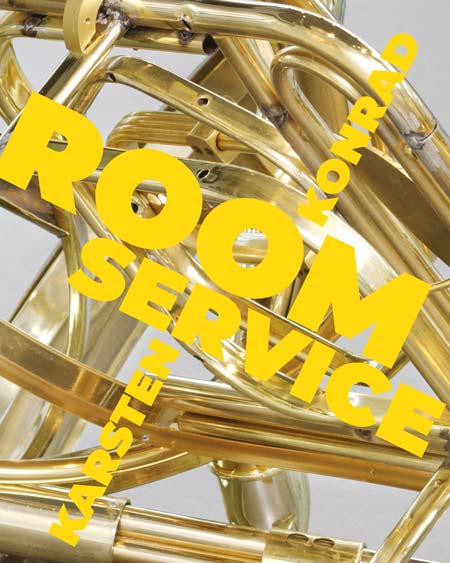
Karsten Konrad
Room Service42€ Add to cartThe Visual Archeologist
Objets trouvés, used designer objects, and discarded furniture are the defining elements of the sculptor Karsten Konrad’s (b. Würzburg, 1962; lives and works in Berlin) material poetics. Not unlike the Dadaist or Surrealist readymade, the works that Konrad has made since the 1990s transform these “disregarded things” into sculptures, immersive installations, reliefs, and collages. Detecting the faint traces that anonymous consumers have left on the secondhand stuff, he unfolds an archaeology of the present. Konrad’s first monograph in a decade offers comprehensive insight into an oeuvre that throws the marginal into relief and questions the destructive impact of unbridled consumerism.
Karsten Konrad studied at Johannes-Gutenberg-Universität, Mainz, and the Royal College of Art, London. He has been professor of sculpture at the Universität der Künste in Berlin since 2016. His works are held, amongst others, by the Bundeskunstsammlung Bonn and the Margulies Collection, Miami.
Each copy is hand-signed by the artist on the spine.
-

Cahier #1
Heinz Gappmayr22€ Add to cartDo we think in images or in language? Can writing visualize time? Heinz Gappmayr (1925-2010) was interested in text as a spatial event and in letters as architecture. Although his works were often presented in the context of Visual Poetry, Gappmayr himself preferred the more neutral term text to lyricism. His understanding of written language as a conceptual medium and typography as an indicator of physicality was closer to Lawrence Weiner’s approach than to that of the Concrete Poets. This volume accompanies an exhibition at the Tiroler Landesmuseum and includes Gappmayer’s most important art-in-architecture projects, as well as a complete notebook from 1961, with commentary by Gaby Gappmayr, the artist’s daughter. A conversation with her provides valuable philosophical insights into her father’s work.