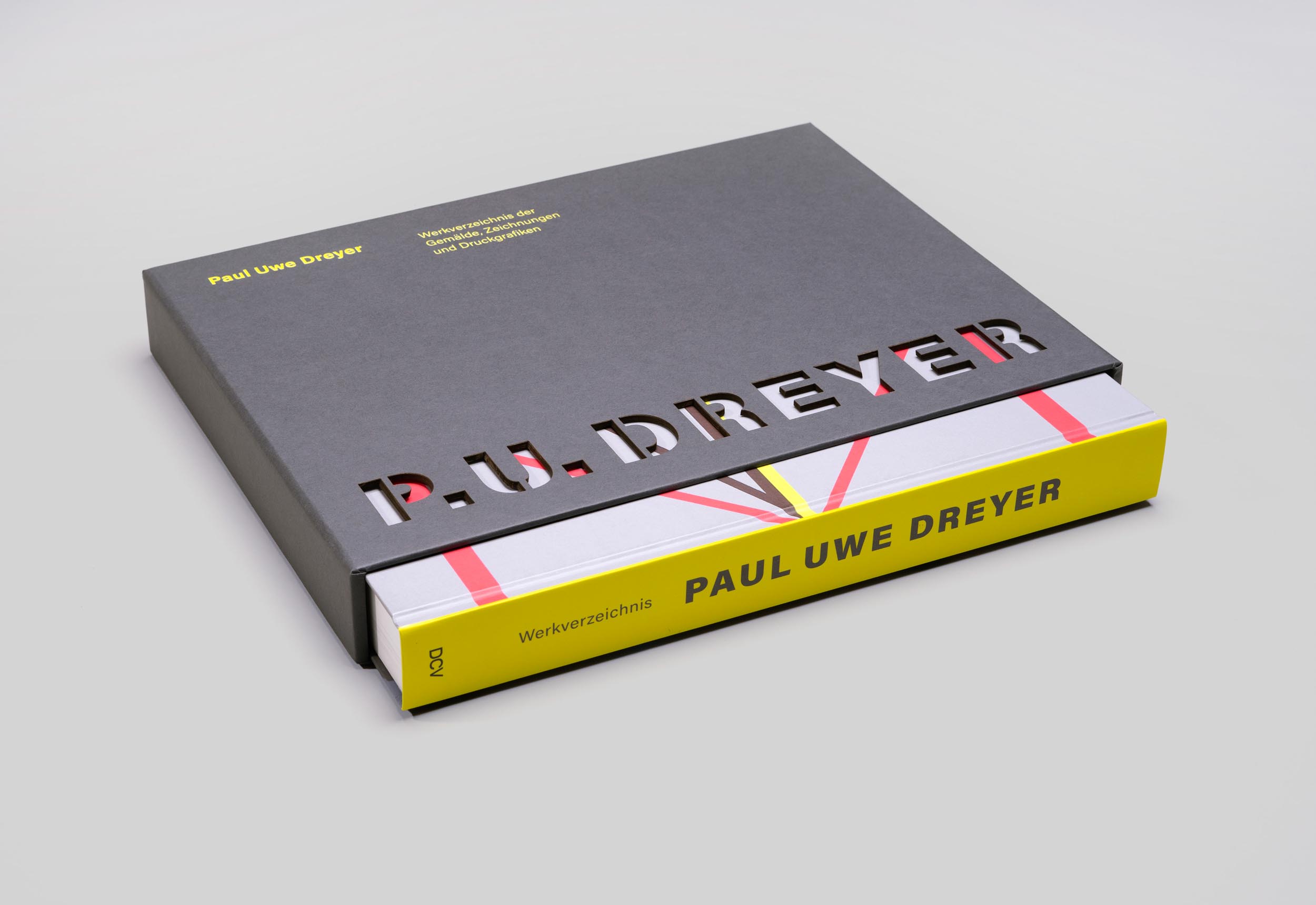
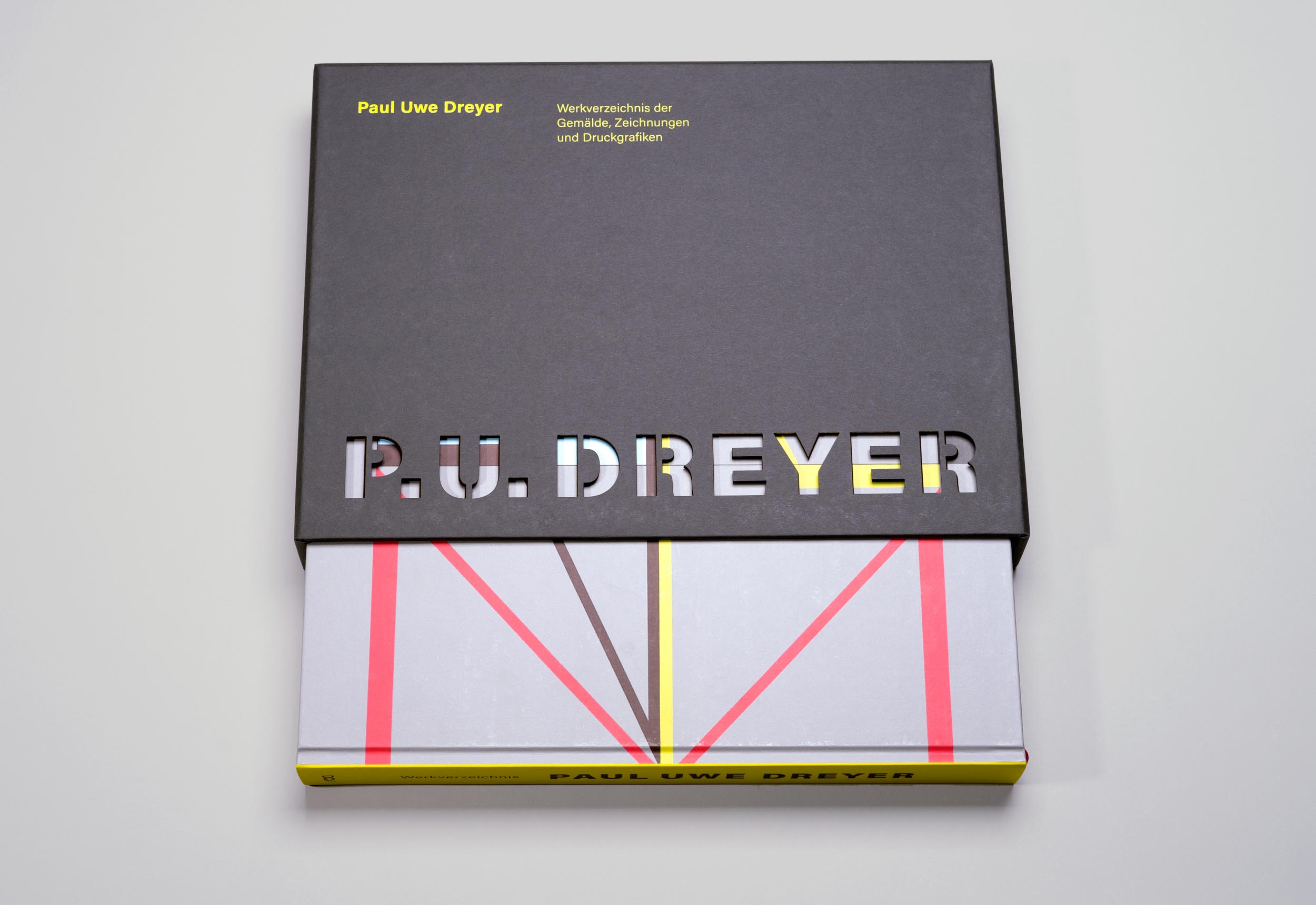
Paul Uwe Dreyer
Werkverzeichnis der Gemälde, Zeichnungen und Druckgrafiken
 | |
|---|---|
| Editor(s) | Anja Rumig |
| Author(s) | Andreas Baur, Anja Rumig, Bernhard Kerber, Dorit Schäfer, Heinz Fuchs, Holger Kube Ventura, Reinhard Döhl, Simone Schimpf, Ulrike Gauss |
| Design | Nathalie Baumann |
| Cover | Hardcover in slipcase with die-cut |
| Size | 32 × 24,5 cm |
| Pages | 384 |
| Illustrations | 670 color and 30 b/w |
| Language(s) | English, German |
| ISBN | 978-3-947563-71-5 | Release September 2021 |
A Painter, Draftsman, and Draftsman of Concrete Art
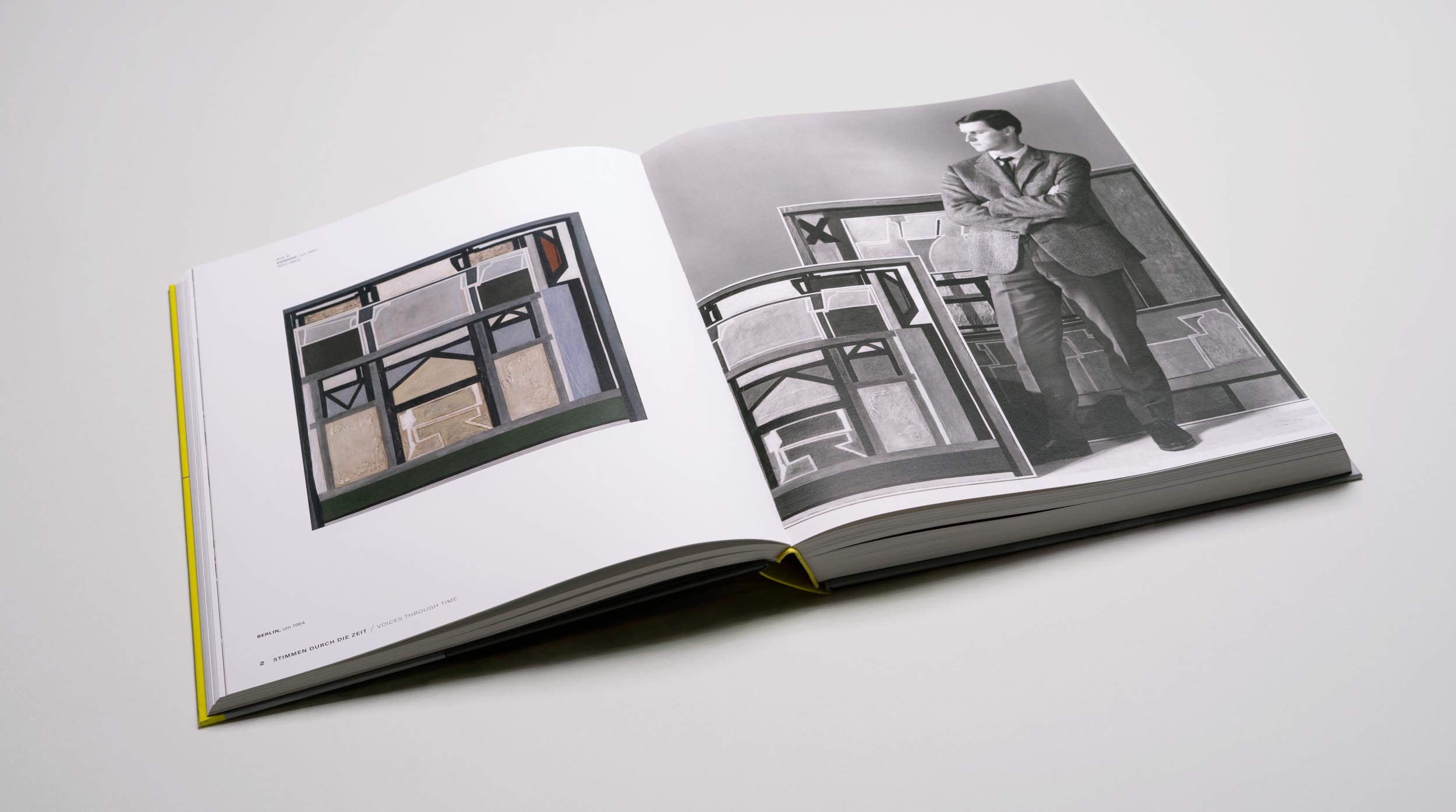
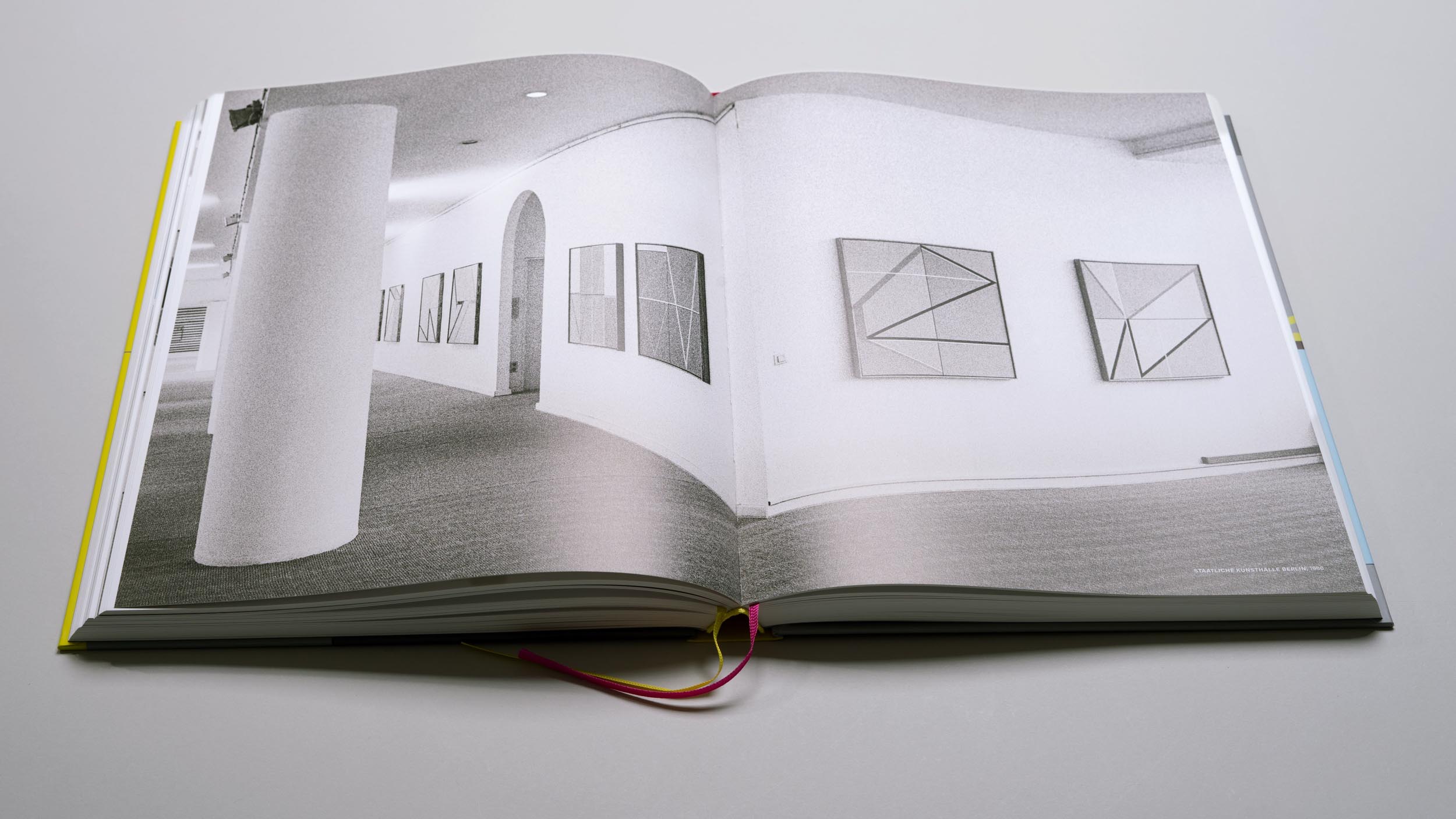
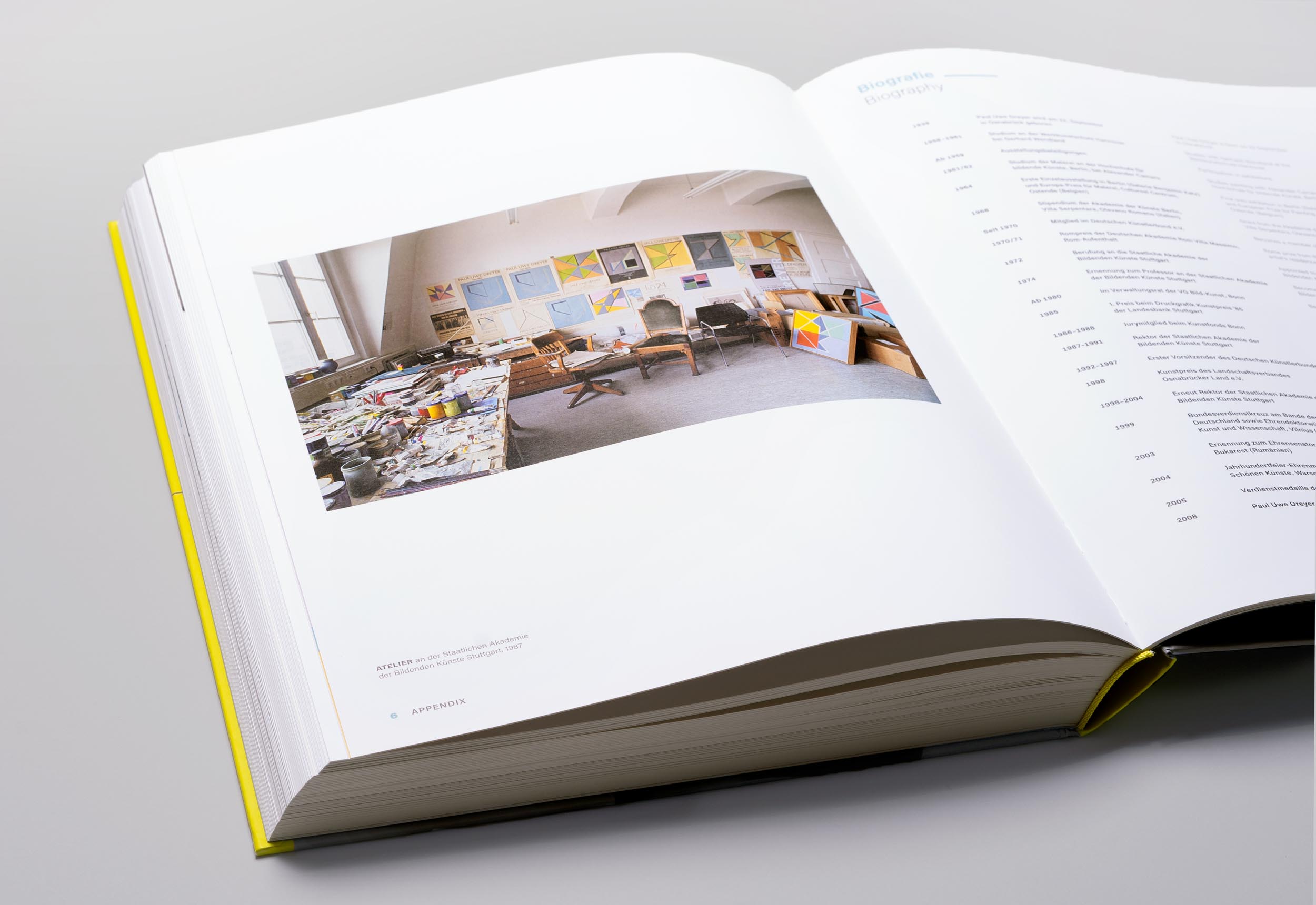
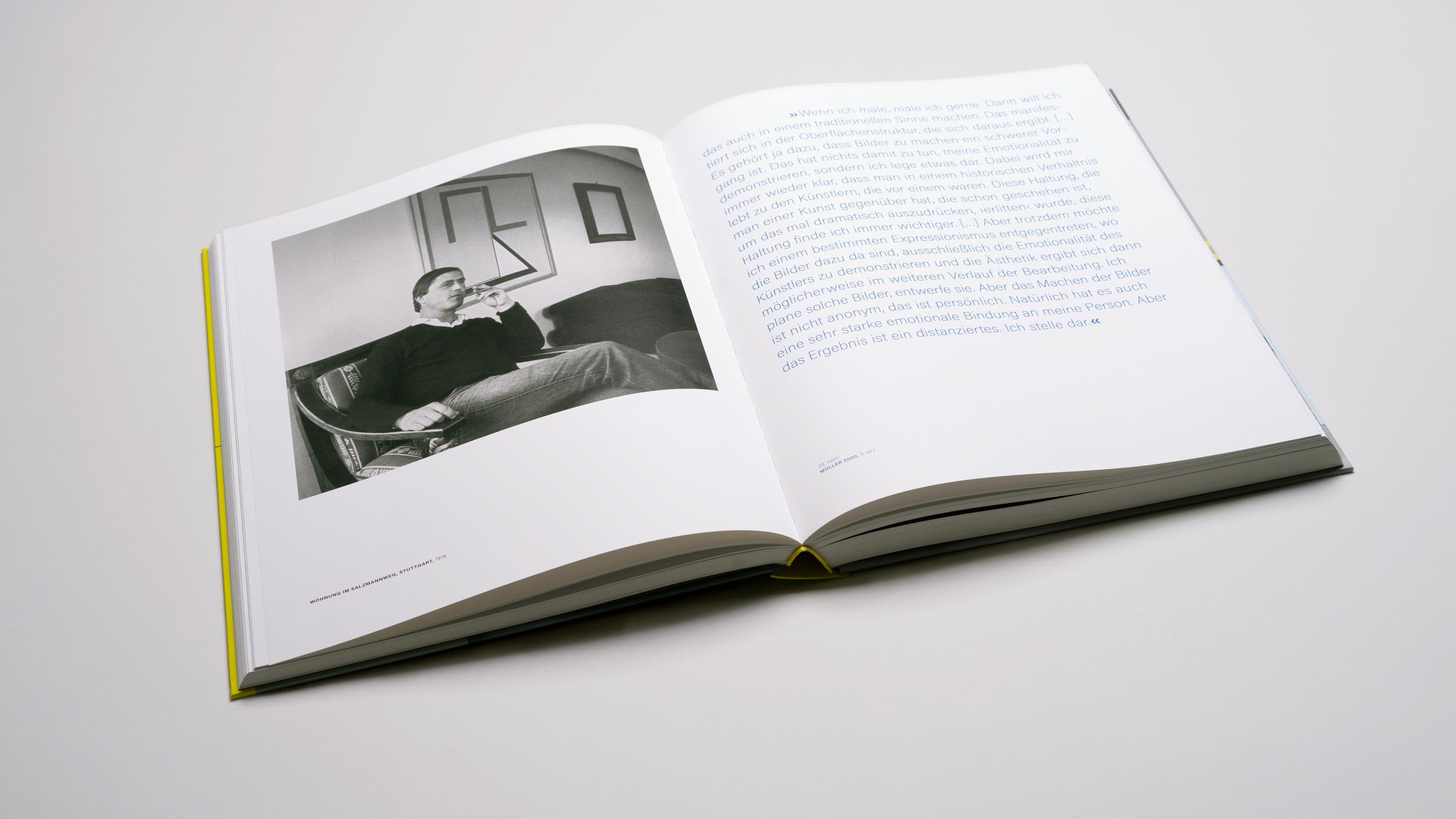
Paul Uwe Dreyer (b. 1939, Osnabrück; d. 2008, Stuttgart) taught painting as a professor at the Staatliche Akademie der Bildenden Künste Stuttgart for more than three decades. His oeuvre shows the hallmarks of geometric constructive art: inspired by subjective experiences of reality, Dreyer’s compositions visualize the dialectics of organizing principles and their potentials for variation, a guiding interest that is already evident in his early work since the 1960s and especially in the pairs and series of pictures he begins creating in the early 1970s. His art unfolds a fascinatingly dynamic yet nonhierarchical dialogue between colors, surfaces, and lines. The chronological catalogue raisonné reveals the consistency with which motifs evolve from his early to his late oeuvre, from architectural, figural, and ornamental tokens through elements resembling symbols and icons to complex penetrations of spaces.
Release September 2021
More books
-

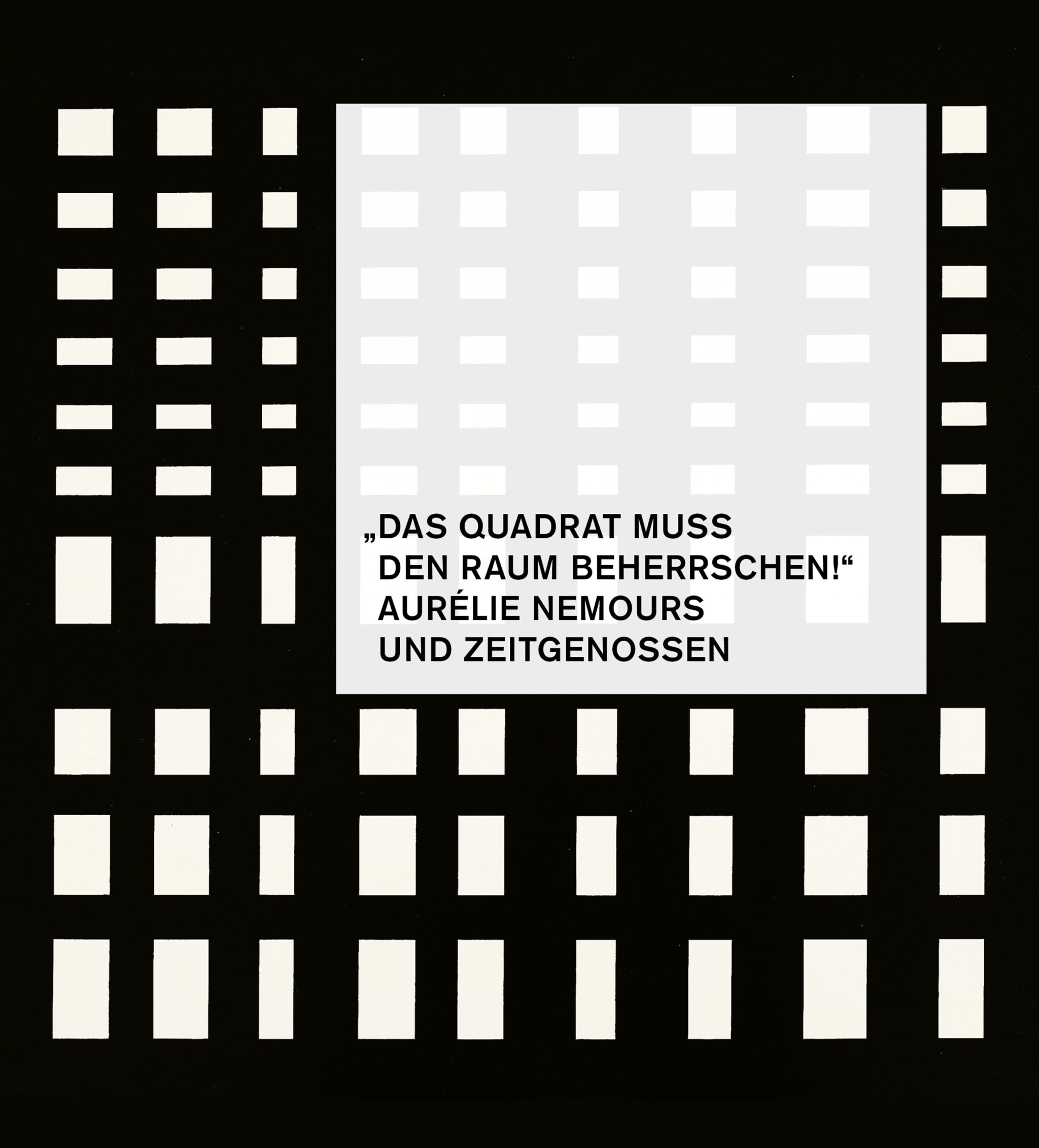
“Das Quadrat muss den Raum beherrschen!”
Aurélie Nemours und Zeitgenossen15€ Add to cartDoes everything in the world obey a mathematical logic, can everything be calculated? In our present age of probability, some would say the answer is a straightforward yes, inevitably prompting the question: Even art? Yes, even art, or so the defenders of Concrete Art would respond, a twentieth-century movement that took abstraction as a focus on the “idea of art itself” (W. Kandinsky) to the next level. The act of painting was now to be subject to preconceived organizing principles as though they were laws of nature. One prominent exponent of the genre was Aurélie Nemours (1910–2005), who had a penchant for the square; her credo was that it needed to “rule space.” That is why the equilateral quadrangle is the defining shape in this catalog, which brings Nemours’ oeuvre into focus. Her iconic position is flanked by works by seventeen others that similarly grapple with the square, including pictures and sculptures with square basic forms, grids, or canvases. All these works derive their force from the stern authority of the square: only when art constrains its means can it bring its full potential to bear.
ARTISTS:
JOSEF ALBERS, GÖTZ ARNDT, MAX BILL, AD DEKKERS, HELMUT FEDERLE, GOTTFRIED HONEGGER, KATHRIN KAPS, FRITZ KLINGBEIL, JOHN MEYER, GEROLD MILLER, AURÉLIE NEMOURS, JOHN NIXON, PETER ROEHR, JAN SCHOONHOVEN, ANTON STANKOWSKI, KLAUS STAUDT, HERMAN DE VRIES, GERHARD WITTNER -

Pieter Slagboom
Scent of Hypnosis42€ Add to cartPieter Slagboom’s drawings are about life and death. About how these ostensible antagonists are inseparable; how, in his imagination, they are even fused. In his enormous canvases, we are held by the essence of our existence as though by a steel vise: we come from the void and in the end shall return to it. Thousands upon thousands of sweeping lines, twisting like Moebius strips, make for an almost physical experience of this truth. The dead and the newborn emerge from the primeval soup of Slagboom’s lines, as do genitals; we spot larger-than-life fantasies of disturbing sexual acts. The circle of life as a short circuit. The energy of some of the pictures in Slagboom’s oeuvre is almost too much to bear—we shudder before the pigments materializing our latent knowledge: that death is suspended in life.
- Out of stock

Soulages
Malerei 1946–201942€ Read more“I paint not with black but with light.”
Pierre Soulages (b. Rodez, France, 1919; lives and works in Paris and Sète, France) is an eminent figure in abstract painting. A member of the Nouvelle École de Paris, he developed his first nonobjective pictures early on, in 1946, putting bars of bold color, typically black, on white grounds. His embrace of total non-representationality, an art that depicts nothing, that stands for nothing but itself, amounted to a radical challenge to the traditional values of painting. In 1979, his work entered a new phase, a painting he calls “outrenoir” or “beyond black.” Soulages now occupies a singular position, and not only by virtue of his choice of materials such as walnut stain and tar and implements like scrubbers, iron hooks, and spatulas. The book documents the arc of his oeuvre from his beginnings after World War II to the present. Illustrating the evolution of his art, it shows how he remained true to his creative vision, a consistency that is doubly imposing given the extraordinary length of his career.
Pierre Soulages studied at the École Régionale des Beaux-Arts, Montpellier, before moving to Paris in 1946. He contributed work to documentas I, II, and III and the 26th Biennale di Venezia. His work has been shown at the Museum of Fine Arts, Houston; the Hermitage Museum, Saint Petersburg; the Musée du Louvre and the Centre Pompidou, Paris; and the Musée Fabre, Montpellier. The Musée Soulages in his native Rodez opened in 2014.
-

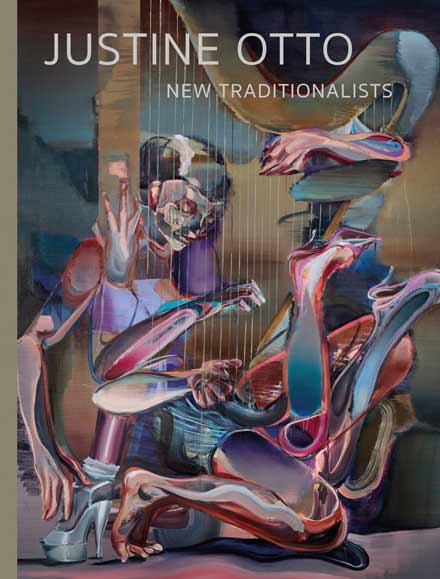
Justine Otto
New Traditionalists38€ Add to cartJustine Otto (b. Zabrze, Poland, 1974; lives and works in Hamburg and Berlin) is one of the most promising artists on the contemporary painting scene. An aficionado of the absurd, she unfolds a metaphysical-psychedelic and often gaudily lustrous cosmos in pictures in which representation clashes with abstraction. In her early work, girls, women, and animals were here preferred subjects; more recently, she has painted heroes—the protagonists in myths of masculinity. After generals, officers, and strategists, she has now turned her attention to cowboys, who appear on horseback or resting under a tree, musical instrument in hand.
Justine Otto studied fine art and painting with Peter Angermann and Michael Krebber at the State Academy of Fine Arts (Städelschule) in Frankfurt am Main and obtained an MFA in 2003. She also worked as a scene designer at Städtische Bühnen Frankfurt, the city’s municipal theater company. Her paintings are held by collections including the Hessisches Landesmuseum, Darmstadt; Museum Franz Gertsch, Burgdorf, Switzerland; and the Phillips Collection, Washington, D.C.
-
Michelle Jezierski
Verge28€ Add to cartHow does a simple line become a horizon? When do we begin to see colors and shapes as a landscape? Michelle Jezierski’s painting homes in on the tipping point at which our perception begins to oscillate between color/surface and space/representation. At that very point, she captures the essence of the landscape as such, which is not a concrete place but a metaphor for inner states of affairs. To get there, Jezierski distills what she sees in her surroundings down to the elements of painting—shapes and colors—which just barely intimate a pictorial space while persistently drifting toward abstraction. The defining feature of her technique is that she layers several pictorial planes and spaces on the canvas in staggered arrangements. “Perpetually discovering new ways to unsettle the visual space,” as she puts it, she engenders ruptures and structures that open up multiple perspectives and a portal for reflection on one’s own perception. Above all, however, the cuts lend her pictures a peculiar rhythm that powerfully pulls in the gaze, making the reader paging through this catalogue forget time and space.
-

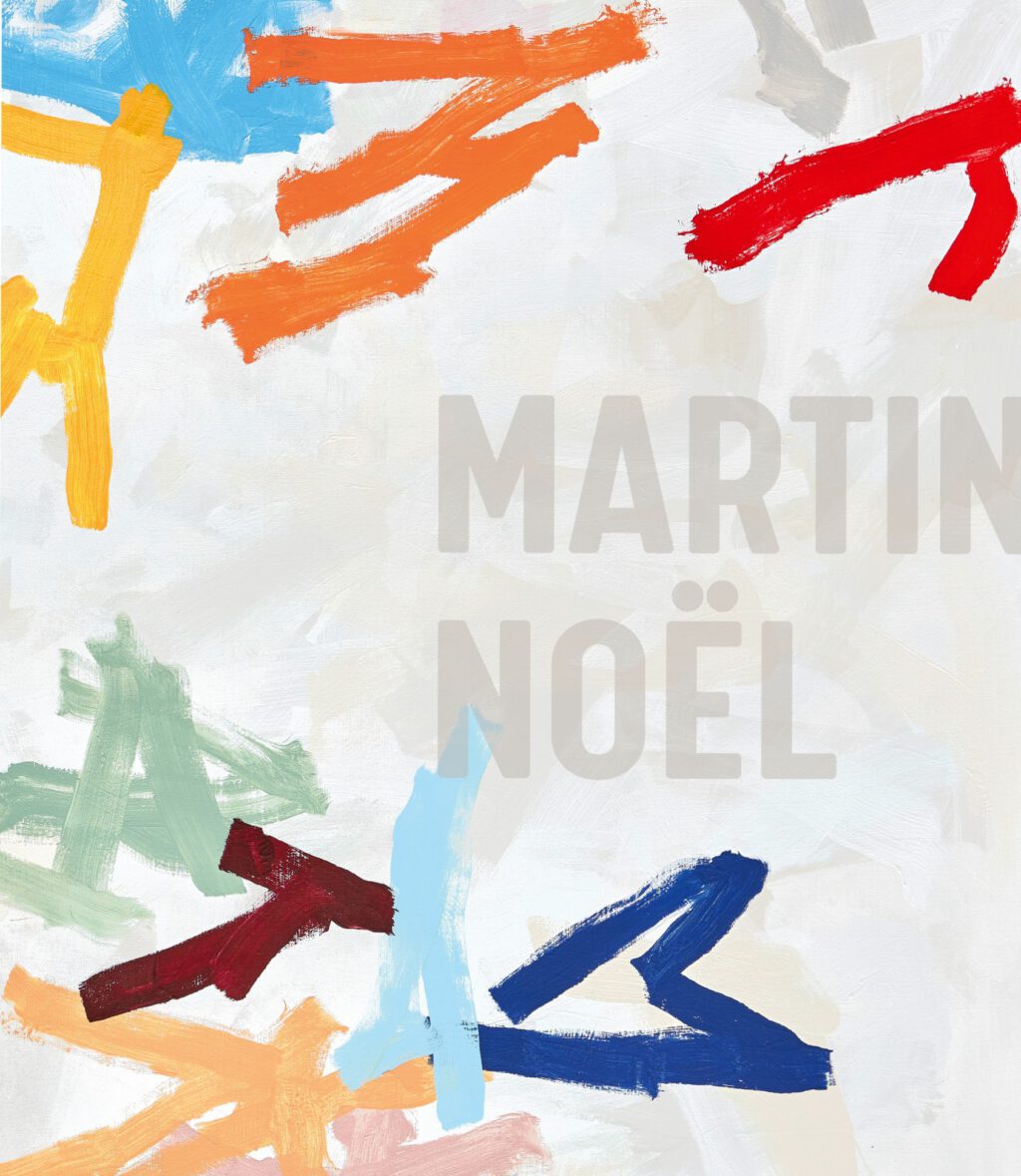
Martin Noël
paintprintpaint35€ Add to cartA Comprehensive Overview on the tenth Anniversary of the Death of Martin Noël
Martin Noël (b. 1956, Berlin; d. 2010, Bonn) was a German painter, draftsman, and printmaker. He was one of the formative innovators of the long-neglected techniques of linocut and woodcut. With his large-format works on paper, he created a position for himself in contemporary art that is as much respected as it is independent. On the occasion of the tenth anniversary of the artist’s death, this volume presents a comprehensive overview of his work from the mid-1980s to the last year of his life in 2010. Thirty-five exceptional works document Noël’s path from his early years as a painter, via the middle phase marked by printing blocks, linocuts and woodcuts, up to his late paintings.
Martin Noël studied Graphics and Painting at the Rheinische Fachhochschule Köln, Cologne. His works are included in, among others, the Federal Collection of Contemporary Art, the Kunstsammlungen Chemnitz, and the collection of the Museum Pfalzgalerie Kaiserslautern.
- Out of stock

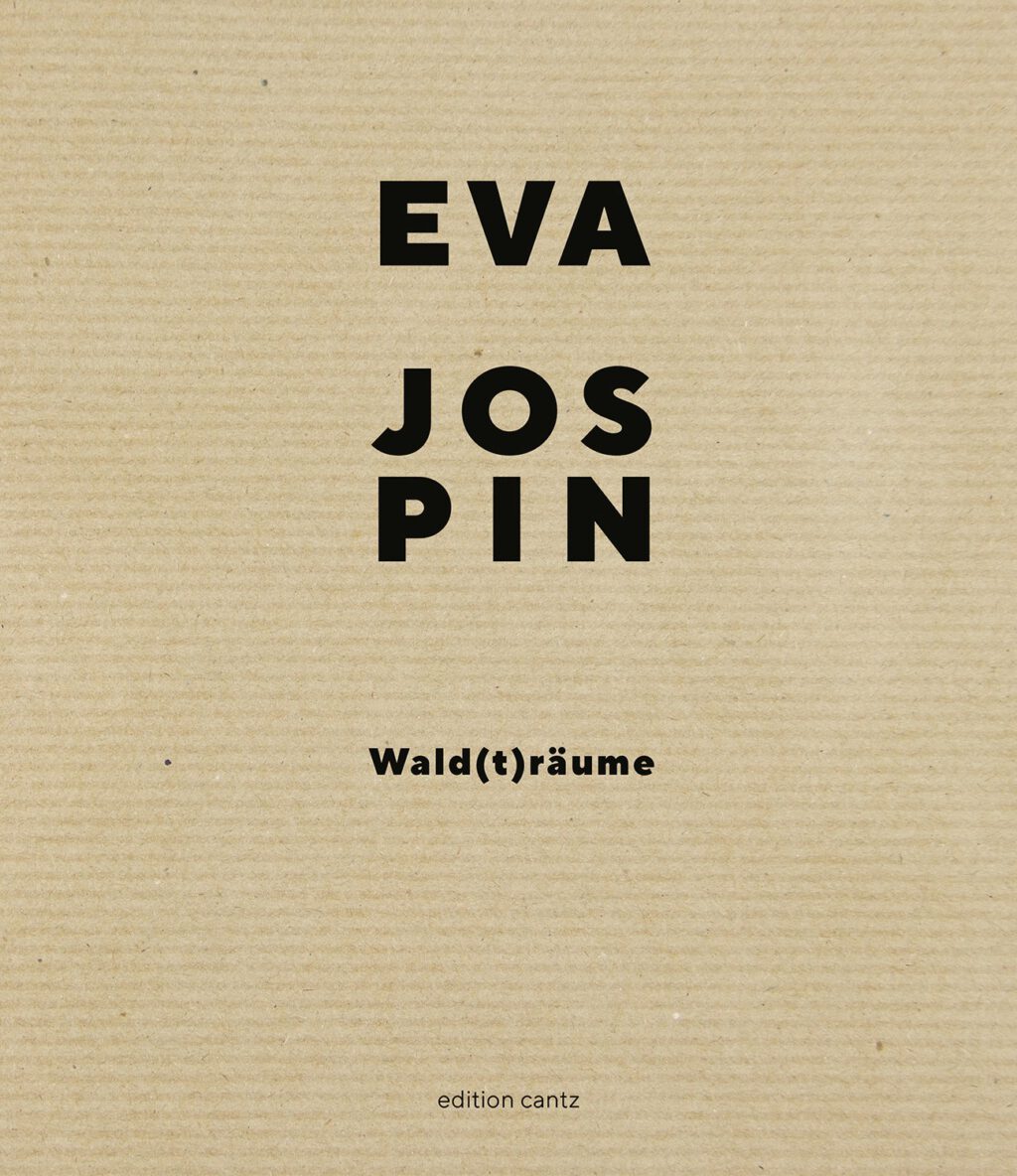
Eva Jospin
Wald(t)räume22€ Read moreThe Forest as a Place of Longing: Eva Jospin’s Magical Corrugated Cardboard Sculptures
The French artist Eva Jospin (b. 1975, Paris; lives and works in Paris) cuts and layers corrugated cardboard to create sculptures and reliefs. Handcraft and precision are essential aspects of her work. The artist retains the original color of the cardboard, since, for her, the material itself already contains sufficient color variations and nuances. The recurring motif is the forest — consisting of numerous trunks, branches, and twigs in extreme density and interspersed with black shadows. They suggest depth and stimulate the viewer’s imagination. Eva Jospin does not reproduce nature one to one, but conveys the feelings of fear, anarchy, or freedom that it triggers: The forest as a universal place of longing.
- With socks designed by the artist and augmented reality

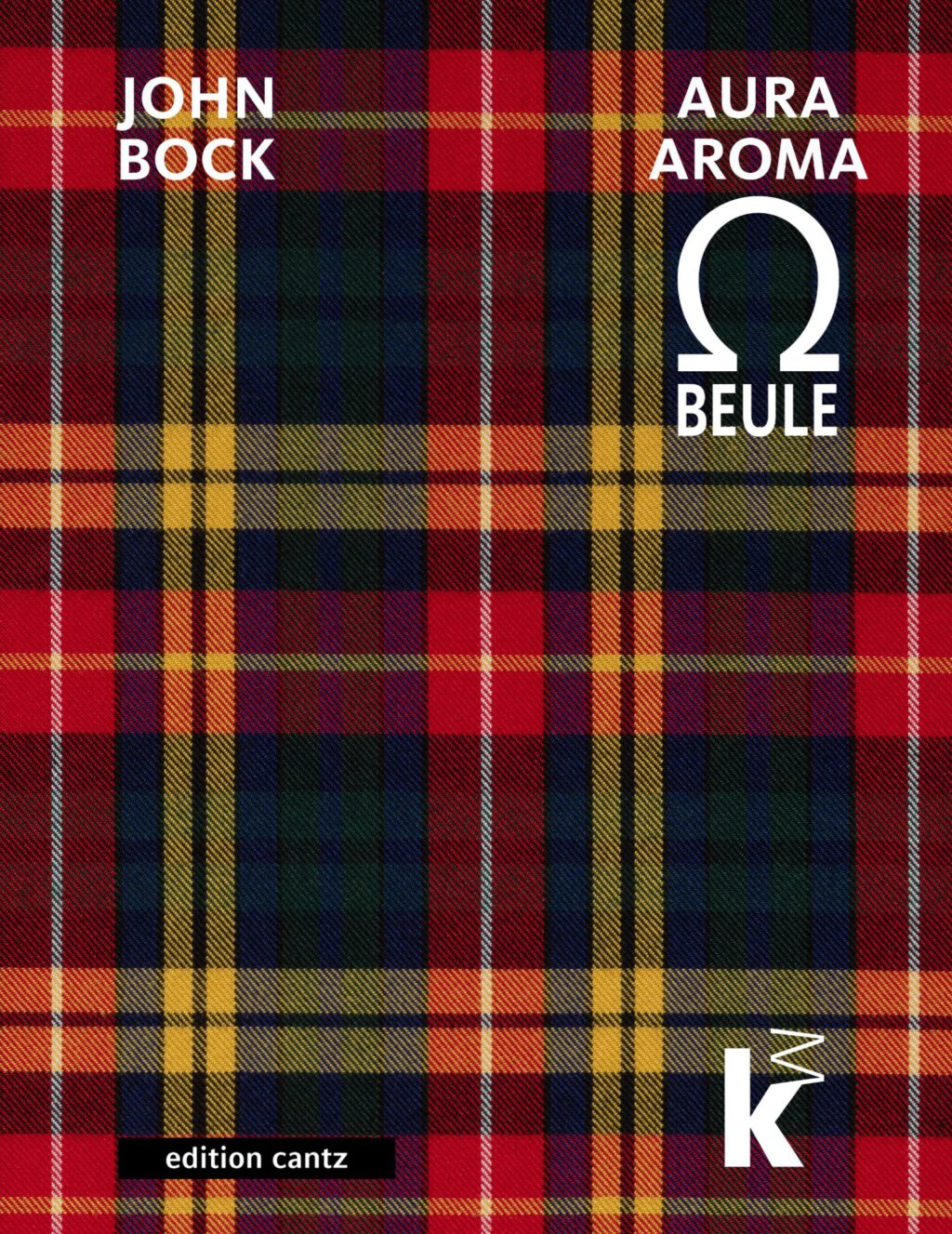
JOHN BOCK
AURAAROMA-Ω-BEULE42€ Add to cartThe Augmented Reality Book for John Bock
John Bock (b. 1965 in Gribbohm, lives in Berlin) is one of the most important contemporary performance and video artists. In his works characterized by humor and absurdity, the artist places language, human bodies, everyday objects, and spaces in peculiar relationships to each other. He attained international recognition with the installation LiquidityAuraAromaPortfolio at the first Berlin Biennale in 1998. Together with his work Voll die Beule from 2013, it is now included in the collection of the Kunsthalle Mannheim. The present augmented reality book not only contextualizes his work, but also immerses the viewer/reader directly in his performances, in which the artist’s head emerges and a filled rubber glove leaks out. A completely new approach to the works of John Bock, packaged in a pair of socks designed by the artist.
John Bock studied at the Hamburg University of Fine Arts and since 2004 has taught at the State Academy of Fine Arts Karlsruhe as Professor of Sculpture. He has participated in the 55th Biennale di Venezia, and his works have been featured worldwide in solo exhibitions at, among others, the Berlinische Galerie, the Contemporary Austin, Texas, the Barbican Centre, London, and the Städel Museum, Frankfurt.
-

Konrad Mühe
Guide38€ Add to cartAn Artist’s Book as an “Optical Illusion”
Konrad Mühe’s (b. Karl-Marx-Stadt, East Germany, 1982; lives and works in Berlin) works interrogate the construction of our identities by uncovering the technological and media apparatuses that sustain it and confronting it with the autonomous lives of objects. Their basic formal principle is the installation hybridizing sculpture and digital moving image, with a particular focus on the projector and the interaction of pedestal or suspension and projection screen. Where the classical black box in the movie theater or exhibition venue seeks to conceal the technical equipment in favor of an immersive visual experience, Mühe brings it to the fore and sets it out in the gallery space as sculpture and installation. Yet his works also undercut the conventional display regime in the white cube: the process of projection emerges as the true creative medium and subject. This book acts as a descriptive illustrated Guide to Mühe’s projects.
Konrad Mühe was Hito Steyerl’s master student and trained at the Berlin University of the Arts and the Burg Giebichenstein University of Art and Design Halle. His works have been featured at numerous film festivals including the 61st Berlinale and in exhibitions at Kunsthalle Düsseldorf, the Moscow Museum of Modern Art, and elsewhere.
-

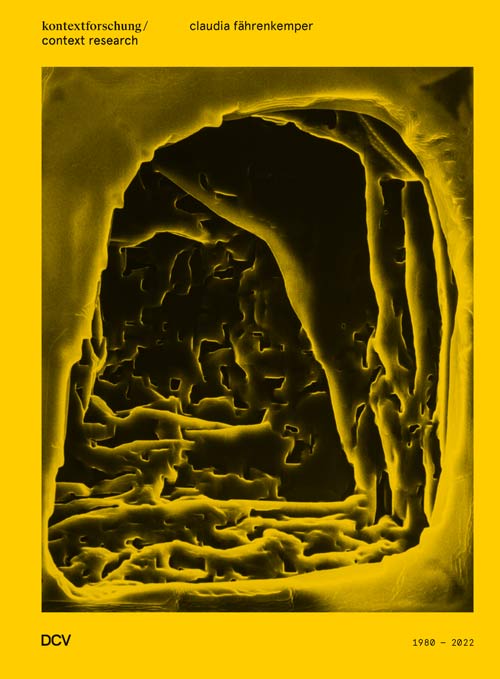
Claudia Fährenkemper
Kontextforschung / context research 1980–202268€ Add to cartClaudia Fährenkemper (b. Castrop-Rauxel, 1959; lives in Steinheim/Westfalen) photographs enormous as well as minuscule objects using scanning electron microscopes to produce images that are as fascinating as they are disconcerting. The play with extreme scales yields fantastic visual worlds: American desert and canyon landscapes, the giant industrial machinery of open-pit mines in Germany, insects, plant seeds, crystals, and plankton, plus historic armaments from Europe and Japan. The lavishly designed book is the first to gather works from her entire oeuvre, which now spans four decades. Surveying the most important of Fährenkemper’s conceptual series, it reveals unexpected interconnections between disparate motifs on vastly different scales from nature, technology, science, and cultural history.
Claudia Fährenkemper studied at Fachhochschule Köln, today’s Cologne University of Applied Sciences, where Arno Jansen was her teacher, and with Bernd and Hilla Becher and Nan Hoover at the Düsseldorf Academy of Fine Arts. Her photographs are held by numerous museum collections, including at the Kunstmuseum Bonn, the National Gallery of Canada, and the Margulies Collection, Miami.
-
MS 00 22
Michael Sailstorfer – Works 2000–202245€ Add to cartMS 00 22 – Michael Sailstorfer: Works 2000–2022
Michael Sailstorfer (b. Velden/Vils, Germany, 1979; lives and works in Berlin) is one of the most renowned German sculptors and object artists of his generation. His sculptural creations, which often require extensive planning and complex production processes, are the results of reflections on and reinterpretations of everyday objects: intriguing, bizarre, and sometimes humorous experimental arrangements and artifacts that interact with their environments, create spaces, or self-deconstruct. These transformative processes combine conceptual depth with poetic allure and tell stories of the passage of time and disintegration. Many of Sailstorfer’s installations depend on the beholder’s active engagement for their effect. He typically documents his sculptural experiments with the camera and later shares them with the public in the form of videos or photographs.
The extensive monograph MS 00 22 presents the most important works from Sailstorfer’s creative career. Formally diverse writings and conversations with the artist offer profound insight into his practice.
Michael Sailstorfer studied with Olaf Metzel at the Munich Academy of Fine Arts from 1999 until 2005 and at Goldsmiths College, London, in 2004–05. He has won a number of art awards, including the Kunstpreis junger westen (2011) and the Vattenfall Contemporary (2012). Selected solo exhibitions: Schirn Kunsthalle, Frankfurt (2007); Kestnergesellschaft, Hannover (2010); Kunsthalle Nürnberg (2011); Contemporary Arts Center, Cincinnati, Ohio (2014).
-
GOTT&GILZ
Supernatural Beings54€ Add to cartGOTT&GILZ clothe provocative nudity into the guise of art-historical classics
The female nude is a constant of art history whose vicissitudes illustrate changing forms of representation and the wild swings of public morality. Many a nude was initially condemned as smut only to be reclassified a few years later as beautiful and becoming and inducted into the hallowed halls (the opposite has also happened). GOTT&GILZ’s photographic paintings build on this long tradition of depictions of naked women by men—theirs is the proverbial “male gaze.” It is a debt they are quick to acknowledge, with nods to Klimt, Schiele, Pollock, et al. No wonder some have responded to their work with kneejerk indignation. Unlike in those art-historical references, then, the impudence lies not in the shattering of traditional norms of representation but in quoting them: the past as affront. The women in the pictures as well as the artists themselves flaunt their desires, shamelessly and relentlessly confronting us with the historic roots of our social and psychological realities.
Freedom is the key idea in the two artists’ oeuvre: the freedom to be authentic and express oneself without shame. Their subtly provocative play with aesthetic conventions and taboos has not only made a splash on the arts scene, it has also prompted vital discussions about gender roles, body images, and the right to sexual self-determination.
By letting it all hang out, they allow us to see ourselves as we are instead of presenting a picture of what we (supposedly) should be like. The insolence of it!
-

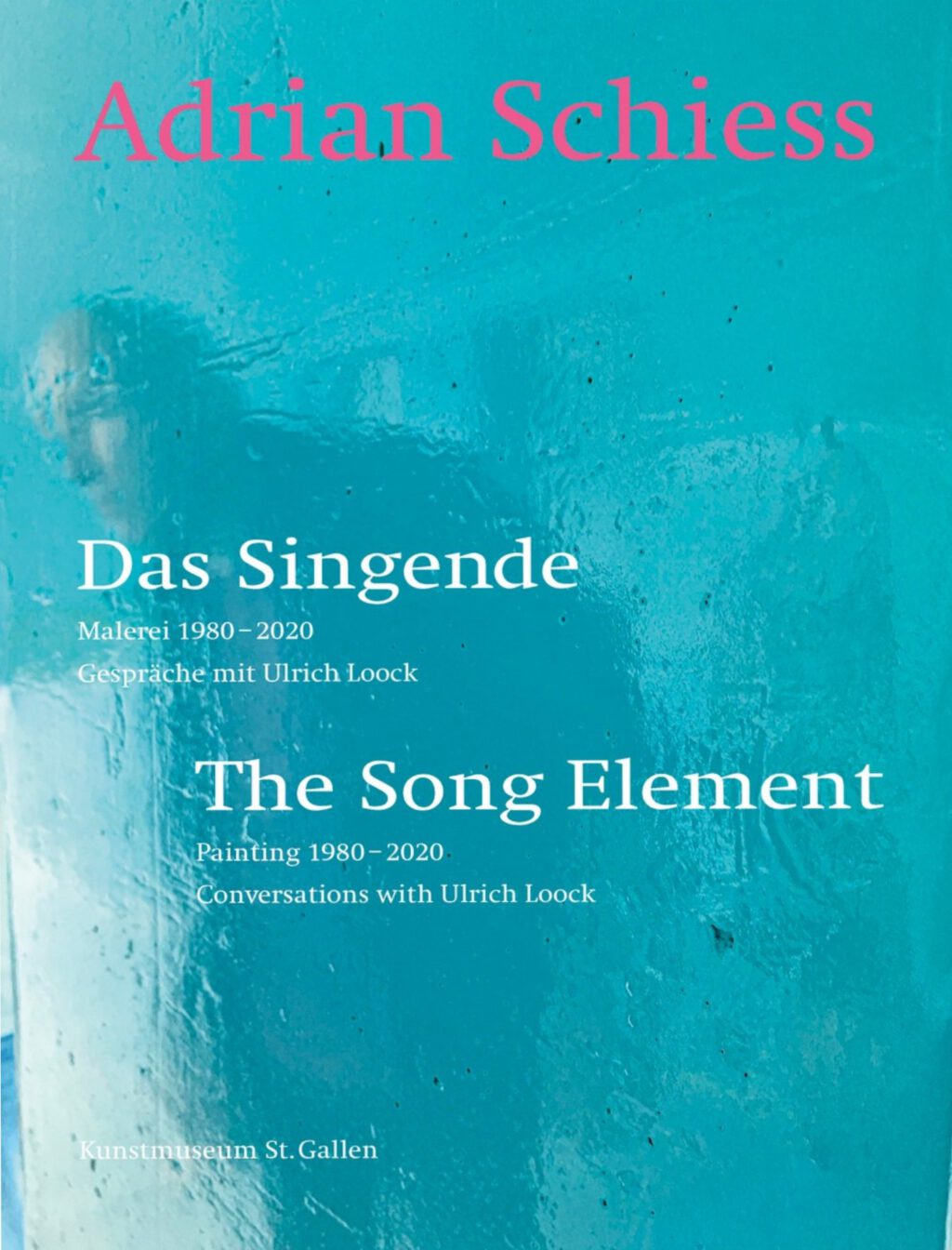
Adrian Schiess
The Song Element68€ Add to cartThe Renowned Swiss Artist and His Work in Its Architectural Setting
Smoothly painted panels laid out on the floor have earned Adrian Schiess (b. 1959, Zurich; lives and works in Mouans-Sartoux, France) international renown. His objects, which may be placed in a room as desired, are conceived as platforms of creative engagement with the appearance and disappearance of painting. They have become integral components of buildings by world-famous architects including Norman Foster and Herzog & de Meuron. For this book, Schiess has compiled spectacular series of photographs and extensive conversations that probe the peculiar quality of his work: hybrid and fluctuating and yet always utterly distinctive. It is the first publication to put the focus on this essential aspect of his output, documenting works created between 1993 and 2018.
Adrian Schiess studied at the Kunstgewerbeschule Zürich and trained as a graphic designer. His works were on display at the 44th Biennale di Venezia and at documenta IX.
-

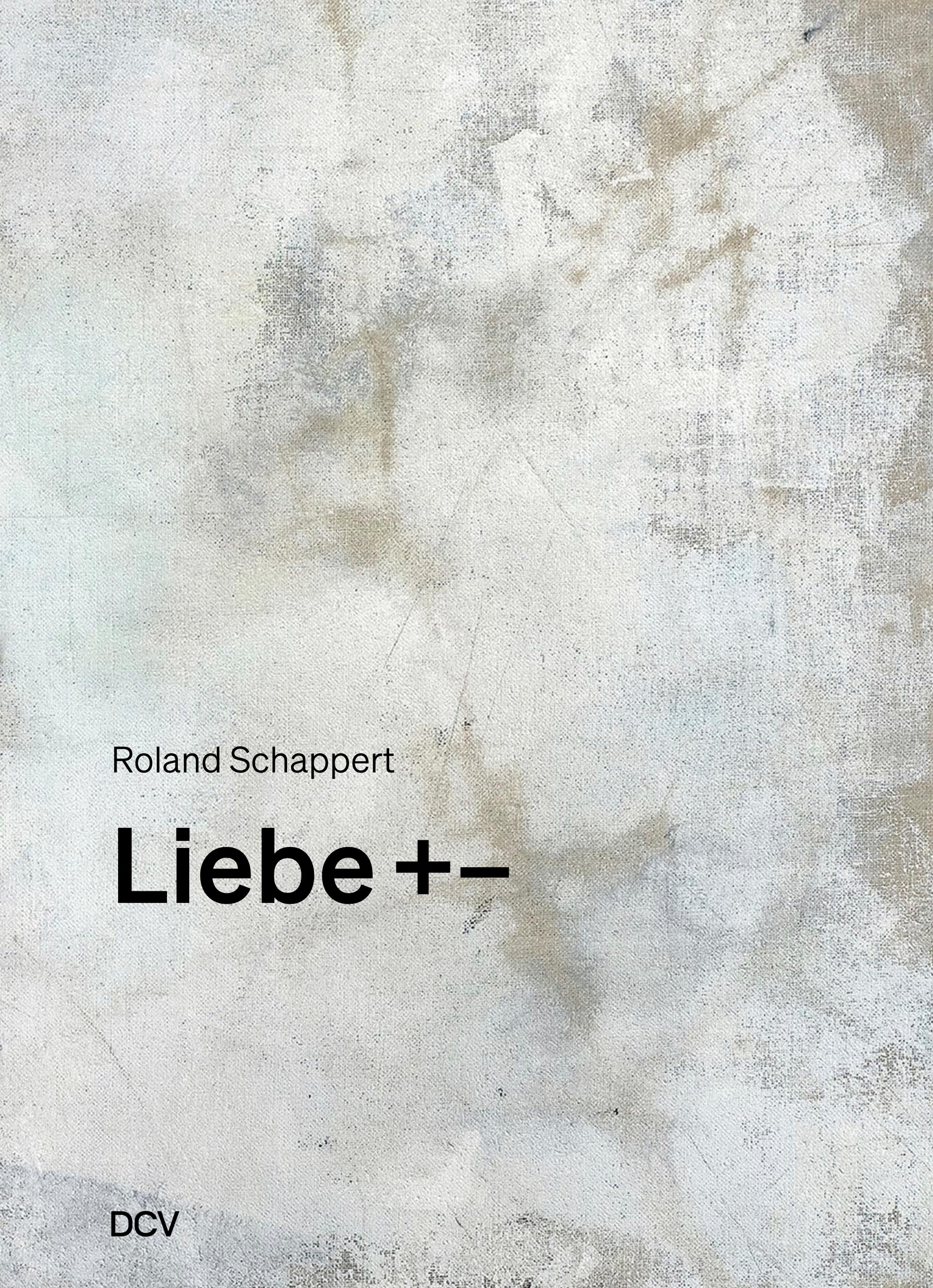
Roland Schappert
Liebe +–24€ Add to cartRoland Schappert’s Liebe+– is a poetic voyage into the mysterious and paradoxical landscapes of love. Combining an unrelenting eye with lyrical precision, Schappert captures the fragile equilibrium between intimacy and distance, between the longing for union and the need for detachment. The +– in the title is a symbolic shorthand for the ambivalence of love: attraction and repulsion, delight and pain, their constant interplay defining the dynamic of love.
The terse and sometimes aphoristic writings enter into a dialogue with the author’s artful and enigmatic pictures and sculptures—text images sewn out of strings of beads or painted in Champagne chalk that subtly mirror and refract the emotional tension of the poems. Nimbly balancing on the fine line between devotion and disaffection, Schappert’s verses are interspersed with ironic allusions to our digital and urban contemporary world.
By forging a symbiosis of poetry and image, this artist’s book charts a world unto itself in which the boundaries between I and you blur and subject and object are fused in a collective we. It invites us to contemplate love with a fresh eye—as tender touch and fractious idea, as a play of expectation and disappointment that we begin anew every day.
‘Love in the age of social media and dating apps, but not from a Gen Z perspective – but from someone who has known this feeling for much longer. And who brings his experiences – which are certainly representative of many – in ever new combinations of text and images into a form that makes reading and viewing a memorable experience.’ – Wolfgang Ullrich
-

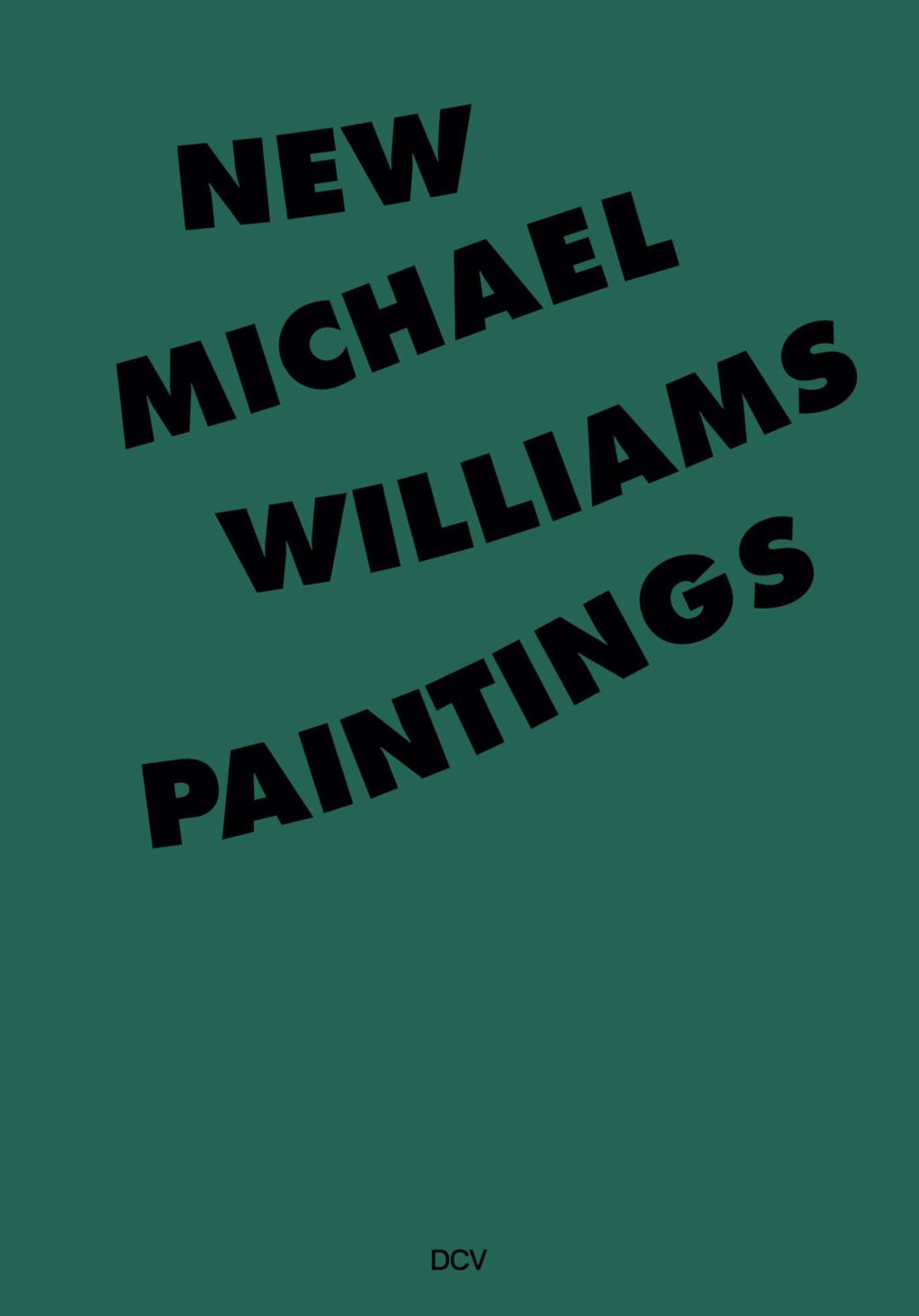
Michael Williams
New Paintings40€ Add to cartAwkward Uncertainty
Michael Williams (b. 1978, Doylestown, Pa.; lives and works in Los Angeles) makes work that interrogates the history of painting, often by dismantling its components into their constituent parts. His pictures employ form to reflect on the complexity and contradictions of modern life. He works on canvas, availing himself of a range of techniques including oil painting, collage, and inkjet prints. In his new works, Williams examines the relationship between painting and photography, transferring the chilly aloofness that is characteristic of the latter onto the former. The photographic “negative” yields a smooth canvas disencumbered of its painterly qualities and the medium’s historic ballast. The book includes several foldout plates that illustrate Williams’s creative approach, and a brief essay by his Austrian fellow painter Tobias Pils.
Michael Williams studied fine arts at Washington University, St. Louis, and has exhibited widely, including at the Wiener Secession, Vienna, and the Museum of Modern Art, New York.
-

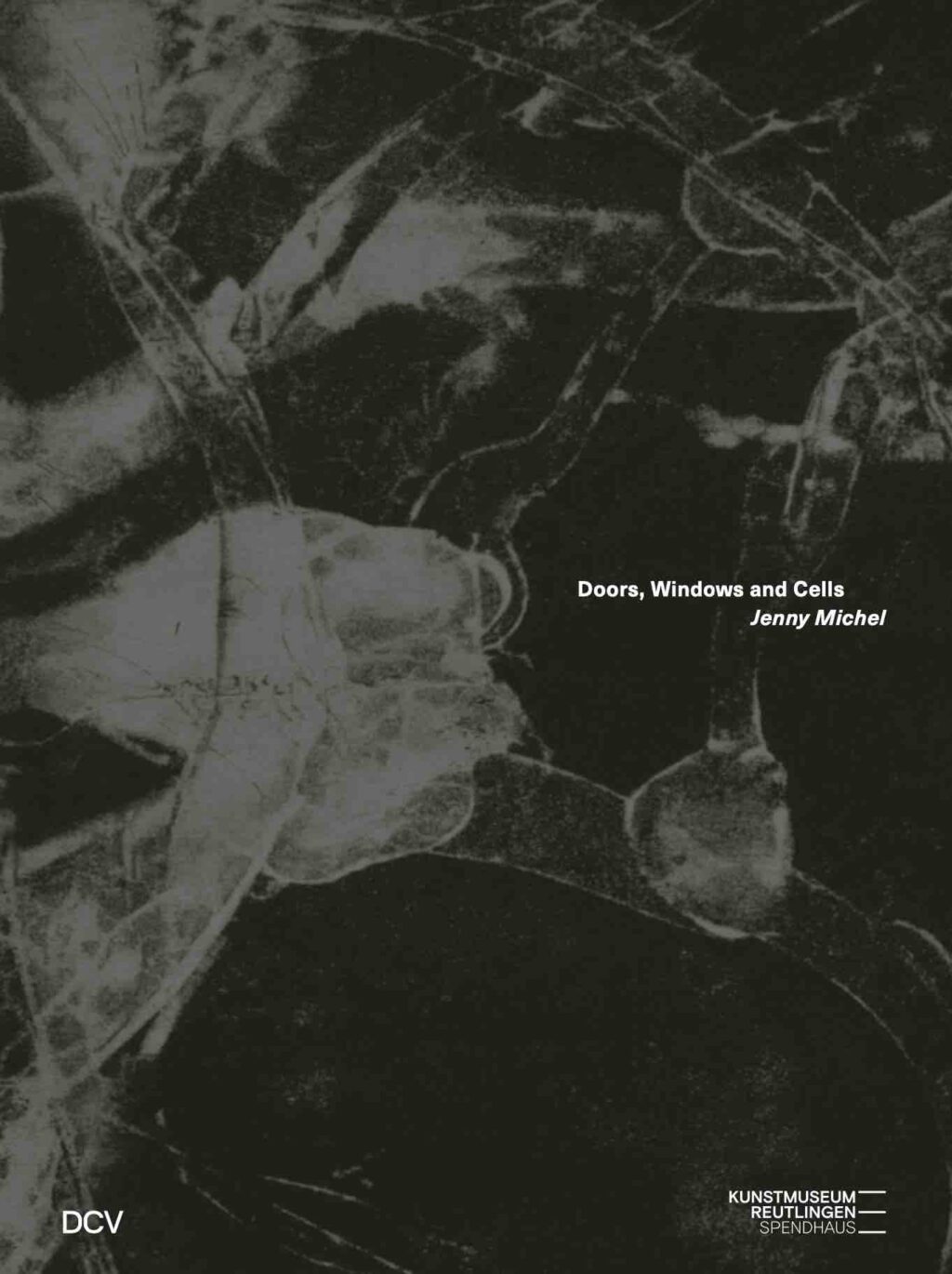
Jenny Michel
Doors, Windows and Cells38€ Add to cartThe Detritus of Our Society
For around two decades, the artist Jenny Michel (b. Worms, 1975; lives and works in Berlin) has devoted herself to minute particles such as dust, cobwebs, and electromagnetic fields in space. Her fascination with orders of knowledge, symbolism, and utopian visions is reflected by installations, drawings, prints, and sculptures that she exhibits in carefully composed sprawling ensembles. Aggregating fantastic fragments of the world manufactured from paper, adhesive tape, staples, and other industrially made small parts, Michel builds disconcertingly dense structures—human knowledge is transformed into the debris of civilization, its legibility lost beneath palimpsestic layers of meanings and resignifications. The extensive monograph surveys major series in the artist’s oeuvre and presents new works on paper.
Jenny Michel studied at Kunsthochschule Kassel and the Academy of Fine Arts Vienna. Her work has been on view at Museum Wiesbaden, the Draiflessen Collection, the Schirn Kunsthalle, Frankfurt, and Berlinische Galerie, among other venues. In 2010, Michel was honored with the HAP Grieshaber Prize.
-

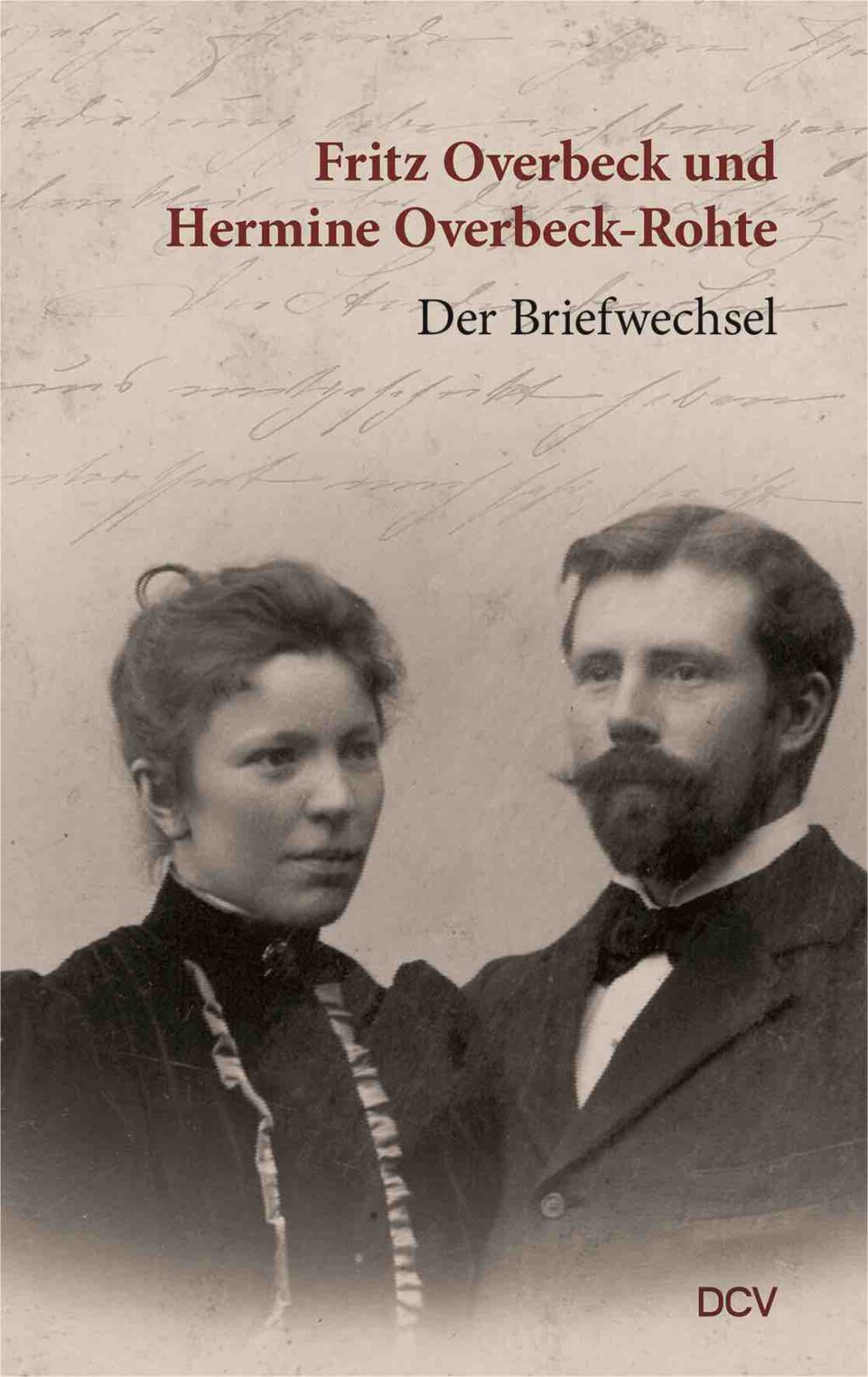
Fritz Overbeck und Hermine Overbeck-Rohte
Der Briefwechsel38€ Add to cartIntimate Glimpses from the Marriage of Two Worpswede Artists
In the final years of the nineteenth century, numerous painters settled in the village at the foot of Weyerberg hill, followed by young women who took classes with the local artists. Fritz Overbeck (b. Bremen, 1869; d. Bröcken near Vegesack, 1909) and Hermine Overbeck-Rohte (b. Walsrode, 1869; d. Bremen, 1937) became one of Worpswede’s husband-and-wife creative duos, though their union has been less celebrated than those of Otto Modersohn and Paula Becker or Rainer Maria Rilke and Clara Westhoff. Like the stories of their more famous neighbors, theirs exemplifies life and work in the artists’ colony, but also the dogged struggle for equality in the creative professions. Yet unlike those other relationships, theirs did not break up over the conflict between art and marital life; it lasted until Fritz Overbeck’s tragic early death. In a first, this book contains virtually the entire extant correspondence between the Overbeck-Rohtes in unabridged form and with numerous annotations. Offering fresh and nuanced insight into the lives and oeuvres of its protagonists, it makes for moving and entertaining reading.
- English edition not available anymore

YAEL BARTANA
THE BOOK OF MALKA GERMANIARead moreShe Is Hope. She Is the Leader. She Is the Messiah. She Is History. She Is Fake.
The video artist Yael Bartana (b. Kfar Yehezkel, Israel, 1970; lives and works in Amsterdam and Berlin) makes work that explores the visual language of identity and the politics of commemoration. The critical scrutiny of collective expectations of political or religious salvation is a central concern in her art. In the video installation Malka Germania—Hebrew for “Queen Germany”—Bartana creates alternative realities from the German-Jewish past and present that bring scenes of the collective unconscious to light. The publication follows the epiphany of Malka Germania, a female redeemer figure, in five chapters whose layout is modeled on that of the Talmud, the central text in Rabbinical Judaism. This organization reflects the polyphonic complexity, rich nuance, and ambivalence that the work casts into visuals and underscores that there is no simple answer. The book includes an interview with the artist and contributions by Sami Berdugo, Christina von Braun, Michael Brenner, Max Czollek, and others. It is published on occasion of the exhibition Yael Bartana—Redemption Now at the Jewish Museum Berlin.
Yael Bartana studied at the Bezalel Academy of Arts and Design, Jerusalem, the School of Visual Arts, New York, and the Rijksakademie van beeldende kunsten, Amsterdam. Her work is held by collections all over the world and has been presented in solo exhibitions at venues including the Stedelijk Museum, Amsterdam, the Pérez Art Museum Miami, and the Moderna Museet, Malmö.
Click here for the German edition.
-

Nam Kim
10€ Add to cartThe large-format paintings of Nam Kim (born 1991 in the US, lives in Vienna) are inhabited by chunky androgynous, naked figures, which gently blend with the vegetation, light and shadows, or ornaments around them. “The figures resonate with fluid grace, caught in the intimate moment between thought and touch.” (R. Grunenberg) Here, the human body is equal to its natural environs and not separate. Kim begins her paintings with zones of gestural abstraction, from which the characters grow like plants into her compositions. Kim grew up in Korea and her painting practice combines elements of Asian traditions (in art and theater) with Western art history and virtuality. This book presents her works of the last three years and includes an insightful essay by Robert Grunenberg.
-

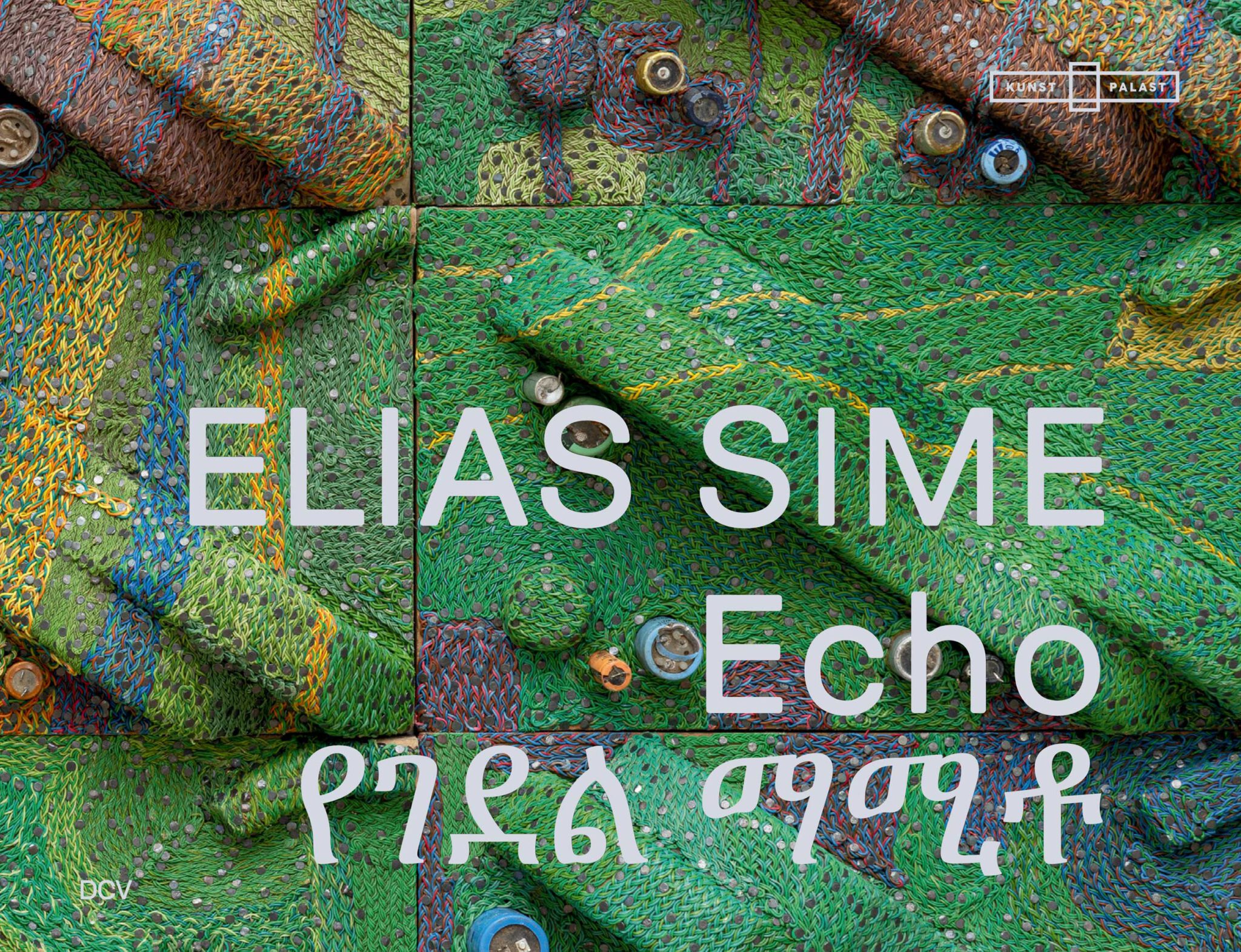
Elias Sime
Echo የገደል ማሚቶ35€ Add to cartEthiopia’s multi-award-winning artist Elias Sime (born 1968 in Addis Ababa) impresses with monumental wall reliefs made of ornamentally interwoven wires and cables or sawn-up circuit boards. For years, together with his team, he has been tirelessly
reworking discarded electronic components into complex and colorful assemblages. In doing so, he draws on traditional Ethiopian techniques of weaving, braiding and carving. Sime is interested in the “biography of the material” and each collage is a search for traces (of the local and global past). The artist obtains the electronic waste, which the countries of the global North are known to like to “dispose of” in the African continent, from the flea markets in Addis Ababa. His friezes are monuments both to the throwaway society and to global networking and interaction.
Echo የገደል ማሚቶ, a richly illustrated book, gives an overview over the artist’s fascinating career and is published on the occasion of the solo show at the Kunstpalast Düsseldorf. The volume includes insightful essays by Felicity Korn and Andria Hickey as well as an important conversation with Hans-Ulrich Obrist from 2016. Also discussed is the Zoma Museum complex, which was initiated by Sime (together with the curator Meskerem Assegued)—a total work of art that is exemplary for sustainability and community building.