Andreas Wegner
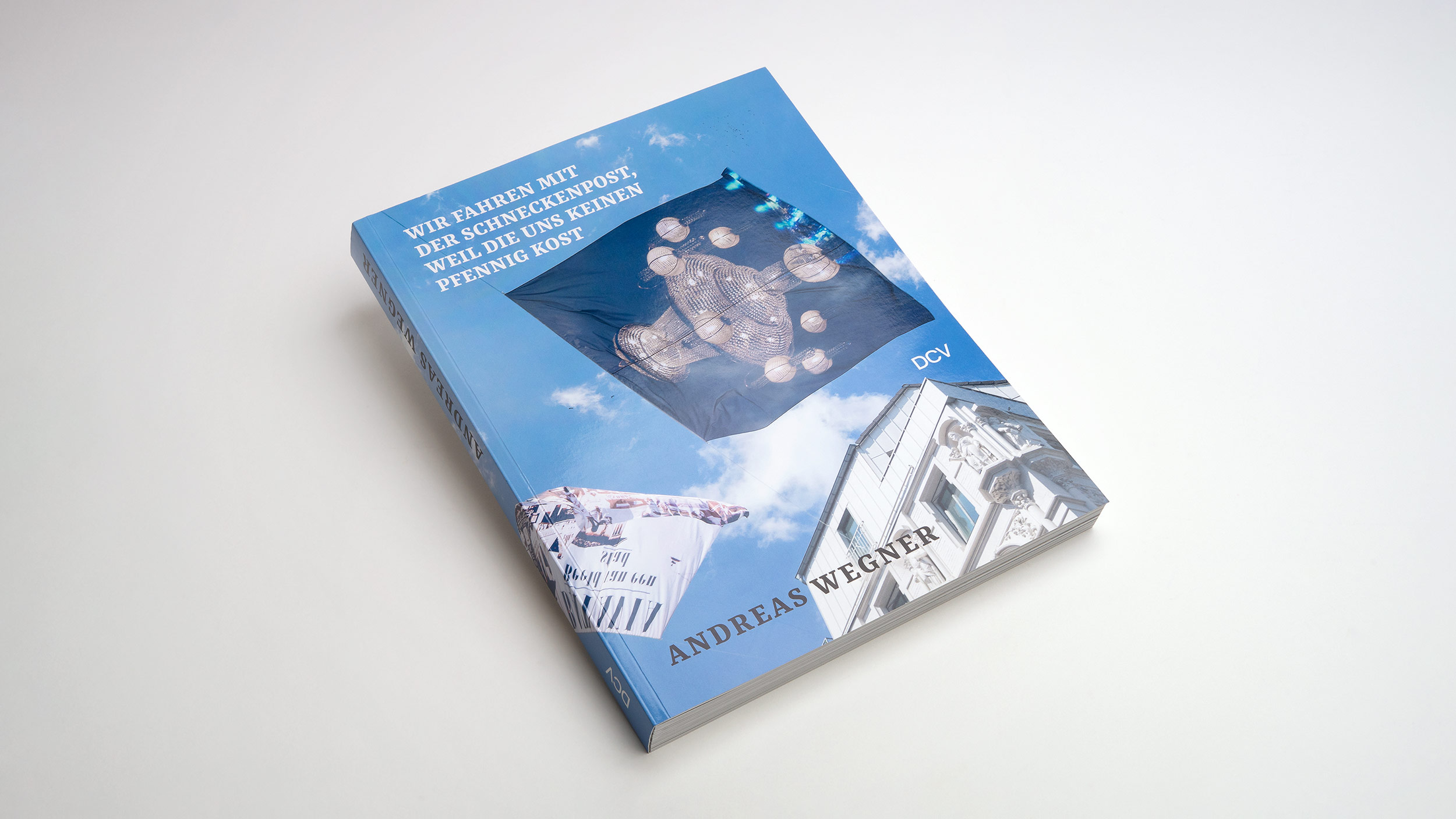
Wir fahren mit der Schneckenpost, weil die uns keinen Pfennig kost
 | |
|---|---|
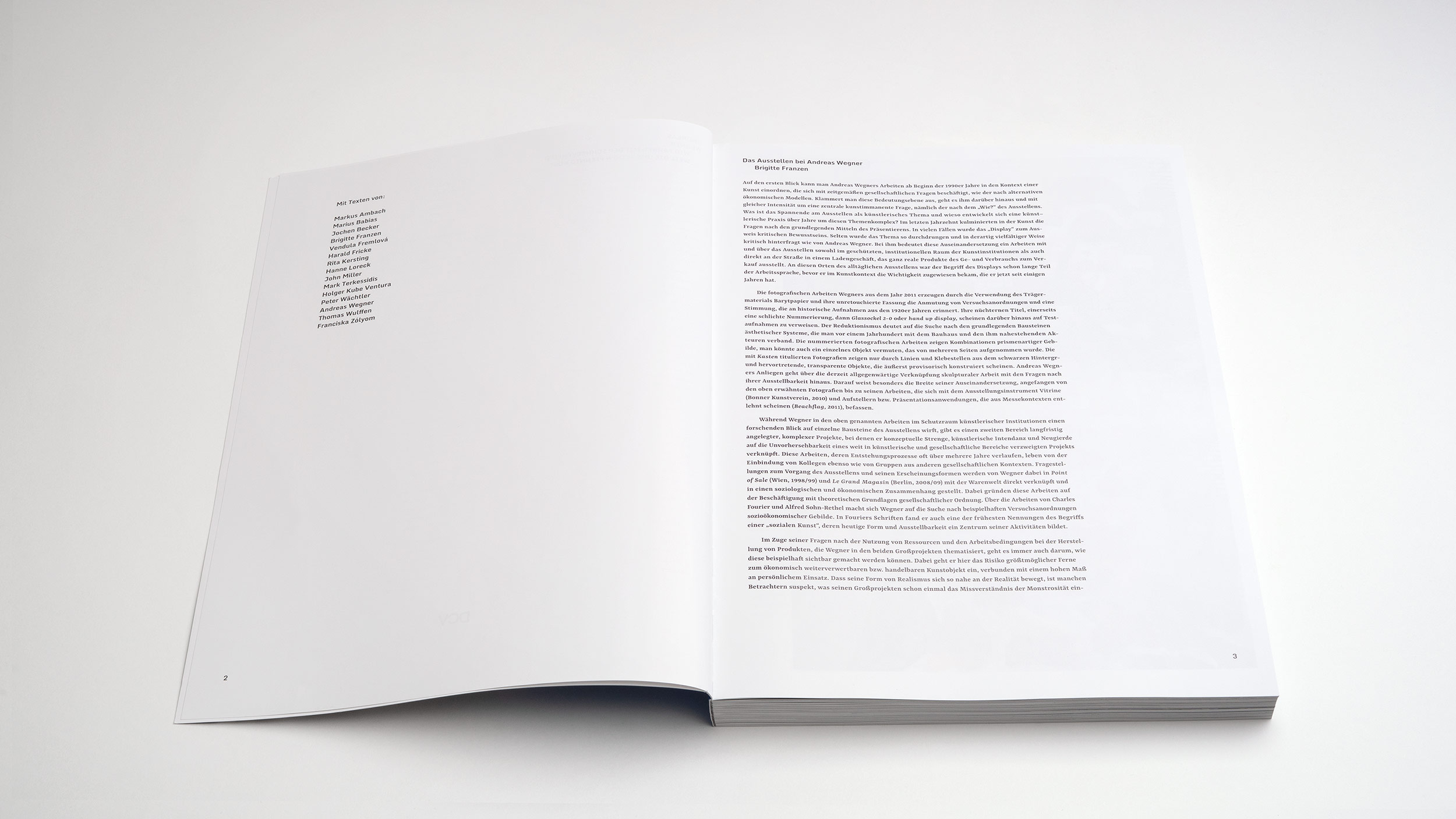
| Author(s) | M. Ambach, M. Babias, J. Becker, B. Franzen, V. Fremlová, H. Fricke, R. Kersting, H. Loreck, J. Miller, M. Terkessidis, H. K. Ventura, P. Wächtler, A. Wegner, T. Wulffen, F. Zólyom |
| Design | mahlke.one |
| Size | 24 x 32 cm |
| Cover | Softcover |
| Pages | 360 |
| Illustrations | 289 |
| Language(s) | German, English |
| ISBN | 978-3-96912-256-3 |
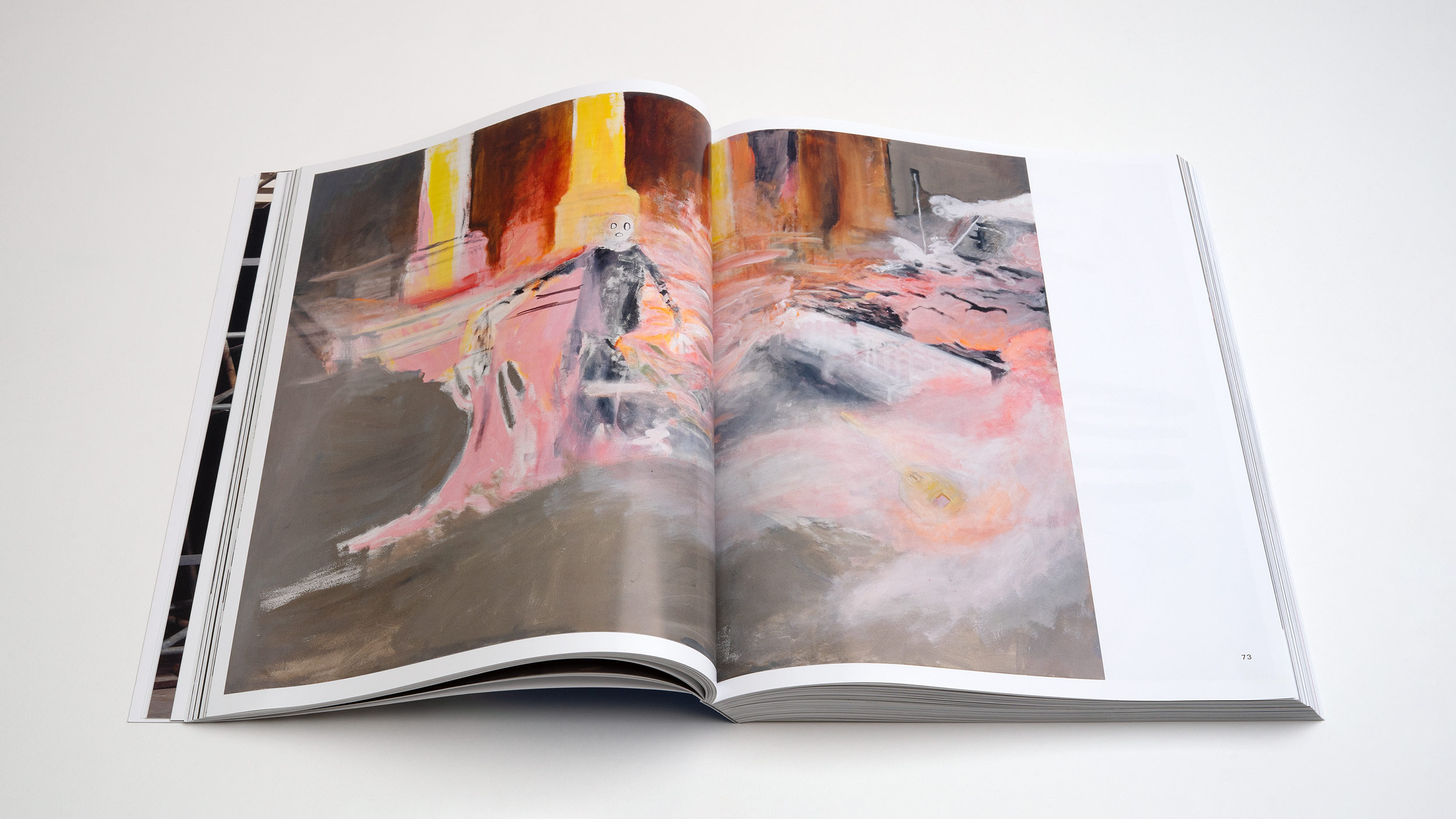
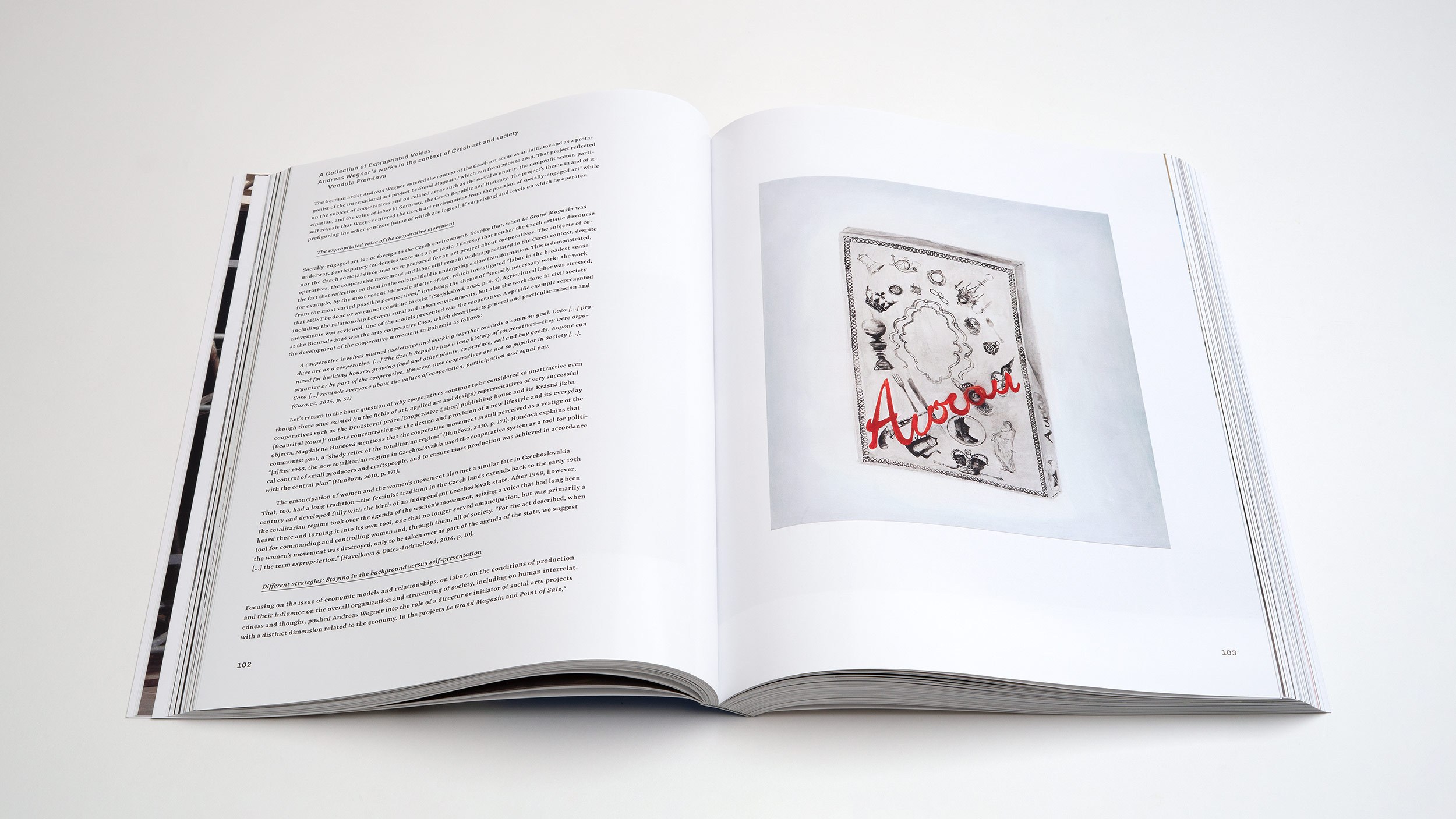
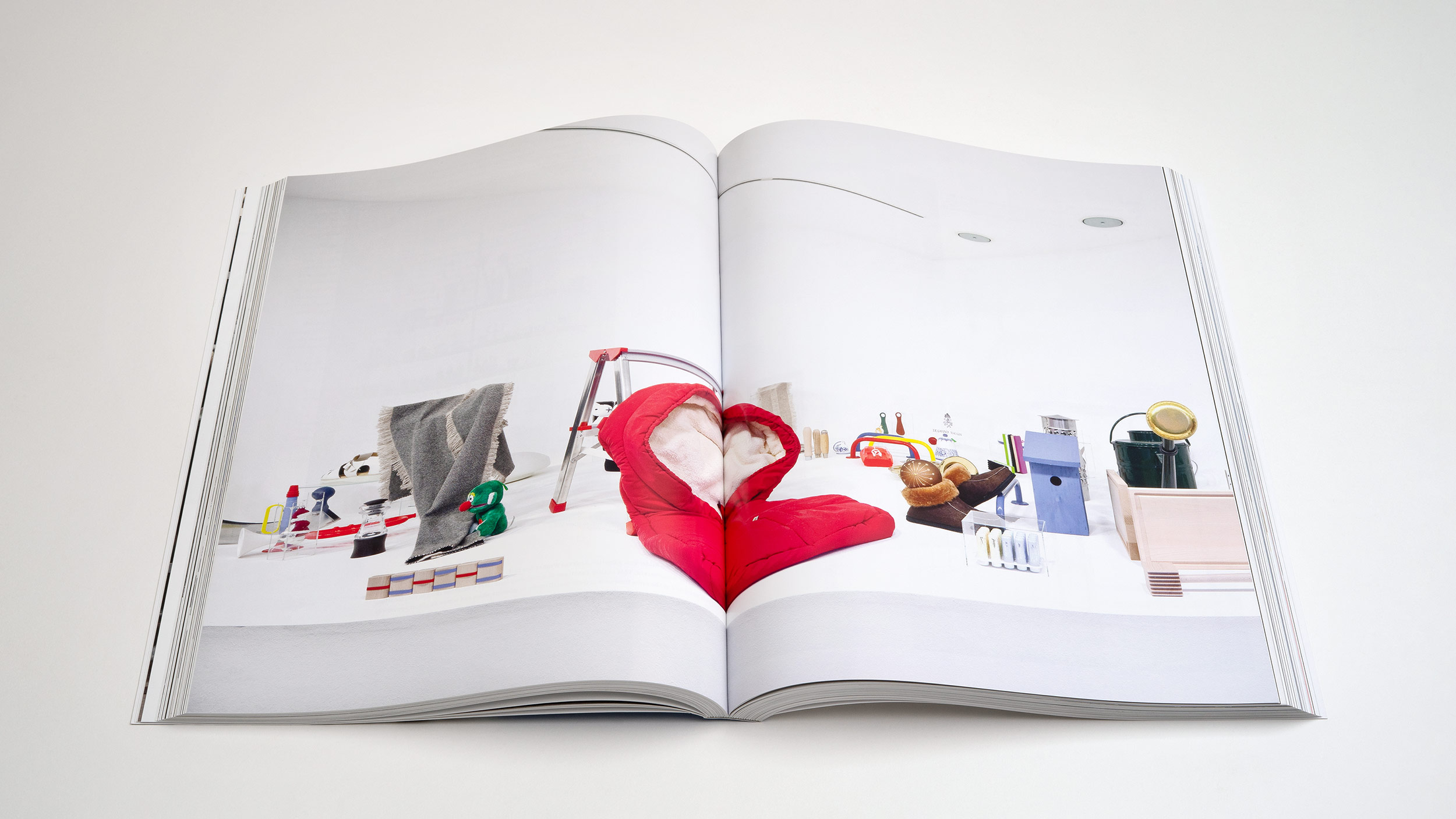
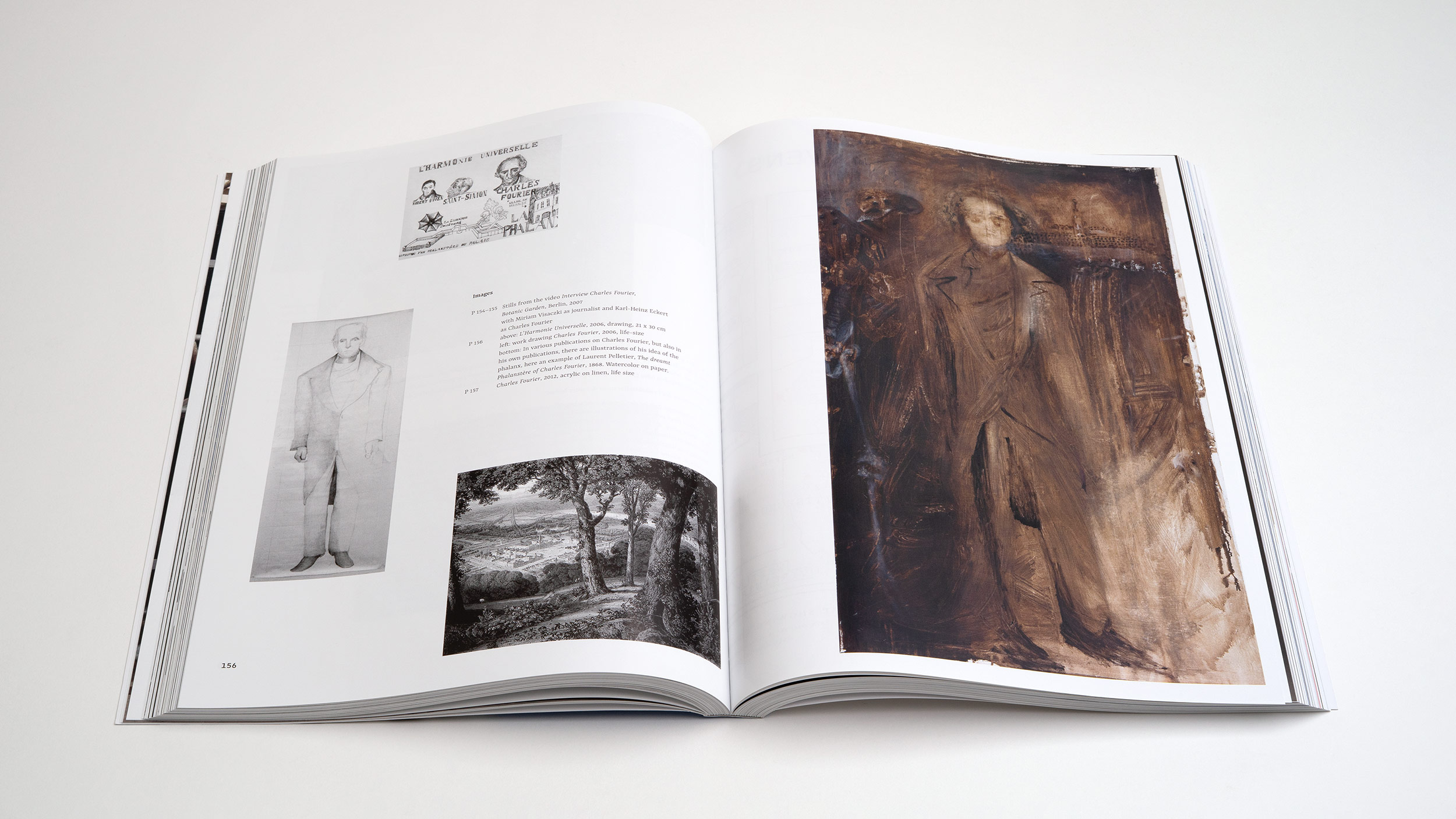
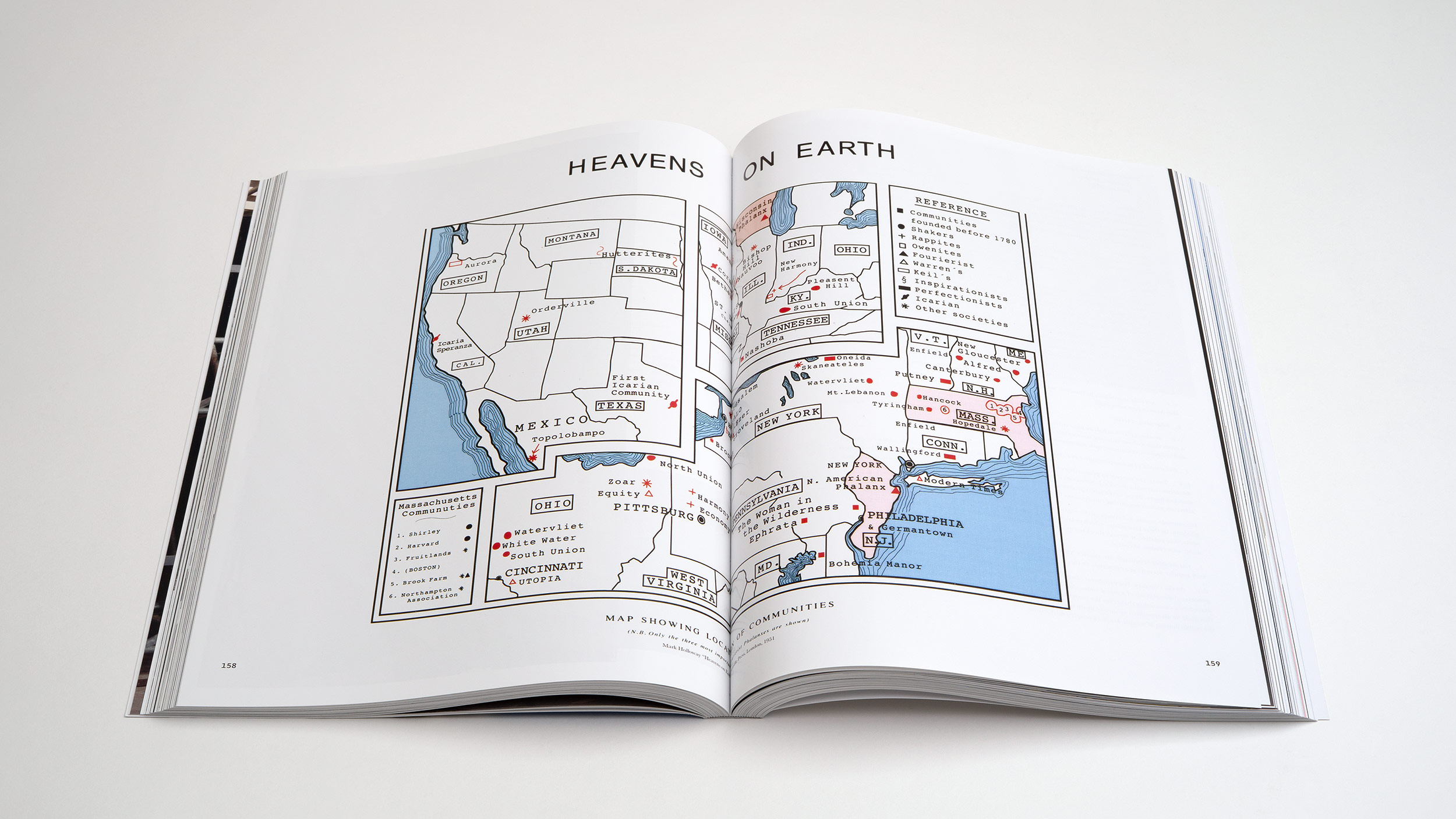
The art of Andreas Wegner is an inquiry into capitalist urbanity. His interventions explore alternative models for urban interaction, trade, city development, traffic, or the use of public space. Inspired by Joseph Beuys’s social sculpture and Charles Fourier’s social utopias, Wegner founded, e.g. a cooperative department store in Berlin, a grocery store in Vienna, and conducted real estate business as a form of creative resistance. This monograph illustrates the artist’s most important projects with ample imagery, essays by renowned authors, interviews, and his own texts. Alongside collective initiatives, installations, photography, film, and sculpture, painting remains a constant in Wegner’s oeuvre to this day.
More books
-

Cahier #1
Heinz Gappmayr22€ Add to cartDo we think in images or in language? Can writing visualize time? Heinz Gappmayr (1925-2010) was interested in text as a spatial event and in letters as architecture. Although his works were often presented in the context of Visual Poetry, Gappmayr himself preferred the more neutral term text to lyricism. His understanding of written language as a conceptual medium and typography as an indicator of physicality was closer to Lawrence Weiner’s approach than to that of the Concrete Poets. This volume accompanies an exhibition at the Tiroler Landesmuseum and includes Gappmayer’s most important art-in-architecture projects, as well as a complete notebook from 1961, with commentary by Gaby Gappmayr, the artist’s daughter. A conversation with her provides valuable philosophical insights into her father’s work.
-

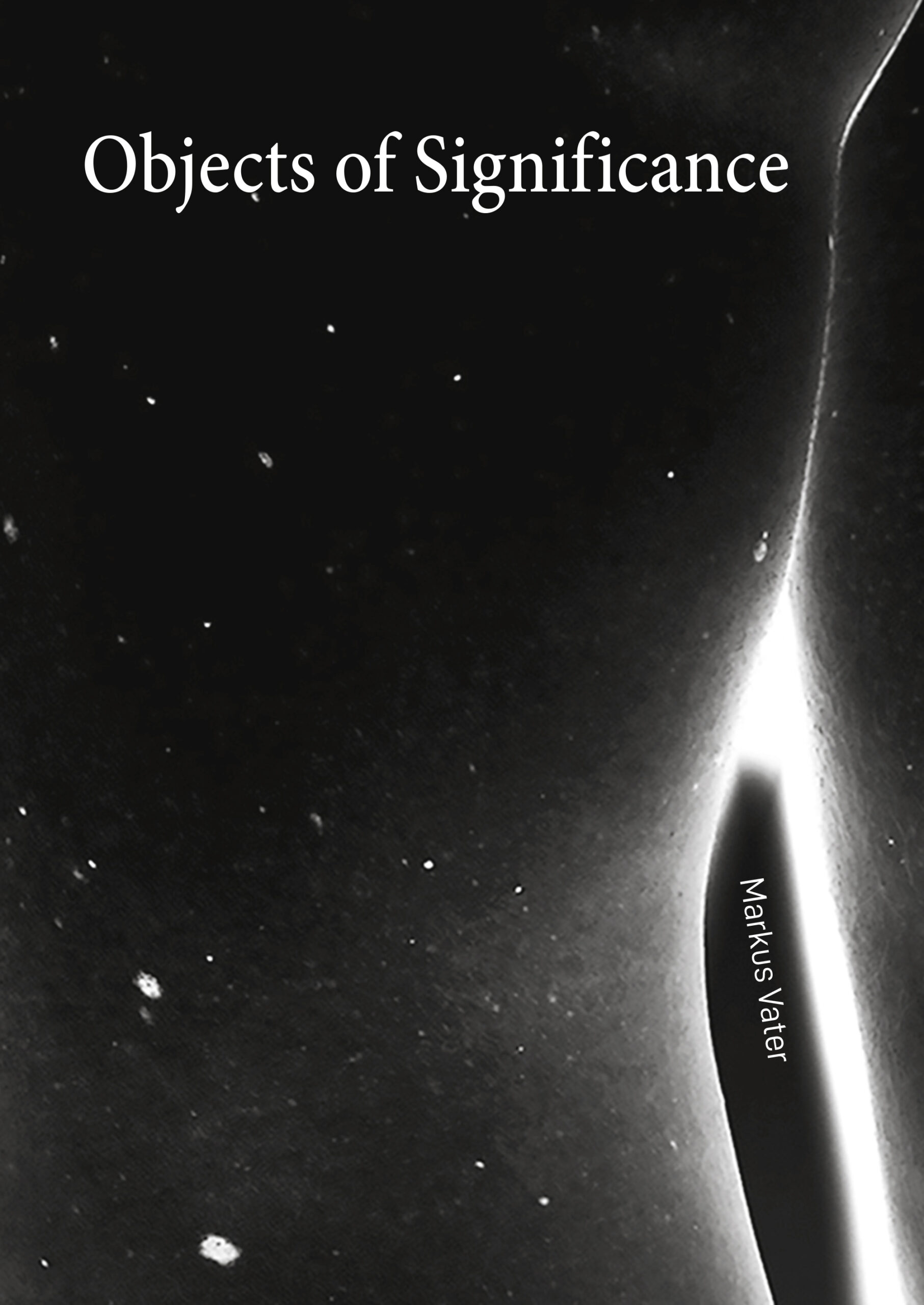
Markus Vater
Objects of Significance32€ Add to cartObjects of Significance is an artist’s book that grew out of a series of photographs and writings which Markus Vater (b. Dusseldorf, 1970; lives and works in London and Dusseldorf) collected over several years. They show and describe what matters to the artist: objects fraught with meaning, questions, relationships, memories. It is a creative and philosophical book, as funny as it is serious, delving into questions like: What do you see when you close your eyes and turn your head toward the sun? Or: How much does a cloud weigh? Vater has interviewed the North Sea for the book and ponders the wind. He sheds light on the conditions in which art comes into being and meditates on what holes are.
-

Margret Eicher
Lob der Malkunst38€ Add to cartContemporary Visual Communication in a Historic Weaving Technique
Margret Eicher’s (b. Viersen, Germany, 1955; lives and works in Berlin) large-format tapestries combine the baroque form of the woven picture with familiar motifs excerpted from contemporary media images. She digitizes her sources and then assembles them in painstaking editing work on the computer. The resulting ‘media tapestries’ occupy the interface between the traditional work of art as a physical object and the electronic noise of the digital realm: two worlds that at first glance would seem to be incompatible yet find themselves in harmonious union in Eicher’s art. In Göttliche Liebe (Divine Love), for example, Caravaggio’s Crowning with Thorns meets a kissing gay couple from a pro-tolerance campaign in Berlin, while Botticelli’s Birth of Venus is sampled together with a subway station in Frankfurt. In conceptual art production, the creative idea is central and its realization becomes secondary; in a final twist, Lob der Malkunst (Praise of Painting) elects this practice as its artistic lodestar. Eicher installs the painter Martin Kippenberger in the interior of Berlin’s Paris Bar, where he poses as a dandy and presides over a clash between the different tendencies in the art of the twentieth and twenty-first centuries.
- Out of stock

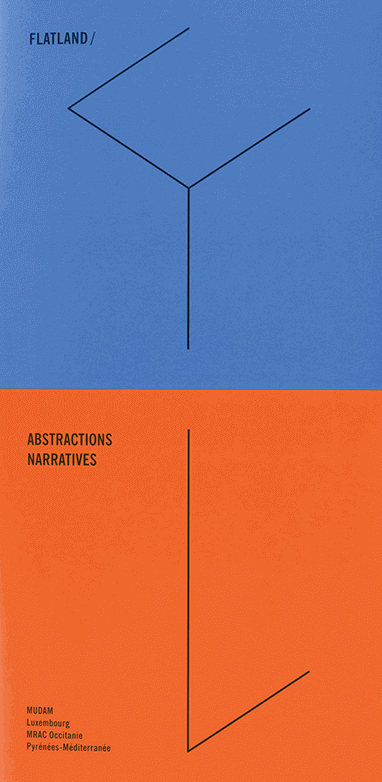
Flatland
35€ Read moreBetween the Dimensions
The title of this book quotes a literary work by Edwin A. Abbott that was first published in 1884 and gradually gained considerable fame: an allegorical satire whose protagonists are geometric figures, narrated by a square that relates its discovery of a three-dimensional world. Flatland examines the ways in which artists have found inspiration in the formal vocabularies of abstraction since the 1960s. The lavishly designed book gathers works from the past six decades that challenge orthodox interpretations of abstraction.
Contributing artists: Laëtitia Badaut Haussmann, Francis Baudevin, Philippe Decrauzat, Marie-Michelle Deschamps, Angela Detanico / Rafael Lain, Hoël Duret, Sylvie Fanchon, Liam Gillick, Mark Hagen, Christian Hidaka, Sonia Kacem, Tarik Kiswanson, Vera Kox, Sarah Morris, Reinhard Mucha, Damián Navarro, Camila Oliveira Fairclough, Bruno Peinado, Julien Prévieux, Eva Taulois, John Tremblay, Pierre Vadi, Elsa Werth, Raphaël Zarka
-

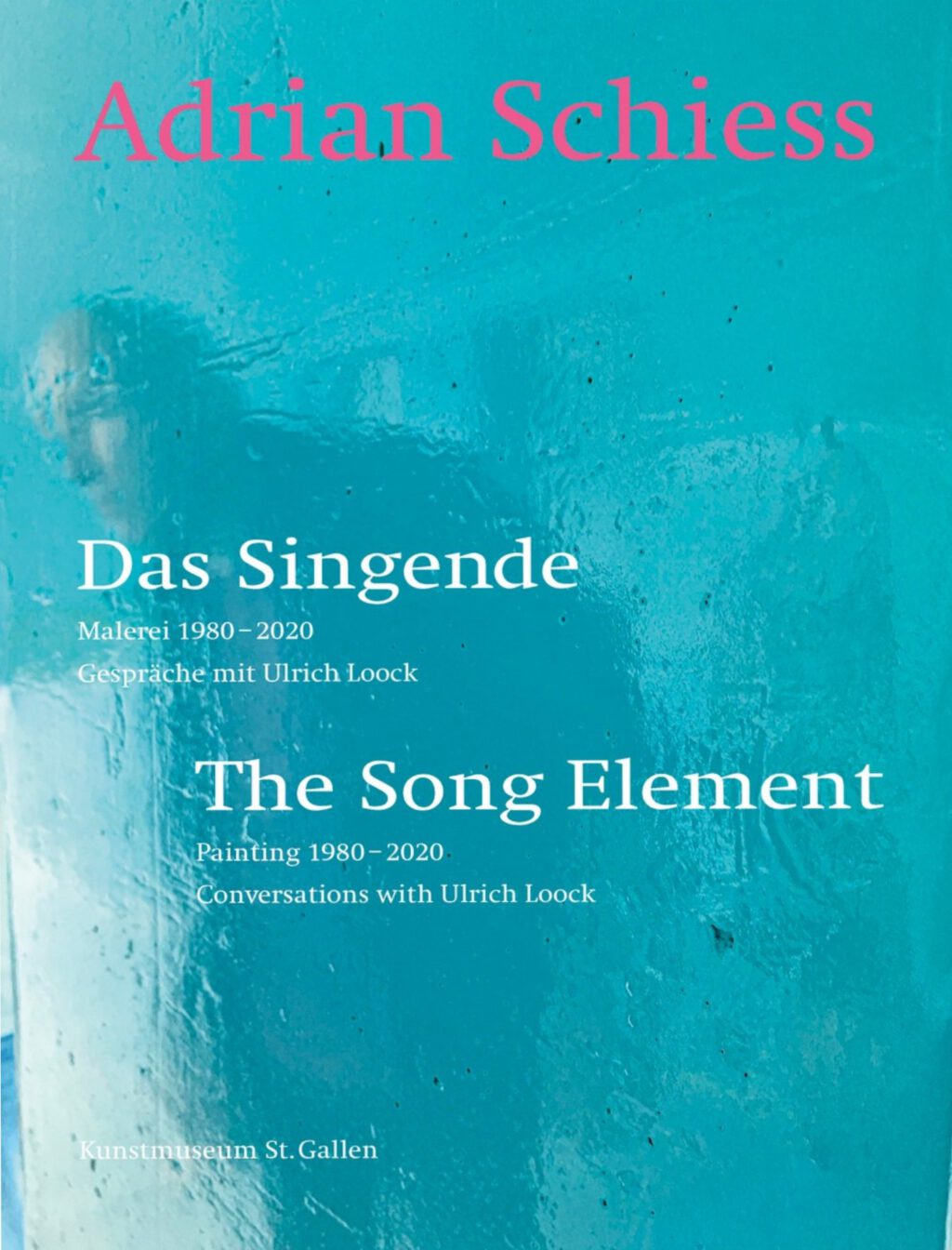
Adrian Schiess
The Song Element68€ Add to cartThe Renowned Swiss Artist and His Work in Its Architectural Setting
Smoothly painted panels laid out on the floor have earned Adrian Schiess (b. 1959, Zurich; lives and works in Mouans-Sartoux, France) international renown. His objects, which may be placed in a room as desired, are conceived as platforms of creative engagement with the appearance and disappearance of painting. They have become integral components of buildings by world-famous architects including Norman Foster and Herzog & de Meuron. For this book, Schiess has compiled spectacular series of photographs and extensive conversations that probe the peculiar quality of his work: hybrid and fluctuating and yet always utterly distinctive. It is the first publication to put the focus on this essential aspect of his output, documenting works created between 1993 and 2018.
Adrian Schiess studied at the Kunstgewerbeschule Zürich and trained as a graphic designer. His works were on display at the 44th Biennale di Venezia and at documenta IX.
-

Gerhard Neumaier
Die Lust an der Macht des Malens zwischen Mythos und Trivialität32€ Add to cartEin Spiel mit den Ambivalenzen
Offenkundig Mythologisches gerät bei Gerhard Neumaier (geb. 1950 in Freiburg, lebt und arbeitet in Baden-Baden) ebenso zur trivialen Episode, wie scheinbar Triviales legendäre Ikonik entfaltet. Dabei bricht sein unvoreingenommener Umgang mit Klassikern wie etwa in der Duchamp-Persiflage „Hokuspokus mit Fokus Lokus“ semantische Vorurteile in den Sehgewohnheiten auf und bietet dem Betrachter neuartige Interpretationen. In der perfomativen Bewegtheit seiner Rakelbilder legt er eine haptische Sinnlichkeit an den Tag, die Cora von Pape in ihrer Einleitung dazu bringt, den Künstler zu zitieren: „Ich male, was ich weiß, damit ich sehe, was ich fühle.“
-

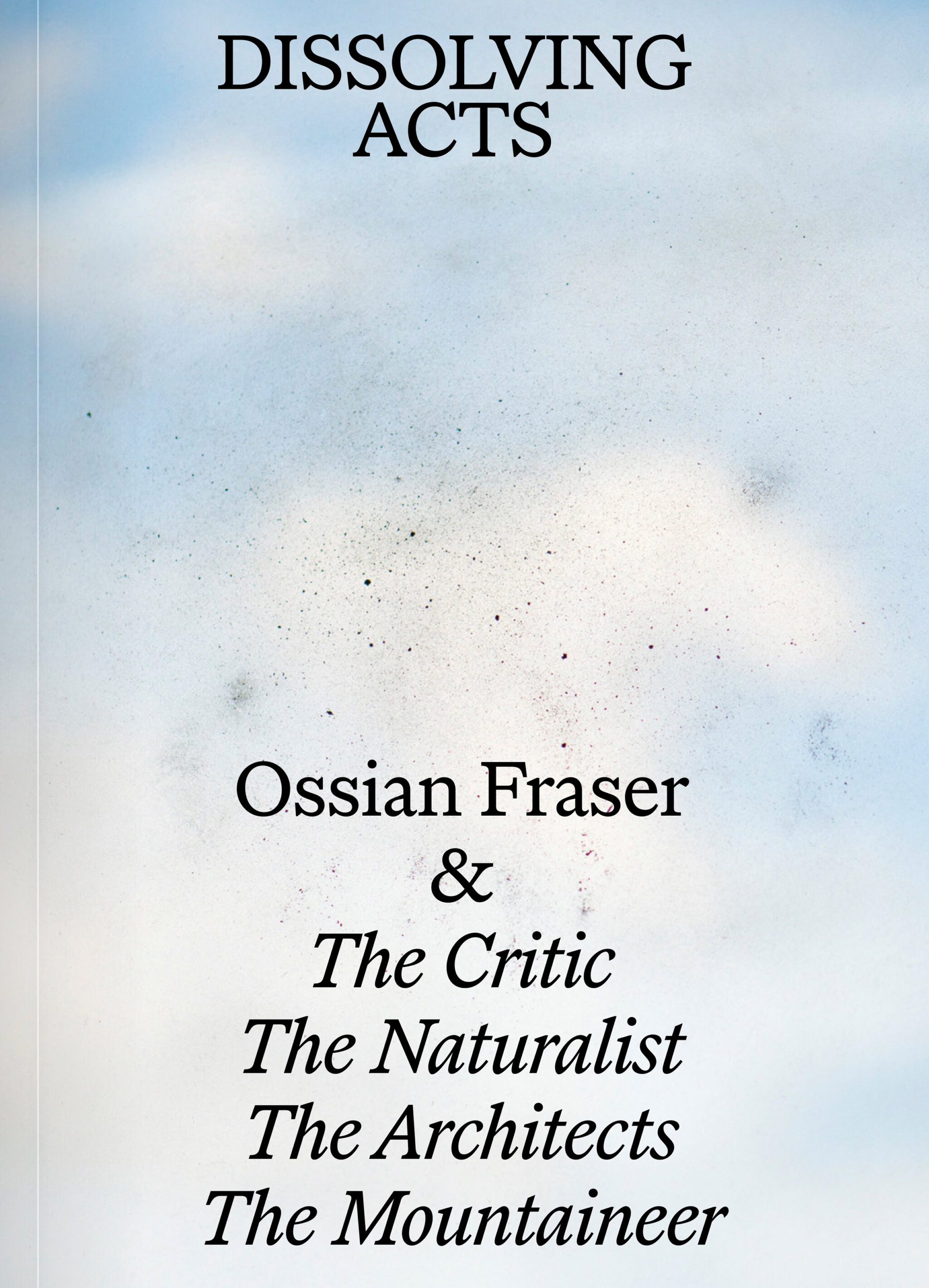
Ossian Fraser
DISSOLVING ACTS38€ Add to cartOssian Fraser (b. Edinburgh, 1983; lives in Munich and Berlin) molds and captures evanescent moments. Working with volatile materials such as water, dust, or light, the artist exposes the latent potentials of unremarkable situations in the urban fabric and natural scenes. A tunnel in a city, a rock face in the mountains become points of departure and elementary components of his site-specific interventions, which he records in photographs. The book is the first to offer comprehensive insight into Fraser’s artistic practice. Series of pictures showcasing his conceptual and poetic pieces alternate with conversations that not only demarcate the framework in which his art operates, but also touch on the great issues of our time.
Ossian Fraser studied fine arts and sculpture at the Alanus University of Arts and Social Sciences, Bonn, from 2006 until 2009 and at the Weißensee Kunsthochschule, Berlin, from 2009 until 2013, rounding out his education in Albrecht Schäfer’s master class in 2013–2014.
-
Michelle Jezierski
Verge28€ Add to cartHow does a simple line become a horizon? When do we begin to see colors and shapes as a landscape? Michelle Jezierski’s painting homes in on the tipping point at which our perception begins to oscillate between color/surface and space/representation. At that very point, she captures the essence of the landscape as such, which is not a concrete place but a metaphor for inner states of affairs. To get there, Jezierski distills what she sees in her surroundings down to the elements of painting—shapes and colors—which just barely intimate a pictorial space while persistently drifting toward abstraction. The defining feature of her technique is that she layers several pictorial planes and spaces on the canvas in staggered arrangements. “Perpetually discovering new ways to unsettle the visual space,” as she puts it, she engenders ruptures and structures that open up multiple perspectives and a portal for reflection on one’s own perception. Above all, however, the cuts lend her pictures a peculiar rhythm that powerfully pulls in the gaze, making the reader paging through this catalogue forget time and space.
-
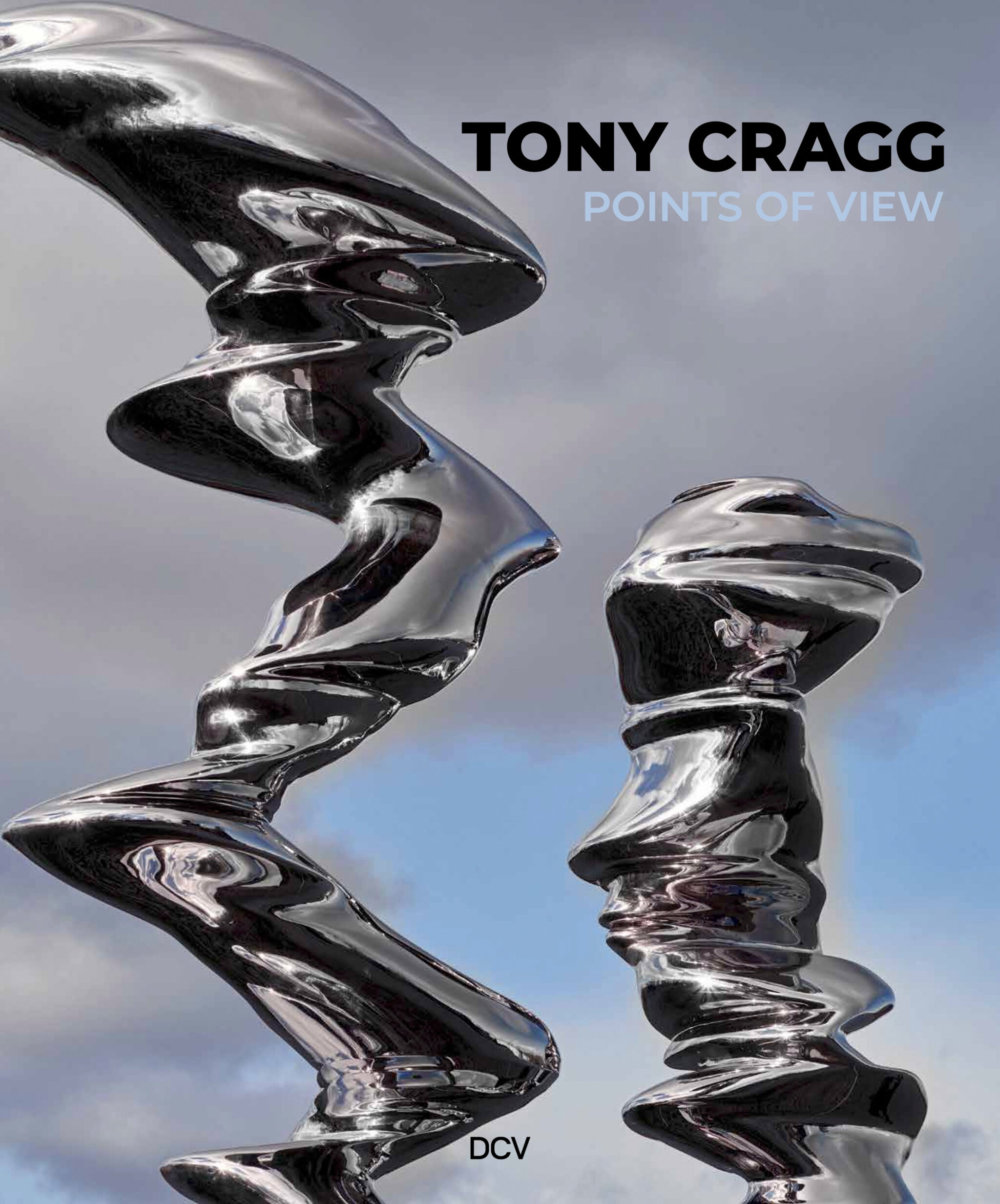
Tony Cragg
Points of View24€ Add to cartThe biomorphic and monumental sculptures of British sculptor Tony Cragg (born 1949, lives in Wuppertal) impress with their virtuosity and their dynamic appearance. They might even evoke movement, as if they are still becoming. Often exhibited outdoors, and in church or museum contexts, they blend into their surroundings like organic entities. Since the 1960s, Cragg’s search for sculptural form manifested through methods like layering and stacking existing materials, rearrangement, and assemblage. He now employs both traditional and new technologies and materials, yet his sculptures have to be seen in clear contrast to normative, repetitive industrial production. This book documents Cragg’s 2025 exhibition in the Anhaltische Gemäldegalerie Dessau.
-

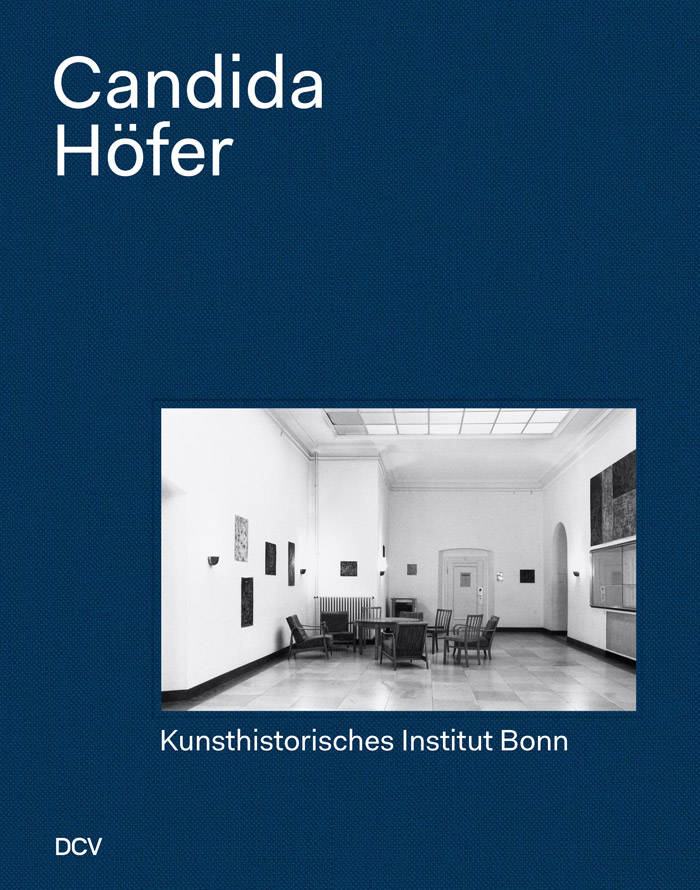
Candida Höfer
Kunsthistorisches Institut Bonn35€ Add to cartThe Kunsthistorisches Institut Bonn, Yesterday and Today
The imposing presence of architecture captured in the absence of humans: that is the defining characteristic of the photographs with which Candida Höfer (b. 1944, Eberswalde; lives and works in Cologne) has risen to international renown. In 1992, she captured the Kunsthistorisches Institut der Rheinischen Friedrich- Wilhelms-Universität Bonn in ten analogue black-and-white pictures that have not been on public display. In 2020, Höfer returned to the institute to take more pictures using a digital camera. The two series now make their public début in the institute’s halls and are gathered in this book. Undertaking a historically and aesthetically captivating comparison, Höfer probes the ways in which university life has changed over almost three decades.
Candida Höfer was a member of Bernd Becher’s inaugural photography class at the Kunstakademie Düsseldorf. Her works were shown at documenta 11 in 2002, and in 2003, she and Martin Kippenberger represented Germany at the 50th Biennale di Venezia.
- Release January 2026

Bettina Buck
Finding Form45€ Add to cartThe German sculptor Bettina Buck (1974-2017) called attention to herself with her “performative sculptures,” which she often presented vis-à-vis museal objects. Buck’s preferred materials came from the hardware store: corrugated cardboard, ceramic tiles, pressed foam, or plastic foil, which are all not meant to last. Out of these materials she created a kind of changeable and transient “protagonists,” who didn’t have a final form but rather emphasized the actual process of finding form (as well as losing form). In a provocative action in 2015, Buck dragged an oversized foam bloc through a museum collection and let it rest next to famous artworks, which gained a new dynamic in this interplay. Buck herself said once that her works were meant to “simultaneously attract and alienate the viewer.” In the exhibition space the objects should “create a tremor, a vibration and a conversation with its surroundings.”
Finding Form, a posthumous monograph presents Bucks complete sculptural works on over 300 pages and contains texts by Phyllida Barlow, Paolo Icaro, Cecilia Canziani, and Andrea Maria Popelka. The book was conceived and published by the artist’s estate, Bureau Bettina Buck.
-

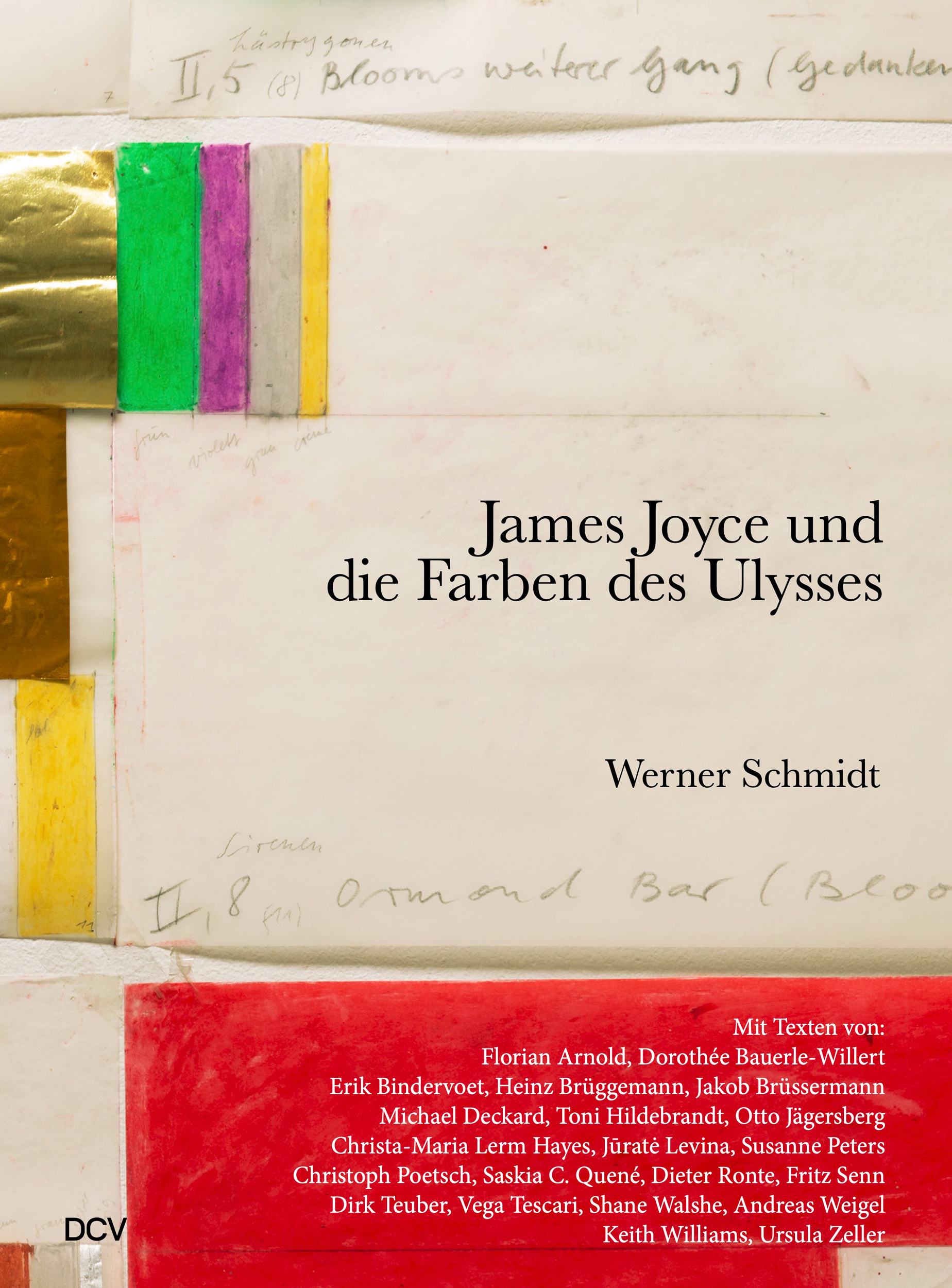
Werner Schmidt
James Joyce und die Farben des Ulysses59€ Add to cartThis imposing volume is the fruit of the artist Werner Schmidt’s decades-long immersion in the preeminent literary monument of the twentieth century: James Joyce’s Ulysses.
What began as a personal reader’s voyage now attains definite form in an eloquently colorful, interdisciplinary and polyphonic tribute—a work between literary study, theory of color, visual art, and reflection on language.
In the book’s first part, Schmidt analyzes and visualizes the use of colors in Ulysses in unique chromatic diagrams and coded color stripes that were literally painted on the walls in exhibitions. They are complemented by a series of photographs taken in Dublin, the novel’s setting, and accompanied by probing meditations on literary and linguistic facets and aspects of politics and the history of religion in the Joycean universe.
The second part gathers the voices of twenty renowned Joyce scholars, who, in five thematically organized chapters, share their perspectives on the color, texture, structure, and effect of Ulysses.
A feast for all who revere Joyce—and a gift of anyone who would not just read but truly wrap their mind around literature in its boldest and most luminous incarnation.
With texts by Florian Arnold, Dorothée Bauerle-Willert, Erik Bindervoet, Heinz Brüggemann, Jakob Brüssermann, Michael Deckard, Toni Hildebrandt, Otto Jägersberg, Christa-Maria Lerm Hayes, Jūratė Levina, Susanne Peters, Christoph Poetsch, Saskia C. Quené, Dieter Ronte, Werner Schmidt, Fritz Senn, Dirk Teuber, Vega Tescari, Shane Walshe, Andreas Weigel, Keith Williams, Ursula Zeller
-

Martin Noël
The Retrospective38€ Add to cartThe Protagonist of the Modern Woodcut
The German painter, draftsman, and graphic artist Martin Noël (b. Berlin, 1956; d. Bonn, 2010) played a leading role in reviving the linocut and the woodcut, two techniques that had long been eclipsed by other media. In his large-format works on paper, he staked out a widely regarded and distinctive position in contemporary art. Noël was especially interested in the compositional relationship between line and surface. Released on occasion of the retrospective of his oeuvre at the Albertina, Vienna, this book presents an overview of the most important periods in the artist’s creative evolution, with an emphasis on the woodcut carved into the printing plate and the woodblock’s subsequent emancipation as an art object in its own right. Particular attention is paid to the application of ink to the surface and its painterly structure as well as the picture’s migration from object to canvas. The resulting paintings are exemplary of Noël’s late oeuvre.
Martin Noël studied graphic art and painting at what is now the Cologne University of Arts and Sciences. His art garnered numerous prizes and other honors, including fellowships from Kunststiftung NRW, Stiftung Kunstfonds, and Letter Stiftung. Works by Noël are in the German Federal Collection of Contemporary Art, Kunstsammlung Chemnitz, and the collection of Museum Pfalzgalerie Kaiserslautern.
-
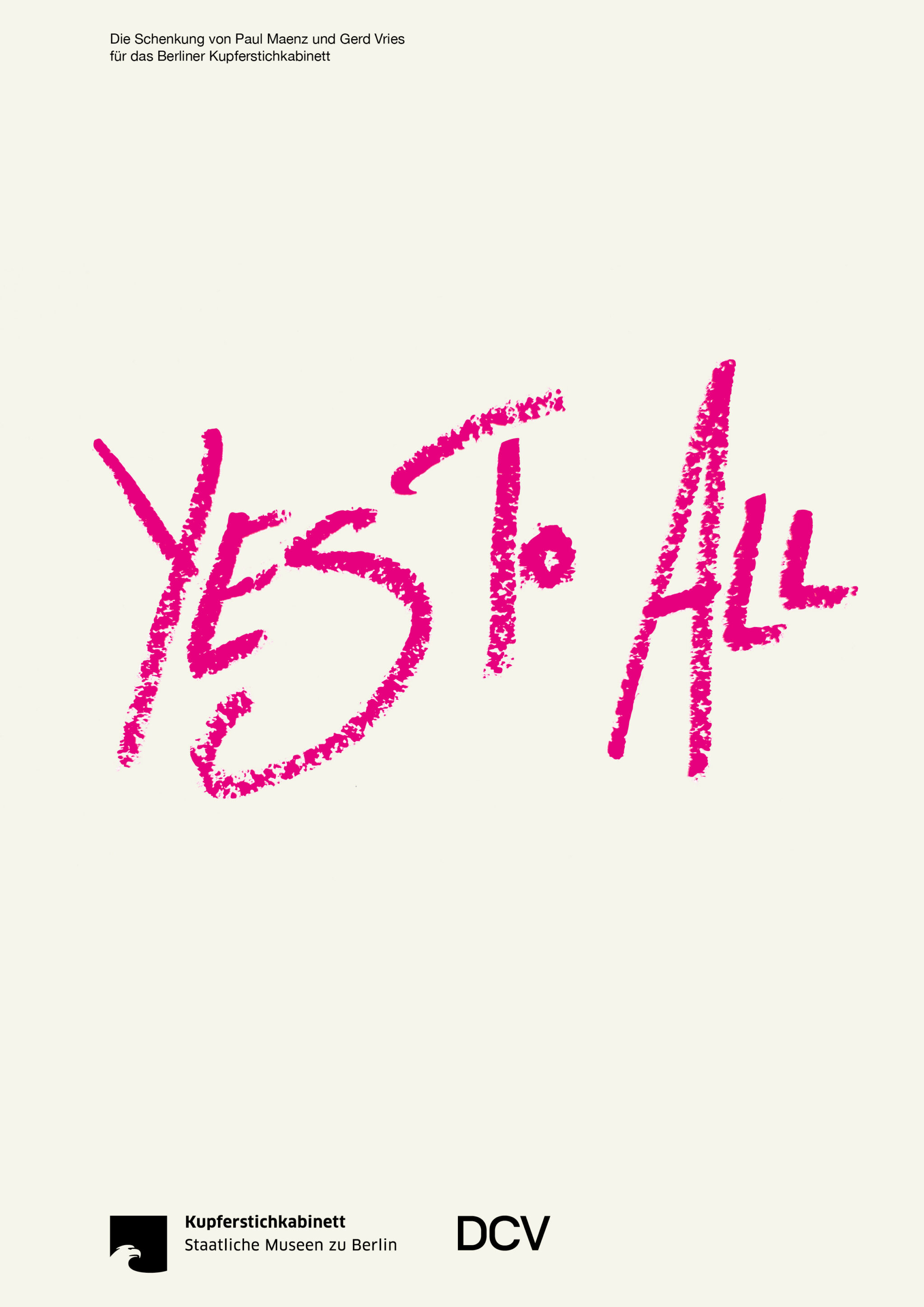
Yes To All
Die Schenkung Paul Maenz Gerd Vries42€ Add to cartThe catalog accompanying the exhibition YES TO ALL offers profound insight into a collection of over nine hundred works on paper—from postcards and drawings to photographs and posters—that was gifted to the Kupferstichkabinett in 2022, with subsequent additions over the years until 2025. The donors are Paul Maenz and Gerd de Vries, who ran a gallery for contemporary art in Cologne until 1990 and chaperoned the evolution of avant-garde art from the conceptualism of the late 1960s to the neo-expressive painting of the 1980s. The most recent works in the collection date from 2024. Several essays and a conversation with the donors invite the reader to experience the stylistic and thematic polyphony of Western art in the late twentieth and early twenty-first centuries in new ways.
EXHIBITION:
YES TO ALL. THE GIFTS OF PAUL MAENZ GERD DE VRIES TO THE KUPFERSTICHKABINETT
KUPFERSTICHKABINETT, STAATLICHE MUSEEN ZU BERLIN
UNTIL JANUARY 11, 2026 -

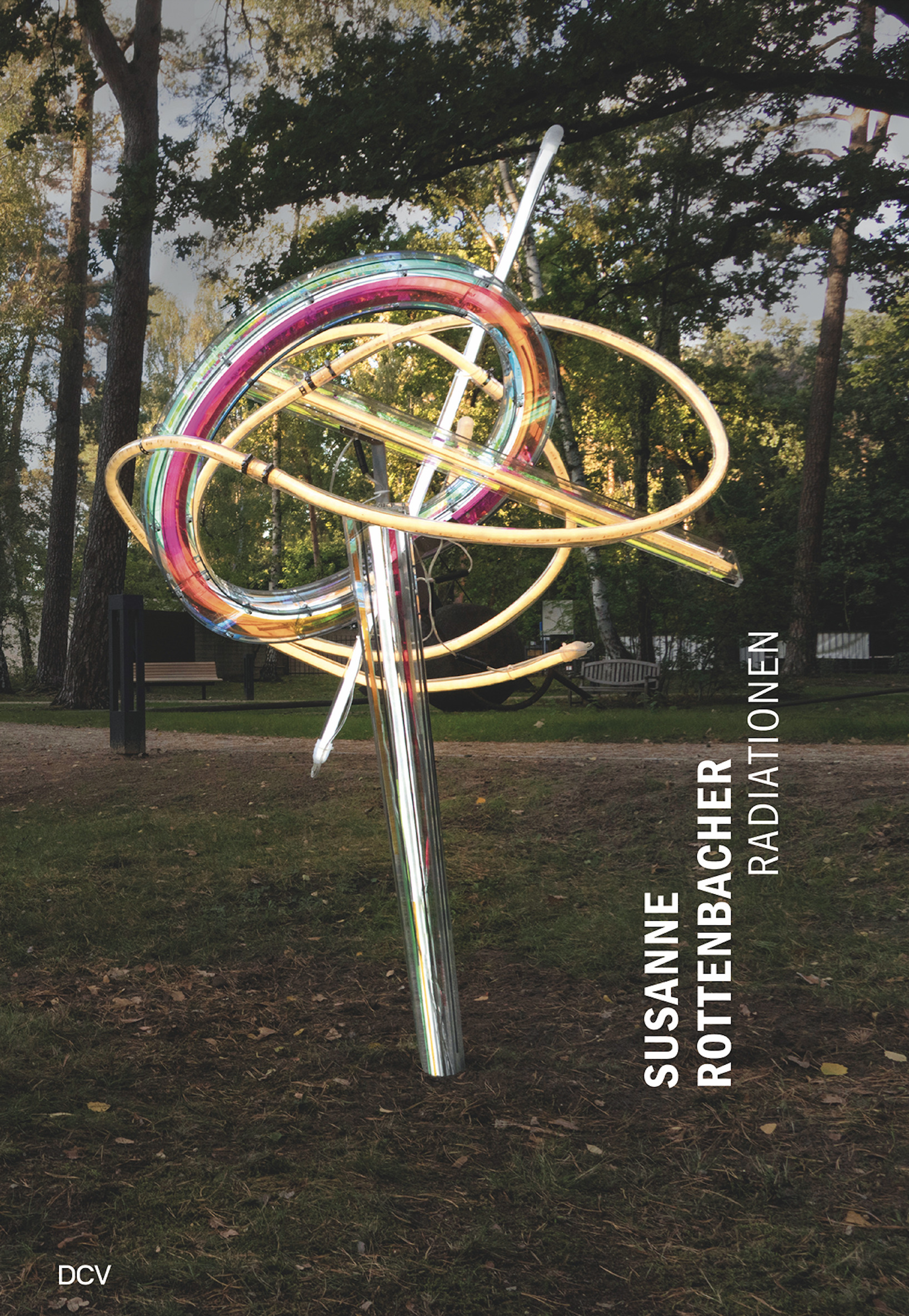
Susanne Rottenbacher
Radiationen40€ Add to cartIn expansive compositions in light, Susanne Rottenbacher (b. Göttingen, 1969; lives and works in Berlin) visualizes the fire of life in its timebound and fluid dimension. Plotinus called fire the “spiritual potency of beauty.” Pursuing a similar vision, Rottenbacher’s works orchestrate light as energy in space. To this end, the artist, who studied light and stage design in the United States and the United Kingdom, creates weightless luminous choreographies realized in colorful LED technology in combination with acrylic glass as a translucent vehicle of form. The results are installations in three dimensions that are deeply silent yet unfold in a magical ecstasy of light.
In Christian sacred architecture, light has been deployed and perceived since the Middle Ages as the aesthetic equivalent of the divine mind’s lucidity. The history of light art, by contrast, is much younger, going back to the years after the First World War. Having built her creative practice over the past fifteen years, Rottenbacher not only continues a century-old tradition of light art in Europe and the U.S.; her works also anticipate a future in which humanity will have room for feelings no less than for scientific knowledge.
-

Larissa Fassler
Building Worlds20€ Add to cartThe drawings and sculptures of Larissa Fassler (born 1975 in Canada, lives in Berlin) both document and question the modern metropolis, its public squares, train stations, and functional buildings. Fassler researches her chosen locations extensively in city archives and online. She tracks trends such as economic disparity, gentrification, homelessness, or drug consumption. She supplements these statistical facts with her own subjective survey methods, such as repeatedly visiting and observing the sites. All of the information gathered finds its way into Fassler’s complex cartographic drawings and sculptures, which reflect the socioeconomic and geopolitical challenges of our time. This book accompanies Fassler’s exhibition at the Kunstverein Lingen.
-

FINALE
DIRECTOR’S CUT25€ Add to cartThe Best Part …
In 1994, Britta Erika Buhlmann took the helm at Museum Pfalzgalerie Kaiserslautern, from which she will retire in the spring of 2022. In her twenty-eight-year tenure, she has enlarged the museum’s art collection and put her personal stamp on it. The classical modernism division was strengthened with the addition of major works by Otto Dix, Hermann Scherrer, and Karl Buchheister, while key pieces by François Morellet, Martin Willing, Werner Pokorny, and others have enriched the museum’s holdings in sculpture. A newly established division of the collection is dedicated to the creations of American artists such as Eric Levin, Kiki Smith, Charles Pollock, and Richard Pousette-Dart. More than a few artists—the list includes Carmen Herrera, Pierrette Bloch, Eva Jospin, and Nobuyuki Tanaka—made their German or even European début at the mpk.
In this book, members of the mpk’s staff offer their takes on selected works in the collection, unfurling a subjective story of their engagement with works that have earned the museum its reputation as a “place of discoveries.”
-

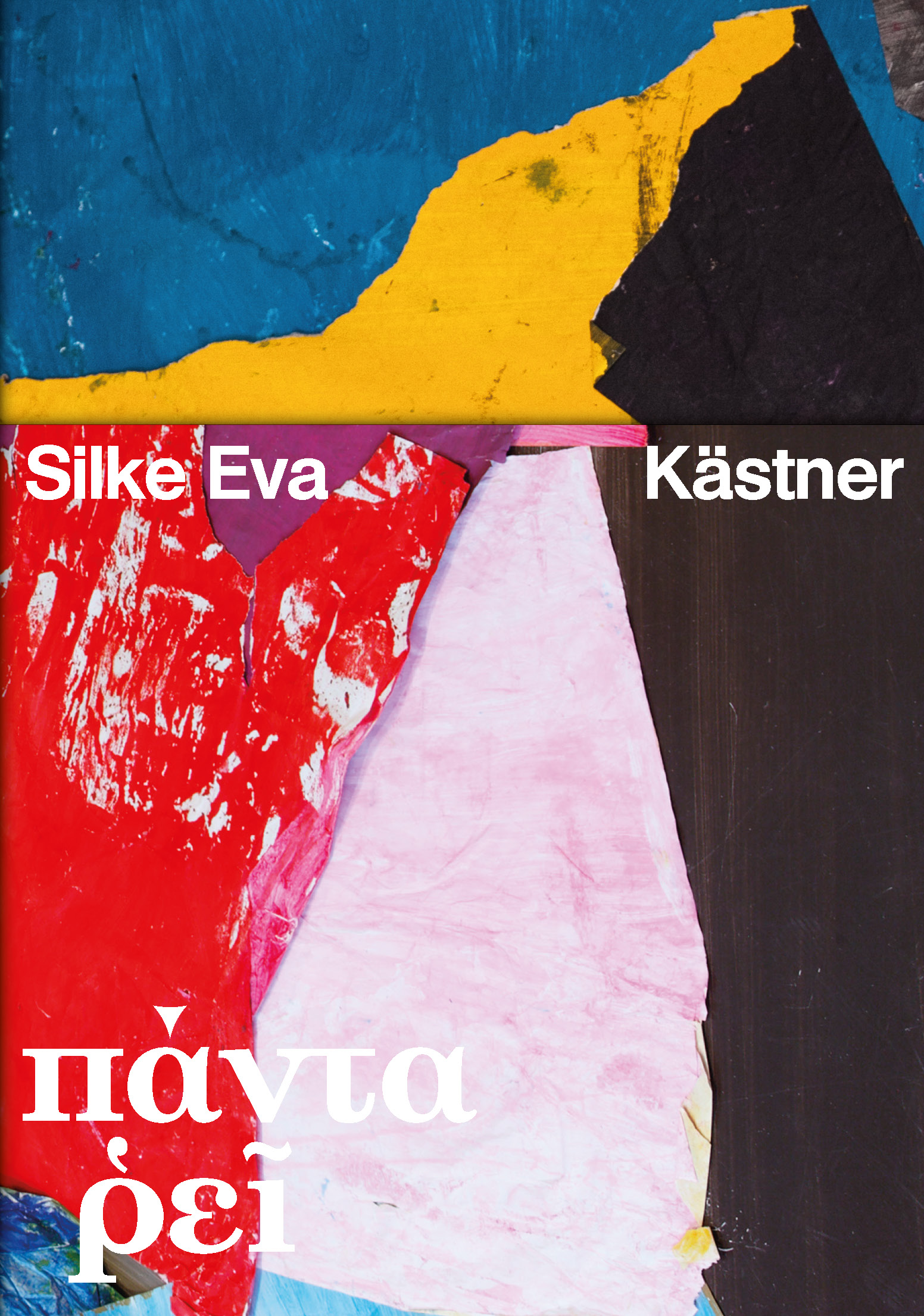
Silke Eva Kästner
Panta Rhei36€ Add to cartSilke Eva Kästner (lives and works in Berlin and Uckermark) developed her creative approach while traveling in India, New York, and Japan. She creates temporary on-site paintings as well as conceptual pieces in which the viewer comes upon prepared materials and becomes part of—or even alters—the picture. Kästner documents these encounters in photographs or filmic traces out of which she compiles films in the editing suite. Probing the potentials of painting as communication, she foregrounds the active intervention and process. In the gallery no less than the urban scene, Kästner places painting in relation to architecture in order to frame it in varying perspectives.
The monograph offers insight into the foci of Kästner’s art; the works are grouped in chapters rather than arranged in chronological sequence. This structure makes the book a space of experience that gives the reader a vivid sense of her ephemeral creations.
After studying with Katharina Grosse at the Weißensee School of Art and Design Berlin, Silke Eva Kästner won the Mart Stam Prize; she honed her craft in India on a NaFöG fellowship and in New York on a yearlong DAAD fellowship. Funding support from the Institut für Auslandsbeziehungen (ifa) enabled her to initiate an ongoing exchange project between Kashmir and Berlin. Her work has been on view at numerous institutions including the Schirn Kunsthalle Frankfurt; the Devi Art Foundation, Delhi; Berlinische Galerie, Berlin; the Queens Museum of Art, New York; Künstlerhaus Bethanien, Berlin; and the Haus der Kulturen der Welt, Berlin.
- Release January 2026
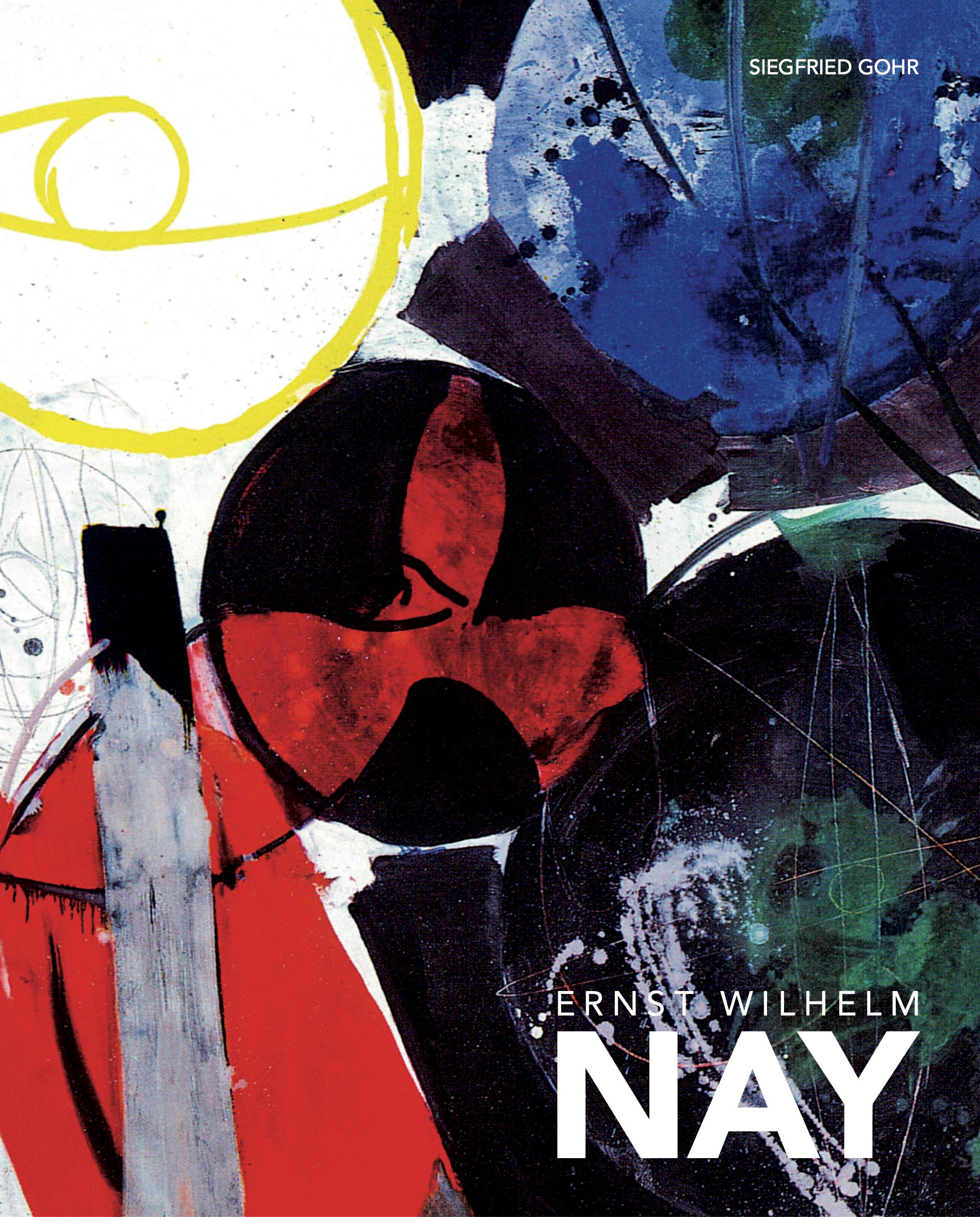
Ernst Wilhelm Nay
Monographie68€ Add to cartThe Great German Artist’s Imposing Oeuvre
Ernst Wilhelm Nay (b. Berlin, 1902; d. Cologne, 1968) was one of the most interesting painters of European modernism. Spanning the decades from the 1930s to his death in Cologne in 1968, his output encompasses paintings as well as an abundance of works on paper. The new monograph surveys all periods in Nay’s oeuvre, from the “Fishermen paintings” to the striking late pictures, which leave no doubt about the artist’s outstanding gift for color. Nay’s evolution is embedded in the history and ideas of his time, on which he reflected in lectures, writings, and notes. The volume unlocks a wide spectrum of fresh insights into Nay’s life and art.
-
Sebastian Stöhrer
Residents40€ Add to cartIf there’s an artist whose oeuvre merits the title “creation,” it is Sebastian Stöhrer. Shaping clay—essentially, soil—he molds his “residents”: colorful and friendly-looking sculptural beings, some of them enhanced with sticks or branches reminiscent of limbs. Despite their air of levity and humor, they are not the products of mere momentary inspiration or a whim. It takes decades of dedicated experimentation with the kiln based on the millennia-old art of ceramics as well as expert knowledge of chemistry and physics to create such colors and shapes. Stöhrer has been called an alchemist, and indeed he has made it his mission to vindicate this researcher’s craft, an ancestor of the natural sciences. Alchemy, like Stöhrer’s oeuvre, combines pure rationality with coincidence and a scintilla of magic. The artist plays an intuitive and sensual game with his clay and the virtually incalculable chromaticity of the glazes—chaos, anarchy, and irrepressible urges being an integral dimension of all creation. In Stöhrer’s “residents,” we encounter the embodiments of that creation: likenesses of ourselves and perhaps also heralds of a future more good-natured version.