
Werner Schmidt
James Joyce und die Farben des Ulysses
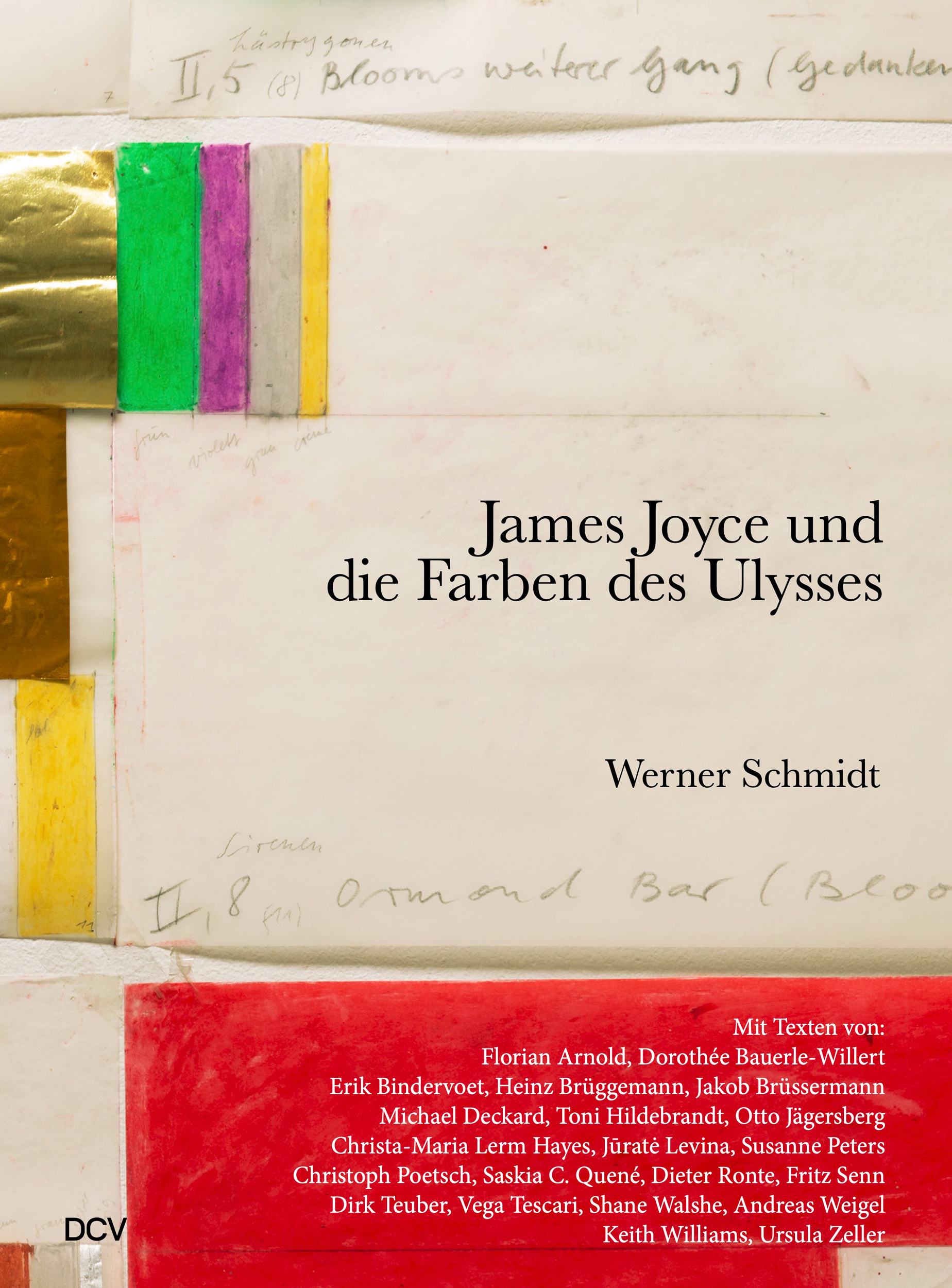 | |
|---|---|
| Design | Werner Schmidt and Frederik Zecheus |
| Size | 20 x 27 cm |
| Cover | Hardcover with debossing, bookmark ribbon and poster |
| Pages | 328 |
| Illustrations | ca. 243 |
| Language(s) | German, partly English |
| ISBN | 978-3-96912-242-6 |
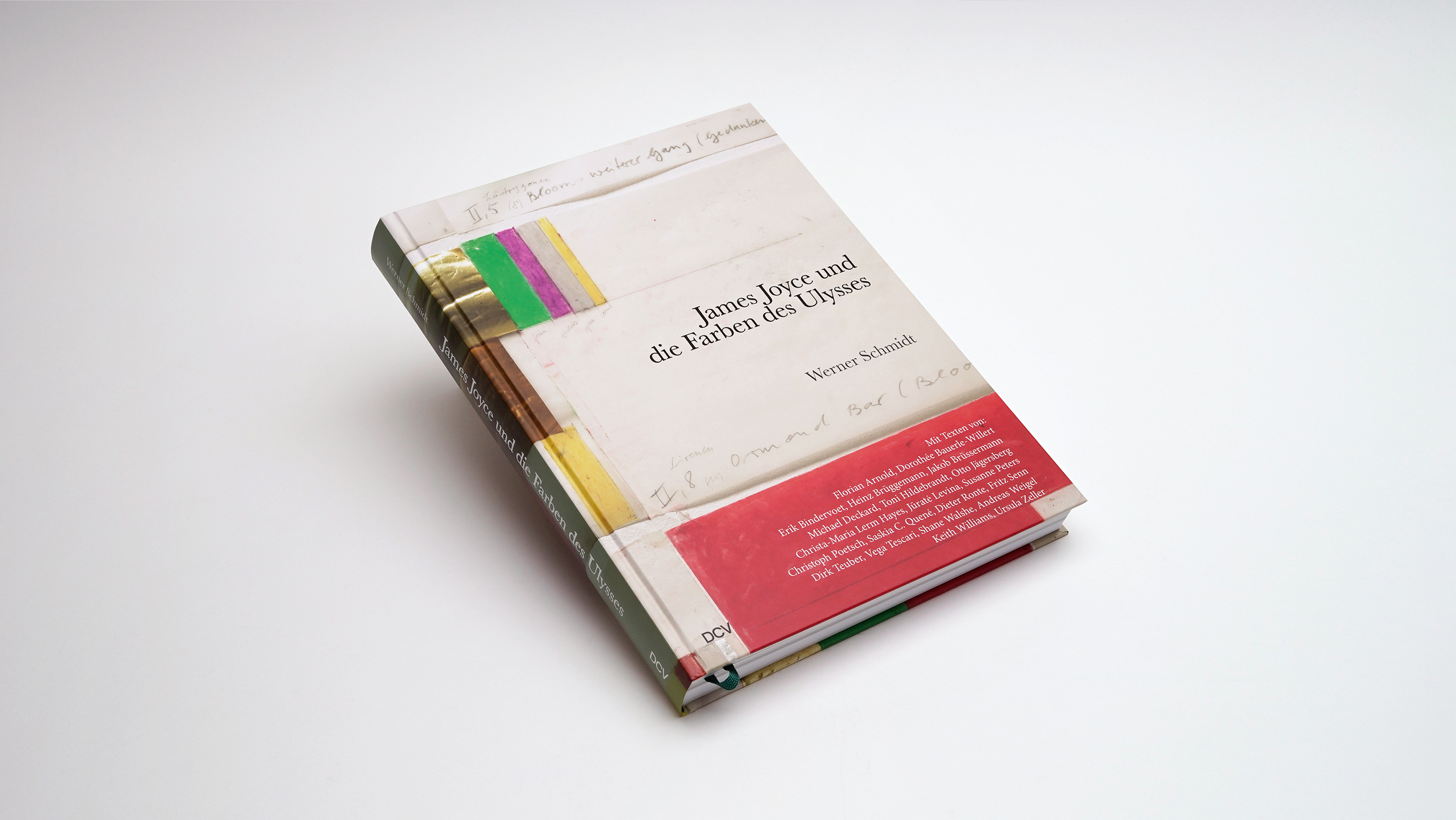
This imposing volume is the fruit of the artist Werner Schmidt’s decades-long immersion in the preeminent literary monument of the twentieth century: James Joyce’s Ulysses.
What began as a personal reader’s voyage now attains definite form in an eloquently colorful, interdisciplinary and polyphonic tribute—a work between literary study, theory of color, visual art, and reflection on language.
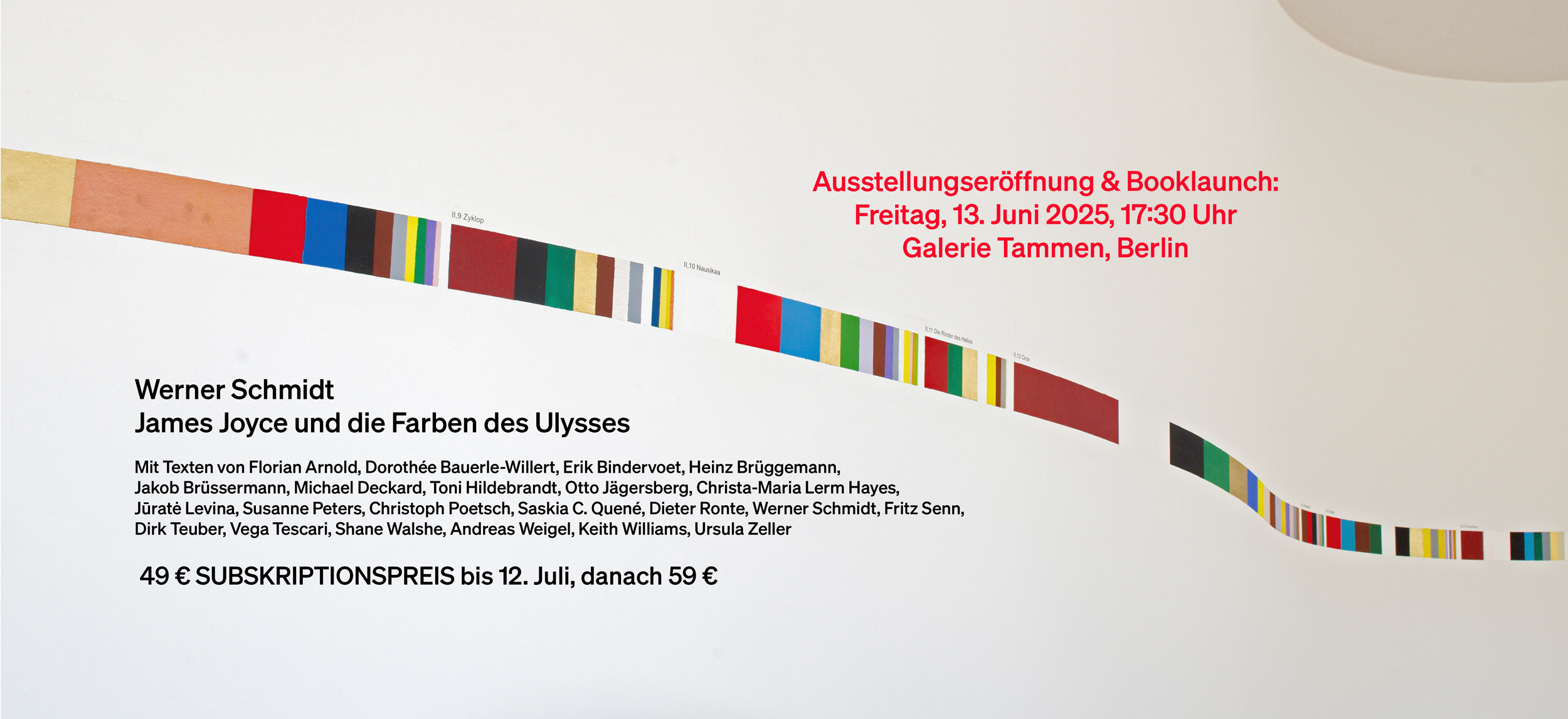
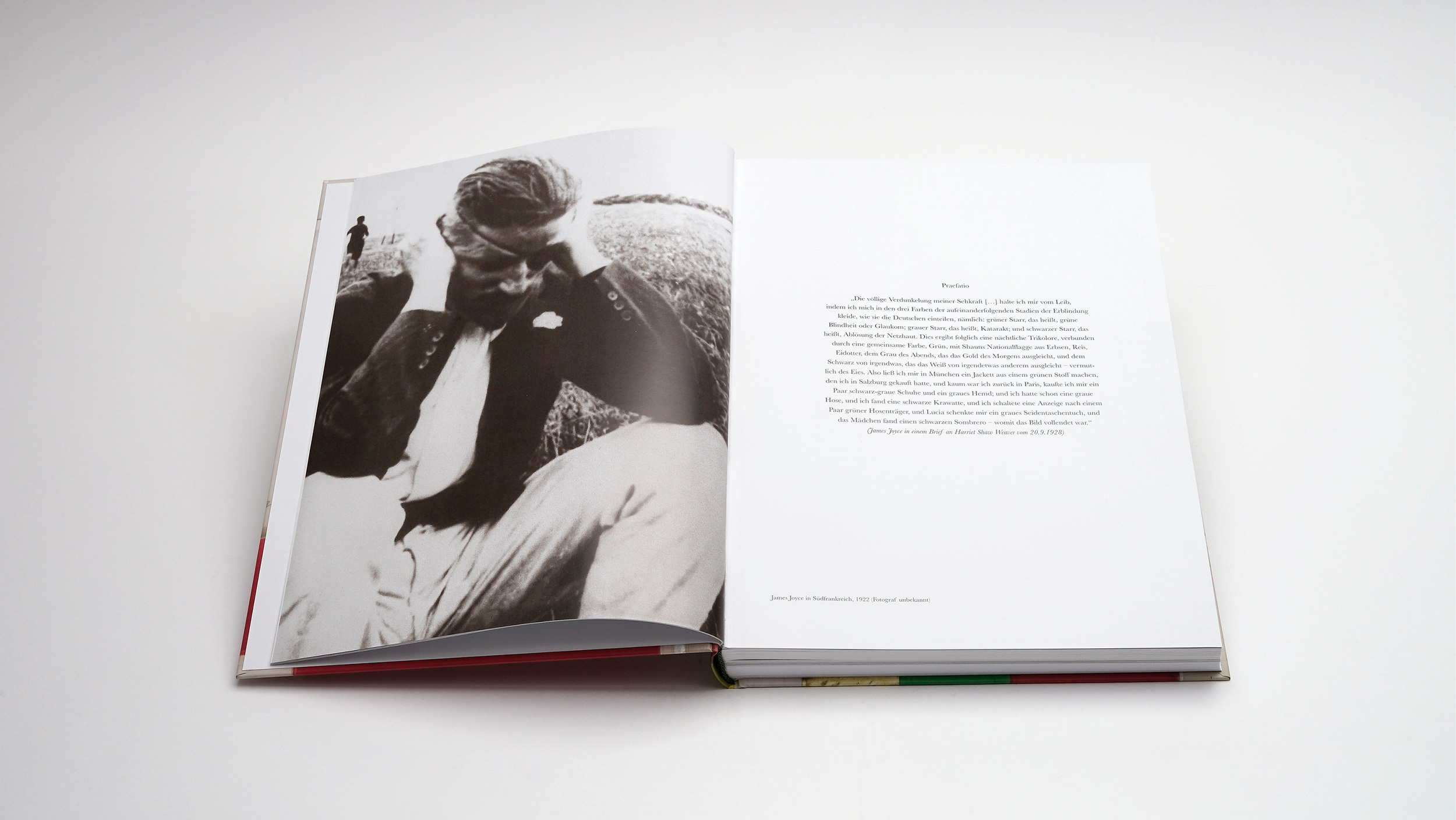
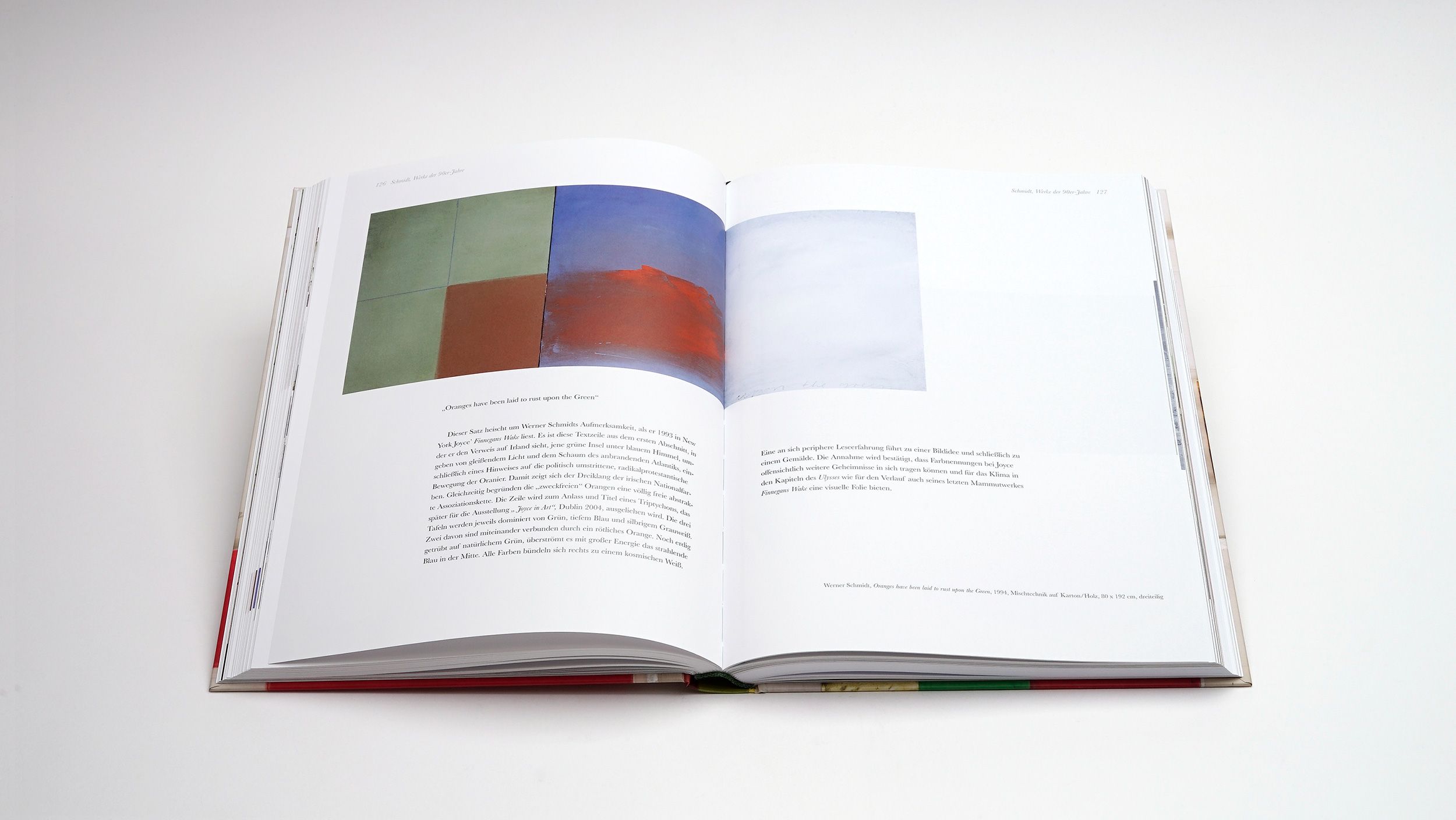
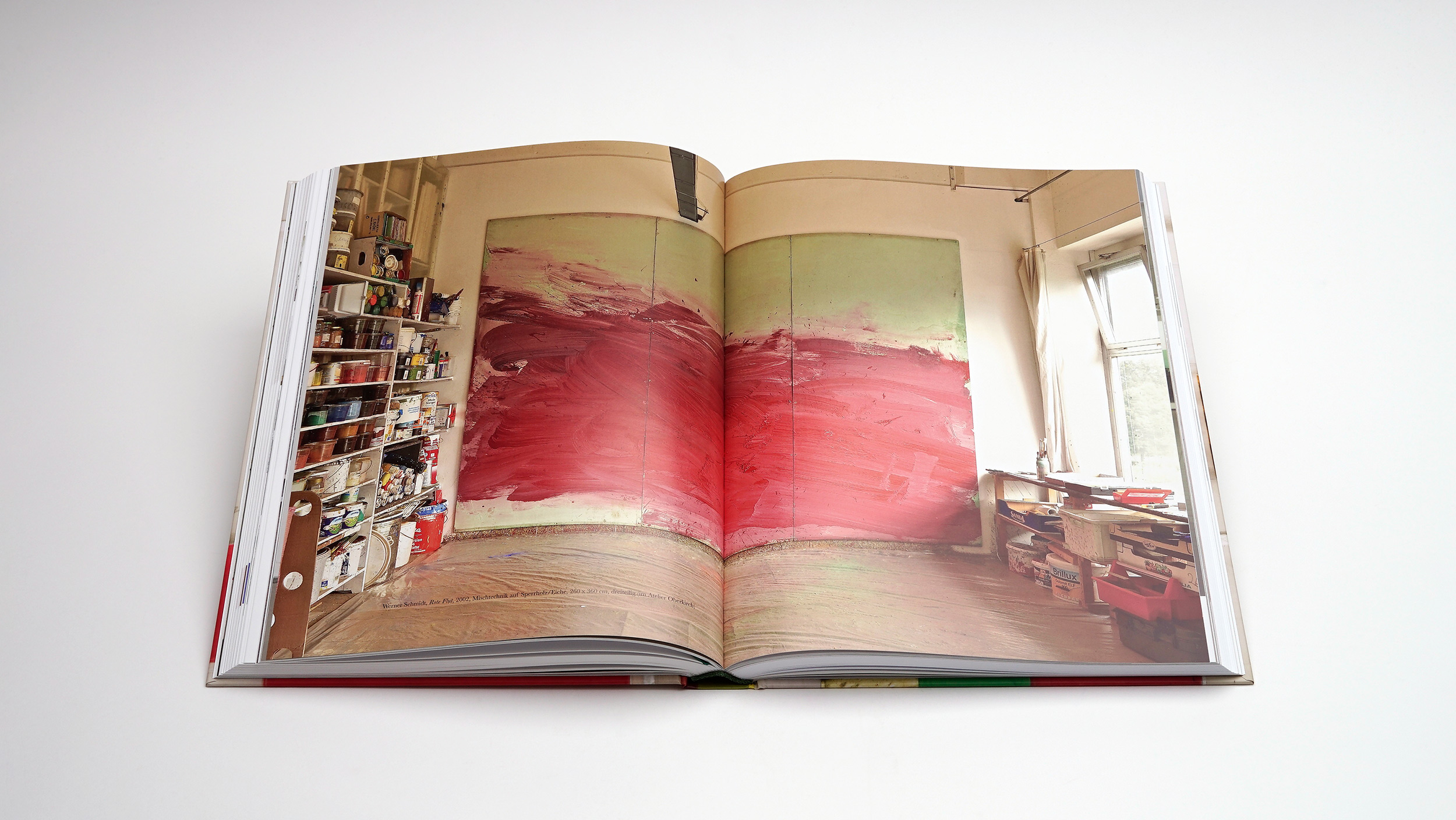
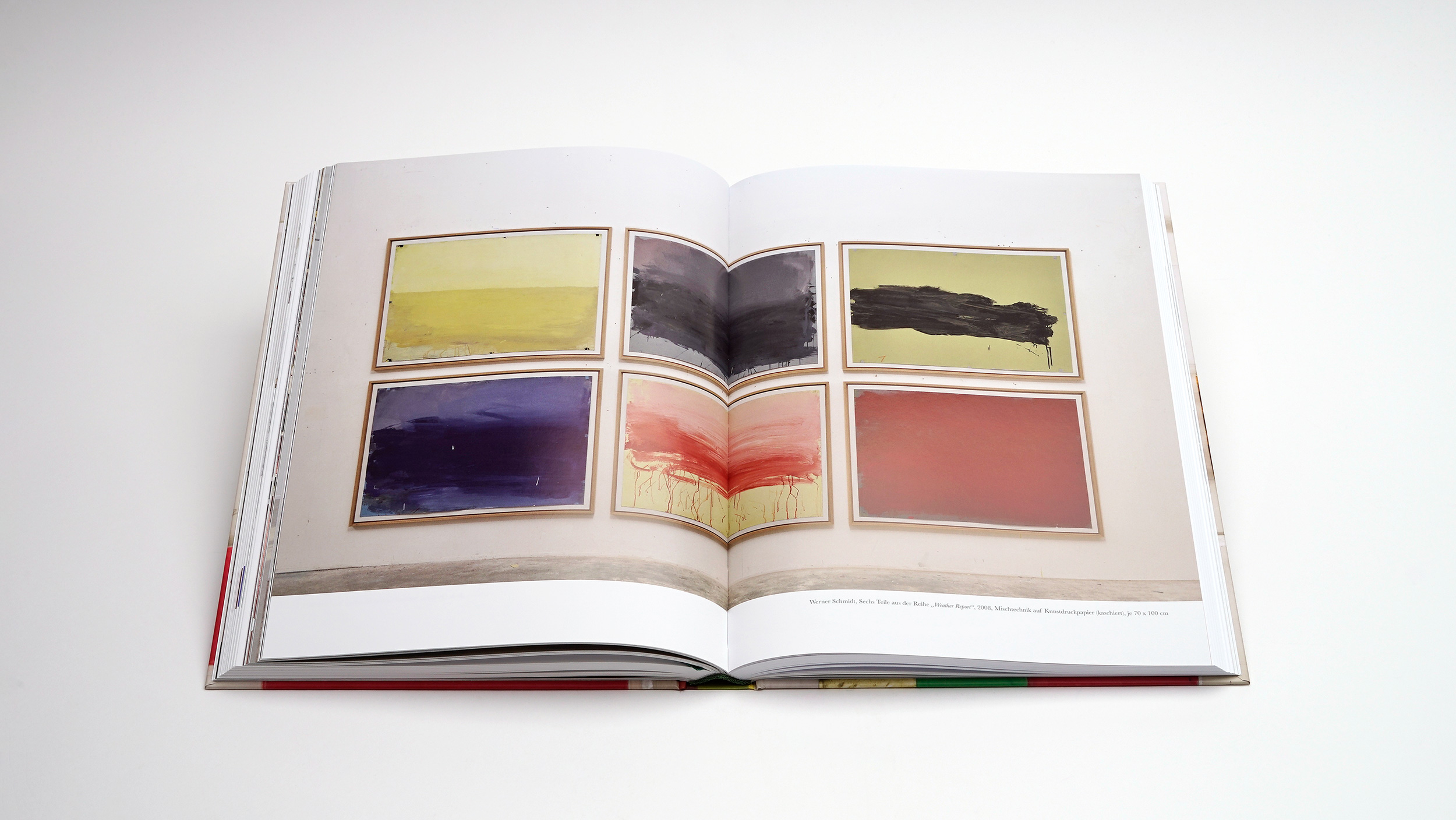
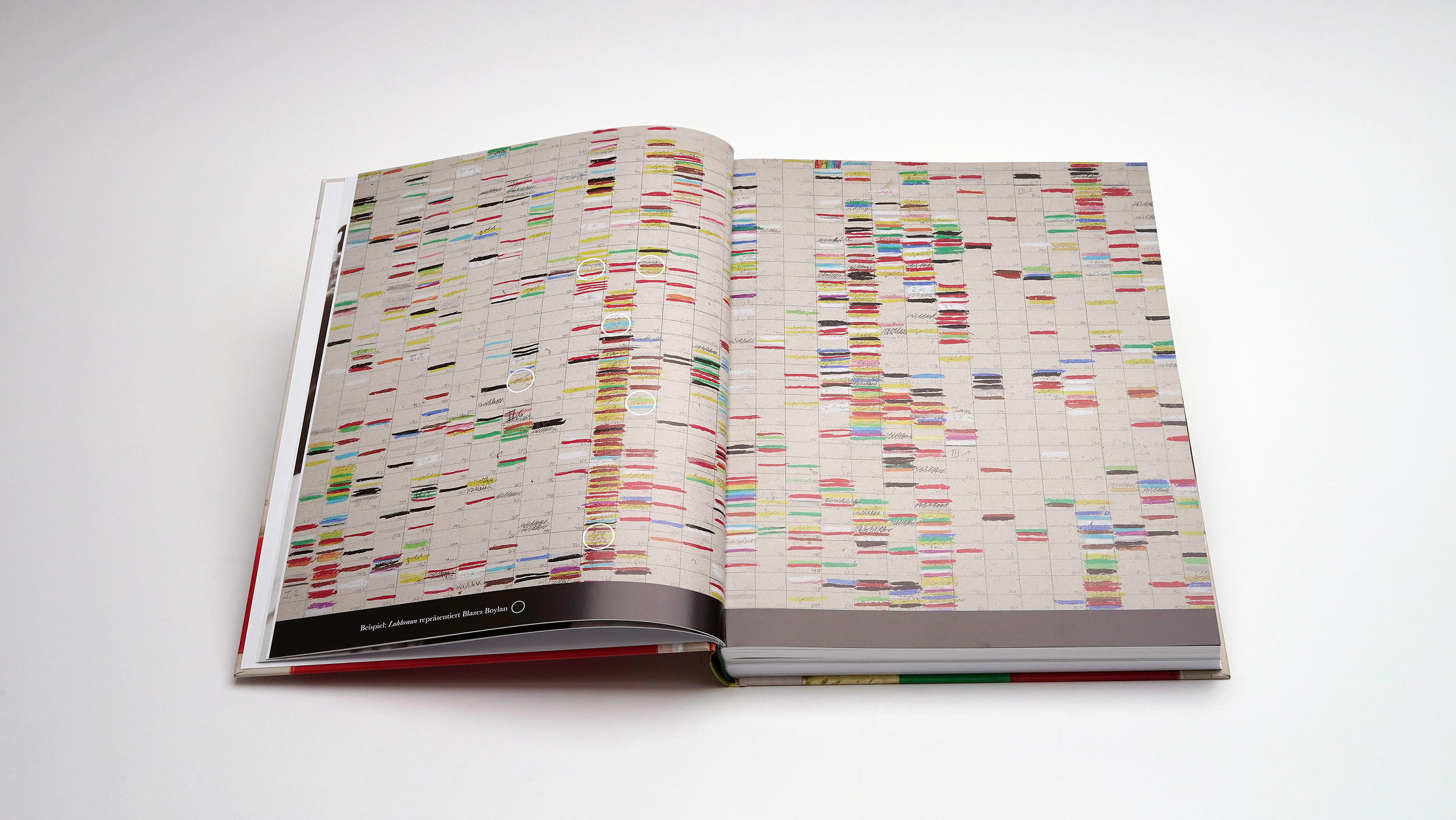
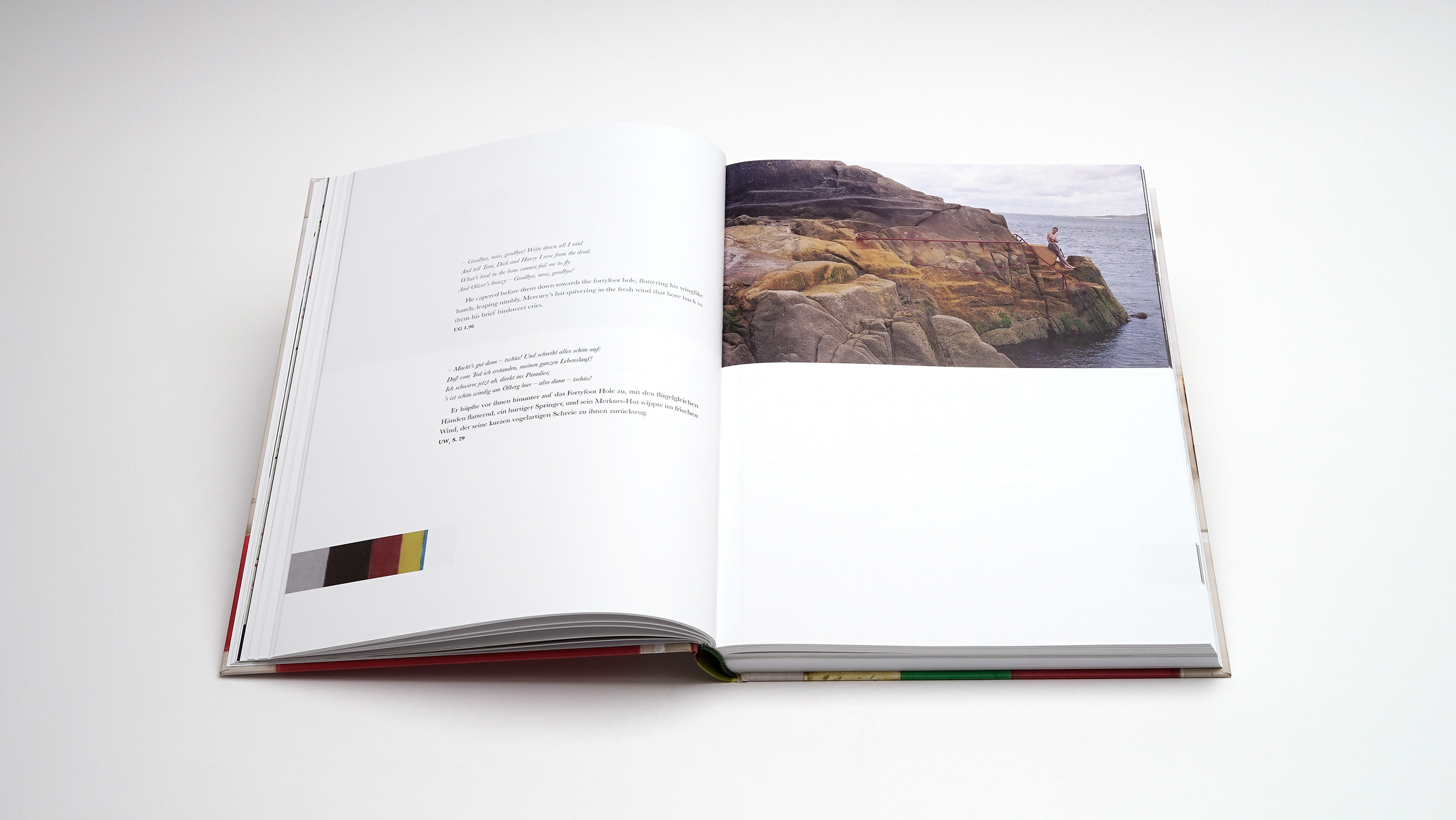
In the book’s first part, Schmidt analyzes and visualizes the use of colors in Ulysses in unique chromatic diagrams and coded color stripes that were literally painted on the walls in exhibitions. They are complemented by a series of photographs taken in Dublin, the novel’s setting, and accompanied by probing meditations on literary and linguistic facets and aspects of politics and the history of religion in the Joycean universe.
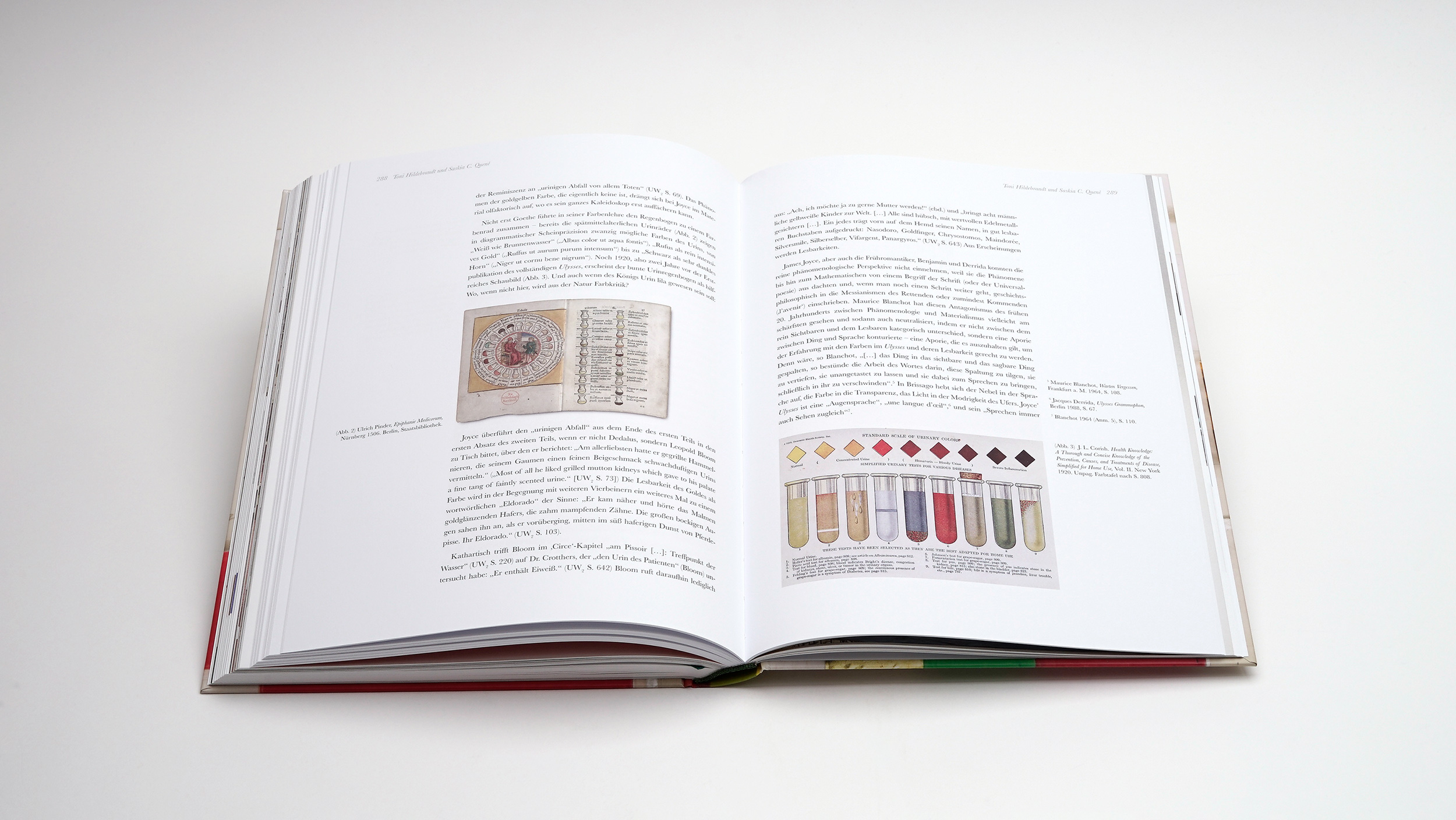
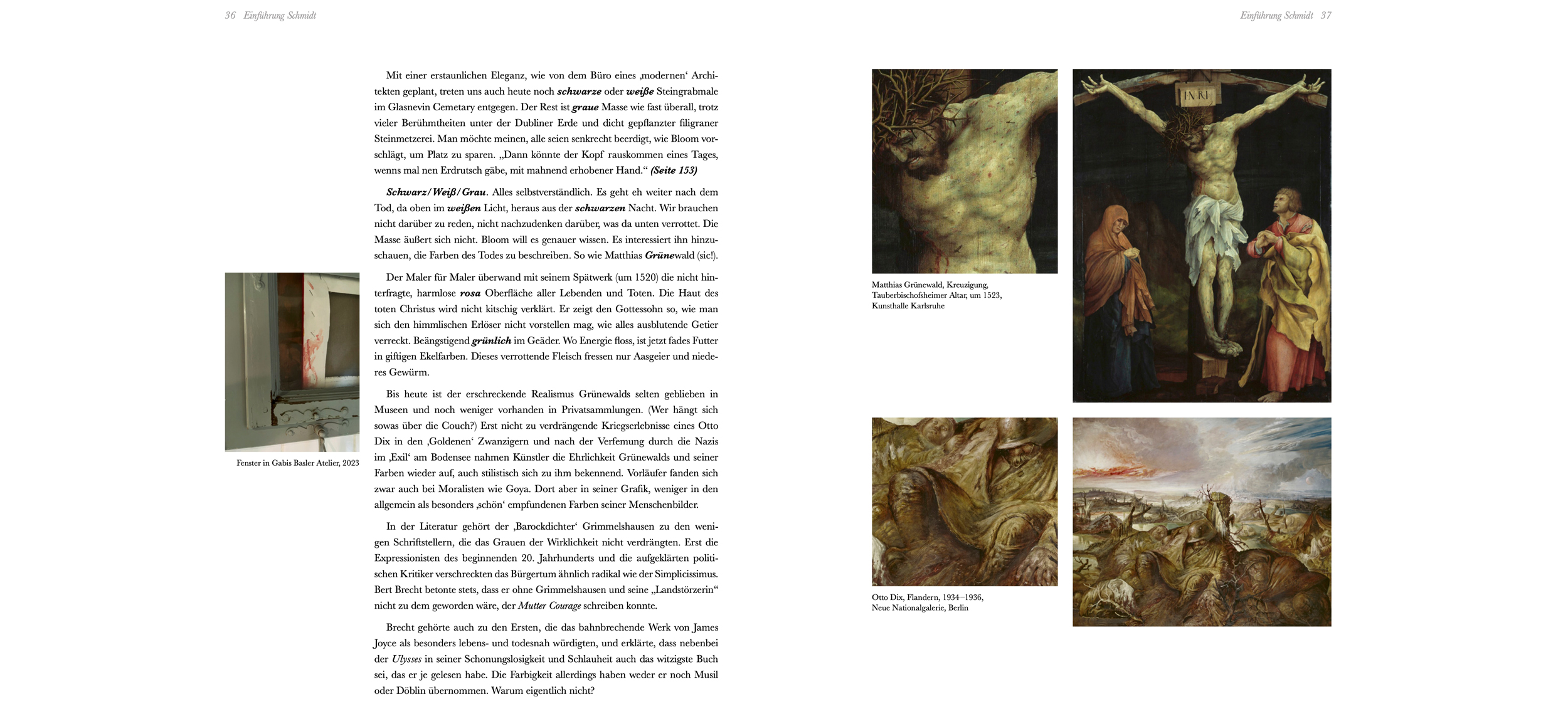
The second part gathers the voices of twenty renowned Joyce scholars, who, in five thematically organized chapters, share their perspectives on the color, texture, structure, and effect of Ulysses.
A feast for all who revere Joyce—and a gift of anyone who would not just read but truly wrap their mind around literature in its boldest and most luminous incarnation.
With texts by Florian Arnold, Dorothée Bauerle-Willert, Erik Bindervoet, Heinz Brüggemann, Jakob Brüssermann, Michael Deckard, Toni Hildebrandt, Otto Jägersberg, Christa-Maria Lerm Hayes, Jūratė Levina, Susanne Peters, Christoph Poetsch, Saskia C. Quené, Dieter Ronte, Werner Schmidt, Fritz Senn, Dirk Teuber, Vega Tescari, Shane Walshe, Andreas Weigel, Keith Williams, Ursula Zeller
More books
-

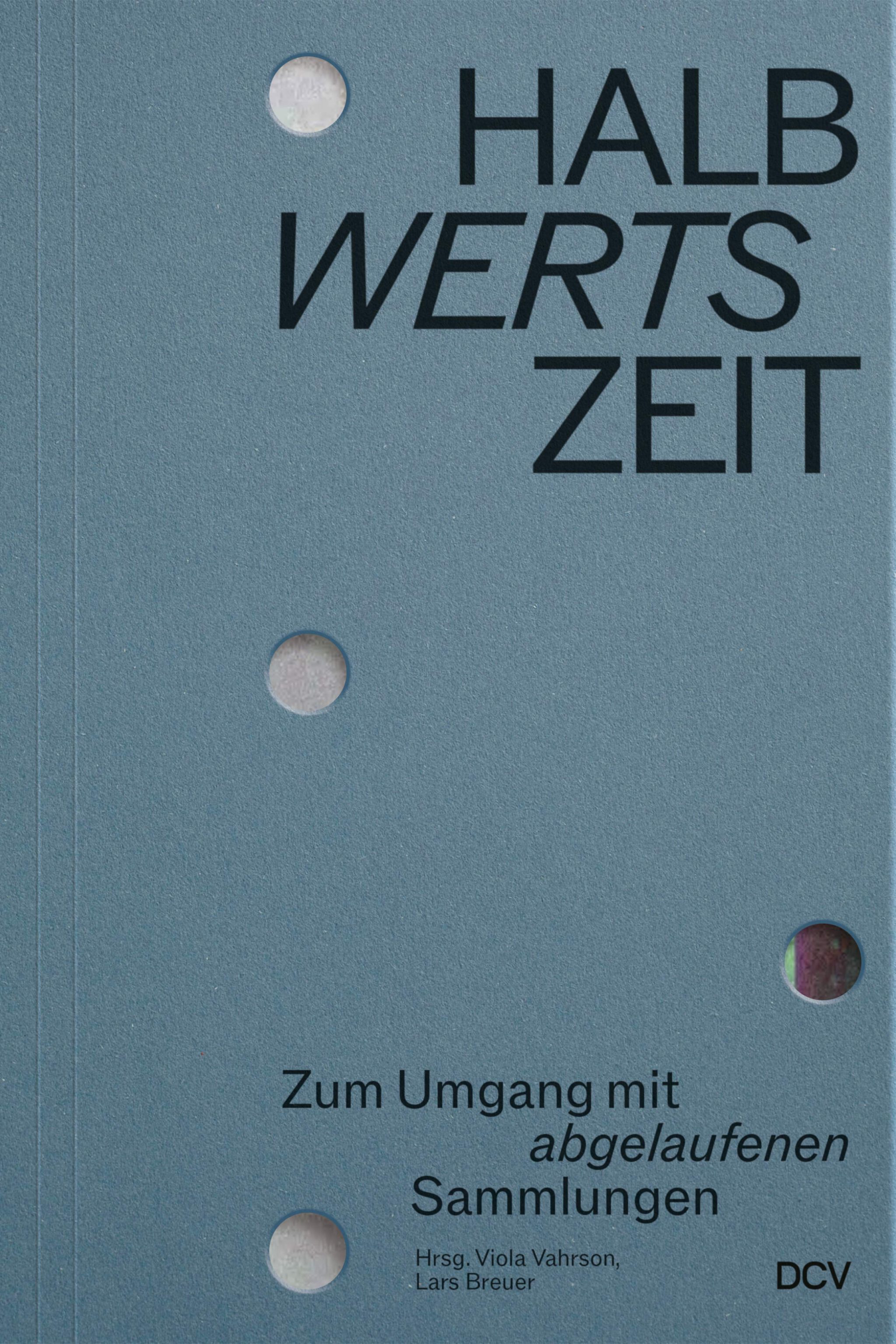
HALBwertsZeit
Zum Umgang mit ‚abgelaufenen‘ Sammlungen28€ Add to cartDo collections have an expiration date? Shifting interests, evolving social contexts, and discursive developments influence when a collection or its presentation is said to be outdated and what that implies for the constraints on, or options for, the actions to be taken in response. The revision or reorientation of a collection presuppose a critical engagement with the criteria regarded as valid at the time, which concern the origins, composition, objectives, and significance of a collection, among other aspects.
The contributions to this volume intertwine historical case studies with contemporary questions about the reasons and circumstances that give rise to the assessment that a collection has outlived its shelf life.
-

Mon Trésor
34€ Add to cartEurope’s Treasure Chamber
What do the torque of the princess of Reinheim, the tableware from the Orient Express, and the radio station Europe 1’s studio building have in common? They are among the treasures of the Saar region. The book presents outstanding archaeological objects and achievements of technology and art dating from the age of the Celts to the present. Drawn from the Saarland and neighboring Alsace-Lorraine, Luxembourg, and Rhineland-Palatinate, the unexpected riches illustrate the cultural and social dimensions of this multinational region in the heart of Europe. The title Mon Trésor describes many of them quite literally: the note a seven-year-old dashed off to his father before his family was evacuated in the first days of World War II; the Roman-era ring that is also a relic, witnessing to flight and danger. All treasures are personal first and foremost, though others may later cherish them as cultural assets.
-

Maximilian Rödel
Celestial Artefacts50€ Add to cart“One must break free from wanting something and confine oneself instead to being something.” — Maximilian Rödel
Inky black, apricot, magenta, and a pastel purple: apparent monochromes, the paintings of Maximilian Rödel (b. Braunschweig, 1984; lives and works in Berlin) actually do not just traverse color spectrums; in a sense, they chart horizons of experience. To contemplate them is to embark on a voyage through space and time. Foreground and background are one, depth and surface at once; an undertow makes itself felt in which the nuances of color interweave, blur into one another, shimmer, flare up. The artist describes his pictures as an unfocused energy that already exists; he merely uncovers it.
The first publication on Rödel’s work presents the exhibition Celestial Artefacts at Neuer Aachener Kunstverein, with an emphasis on the Prehistoric Sunsets series (2018–2021). It is complemented by reproductions of selected works and an extensive index that also includes details from earlier series that are relevant in the context. Aperçus contributed by Rafael Horzon and Leif Randt and writings on art by Domenico de Chirico, Lena Fließbach, Stefanie Gerke, Philipp Hindahl, and Maurice Funken add another dimension to the paintings.
-

Werner Schmidt
James Joyce und die Farben des Ulysses59€ Add to cartThis imposing volume is the fruit of the artist Werner Schmidt’s decades-long immersion in the preeminent literary monument of the twentieth century: James Joyce’s Ulysses.
What began as a personal reader’s voyage now attains definite form in an eloquently colorful, interdisciplinary and polyphonic tribute—a work between literary study, theory of color, visual art, and reflection on language.
In the book’s first part, Schmidt analyzes and visualizes the use of colors in Ulysses in unique chromatic diagrams and coded color stripes that were literally painted on the walls in exhibitions. They are complemented by a series of photographs taken in Dublin, the novel’s setting, and accompanied by probing meditations on literary and linguistic facets and aspects of politics and the history of religion in the Joycean universe.
The second part gathers the voices of twenty renowned Joyce scholars, who, in five thematically organized chapters, share their perspectives on the color, texture, structure, and effect of Ulysses.
A feast for all who revere Joyce—and a gift of anyone who would not just read but truly wrap their mind around literature in its boldest and most luminous incarnation.
With texts by Florian Arnold, Dorothée Bauerle-Willert, Erik Bindervoet, Heinz Brüggemann, Jakob Brüssermann, Michael Deckard, Toni Hildebrandt, Otto Jägersberg, Christa-Maria Lerm Hayes, Jūratė Levina, Susanne Peters, Christoph Poetsch, Saskia C. Quené, Dieter Ronte, Werner Schmidt, Fritz Senn, Dirk Teuber, Vega Tescari, Shane Walshe, Andreas Weigel, Keith Williams, Ursula Zeller
-

Freeters
HELP! Artistic Intelligence38€ Add to cartFREETERS stands for an artist collective that designs, creates, transforms and plays with spaces, for and with the people who experience their time there. The artistic intelligence used in the process transforms into spaces for thinking, working, living, playing and learning, creating identity, emotion and inspiration.
This book is about the mediation of artistic thinking and artistic action in processes. The artistic practice of Freeters is characterized by strategies of thought and action that are needed in a society with constantly changing conditions, in a working world that overturns itself in its dynamics. The necessity of shaping the present through artistic thought and action can no longer be limited to the art context.
FREETERS’ AI approach should be understood less as a scientific methodology and more as a call not to reduce our intelligence to only rational thought processes with a utility maxim. Of course, AI has already made impressive progress in many areas of our public services via the hard components of machine learning. However, it is doubtful whether this approach alone can really give rise to a superintelligence that will one day create a resource-saving paradise on earth. Nor is it guaranteed that we as Homo Sapiens will be assigned a place in this paradise by such a unilaterally gifted superintelligence. Cognitively, this machine will be superior to us in any case – only the necessary feeling of happiness of a consensual coexistence does not seem quite conceivable.
-

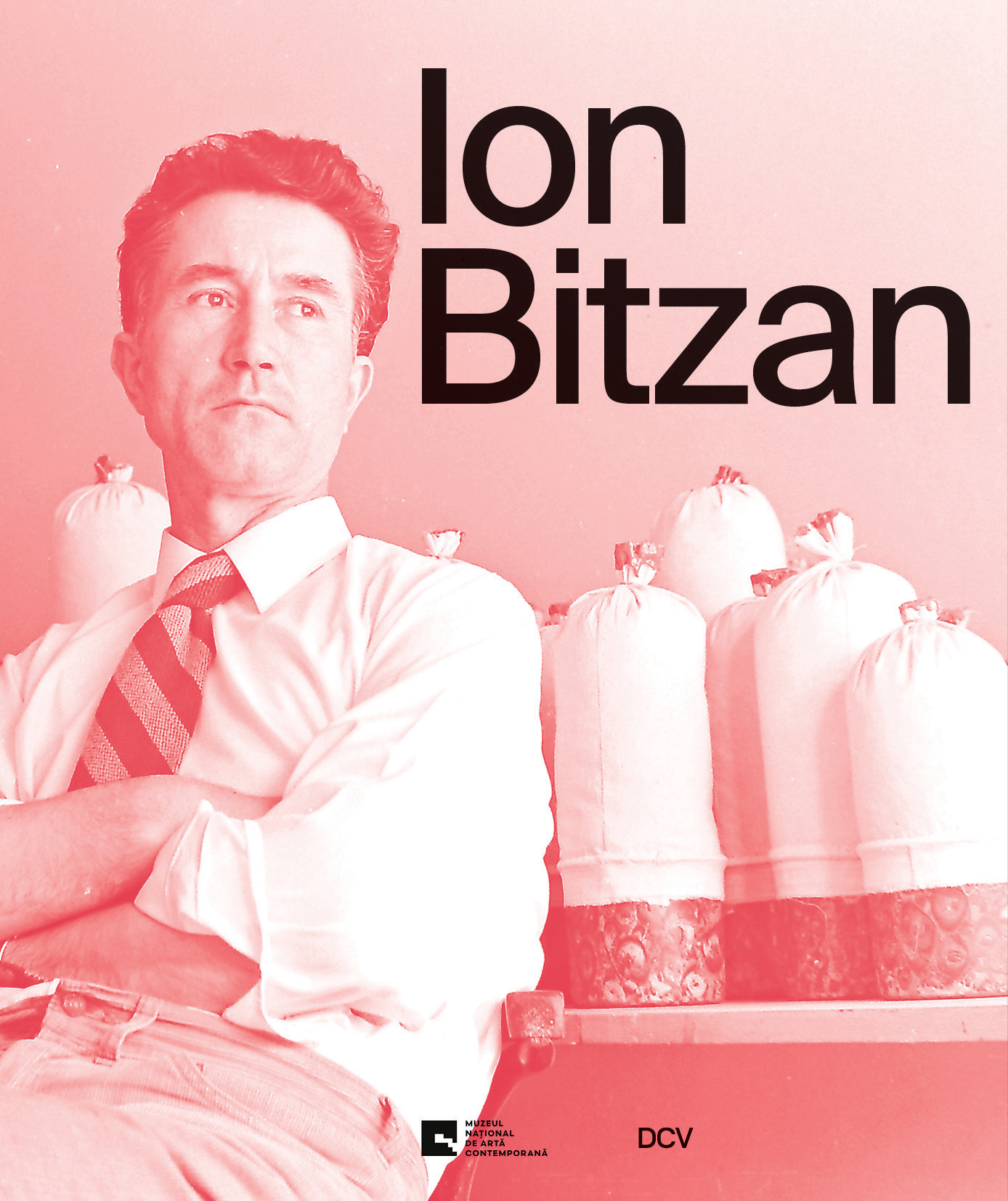
Ion Bitzan
48€ Add to cartThe painter and object artist Ion Bitzan (b. Limanu, 1924; d. Bucharest, 1997) belonged to the generation of Romanian artists who, in the 1960s and 1970s, broke through their country’s isolation to connect to the international avant-garde. His creativity and the quality of his artistic experiments, which drew inspiration from conceptual art, Dada, and other sources, made him a leading figure in the Romanian art of the Ceaușescu era. This book also sheds light on the complex relationship between artistic innovation and political (propaganda) art behind the Iron Curtain during this period, in which nothing was ever black or white. Bitzan represented Romania at the Venice (1964) and São Paulo Biennales (1967, 1969, 1981). In 2017, the National Museum of Contemporary Art (MNAC) in Bucharest mounted a major retrospective of his oeuvre.
-

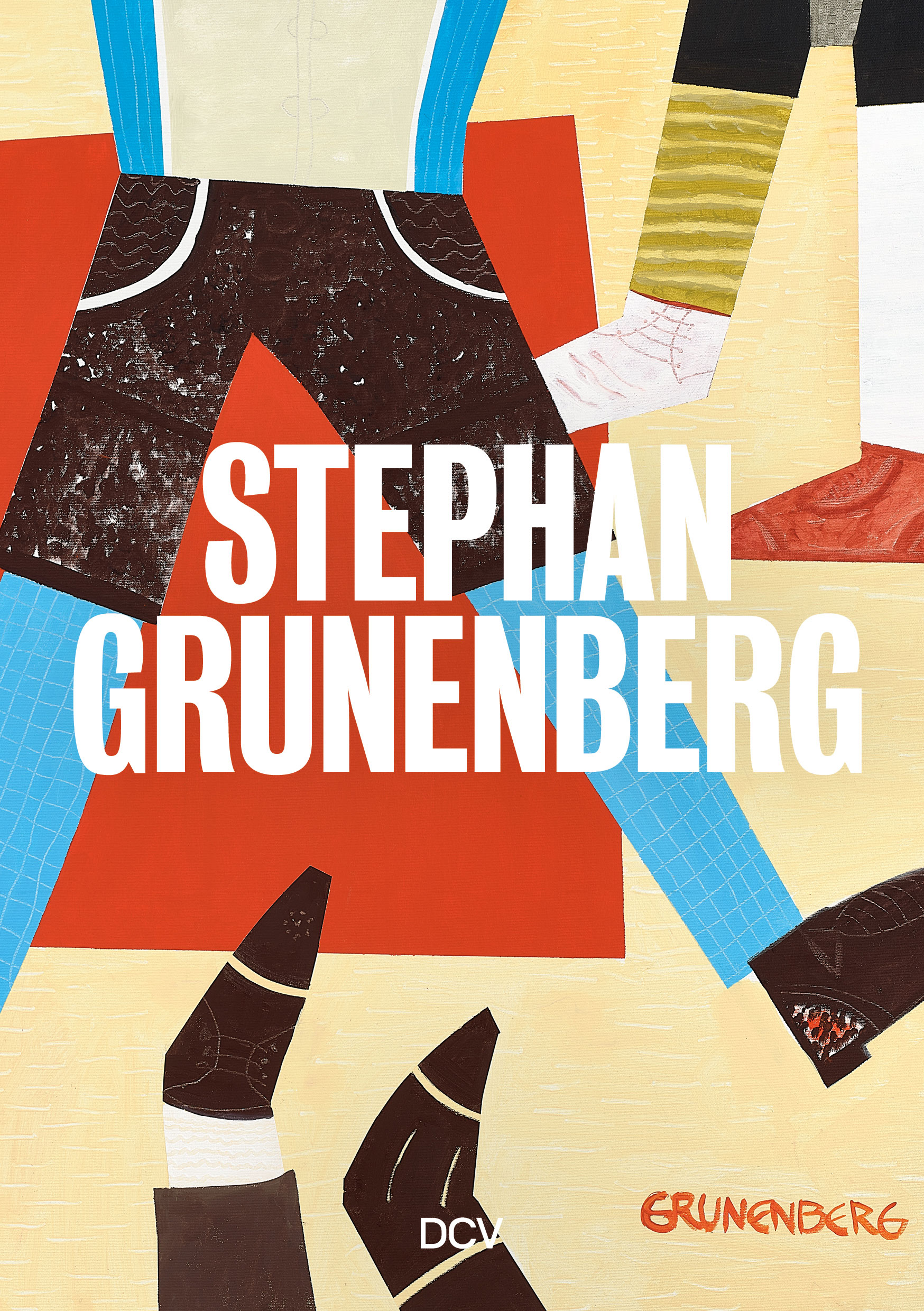
Stephan Grunenberg
10€ Add to cartStephan Grunenberg (b. 1954) paints peculiar portraits: not heads or sitting and reclining figures but seemingly independent feet, legs, trousers, socks or soles of shoes. These and other under-appreciated motives are playfully arranged in captivating compositions which take issue with our hierarchical habits while looking at art. “Leaving out the ‘civilized’, educated head and centering on neglected parts such as the legs, including the lower abdomen—which is either eroticized or made taboo—is the artist’s point”, writes Oliver Koerner von Gustorf in an essay that accompanies the images inside this small and attractive new book. The paintings reproduced in this volume were all exhibited in Grunenberg’s latest exhibition in 2024, which was titled tongue-in-cheek „Representatives Regional To Earth.”
-

America! America!
How real is real?38€ Add to cartMyths, Projections, Aspirations
In times of fake news and alternative facts it is becoming even more clear how the American Dream is closely interwoven with emotional pictures and symbols. At the same time, it can be said that no other nation might have the same strong awareness of the power of images. Images of the American Way of Life, which are produced in media and entertainment, are able to consolidate existing power structures and perceptions of reality, but also question them in a radical way. The psychologically charged canvasses of Eric Fischl, the hermetic scenes of Alex Katz, the enormous film-noir-like graffiti paintings of Robert Longo dissect the dreams and fears of an insecure white middle class. Simultaneously, artists such as Jeff Wall or Cindy Sherman conquer scenes that critically reflect our media-influenced perception, becoming models for subsequent generations. By showing 70 masterpieces of US-contemporary art, the book shows how artists from the 1960s to date comment on the American reality.
-

Alexandru Chira
42€ Add to cartAlexandru Chira’s (b. Tăușeni, Romania, 1947; d. Bucharest, 2011) oeuvre systematically and comprehensively maps a fictional field of research. His paintings, drawings, and objects, whose individual elements recall switches, screens, keyboards, and levers, were designed to “bring rain and rainbows,” to promote prosperity and prevent floods. Working in his art laboratory, Chira resembled a farmer tilling his field. He sowed symbols across his paintings, sometimes transplanted them to create new semiotic interconnections, then reaped them and stored up his harvest in painted machines of varying shapes and dimensions. In the 1990s—by then Chira held a professorship and was a widely recognized artist—he fulfilled a lifelong dream by building the “Tăușeni Ensemble,” the largest monument single-handedly created by one man in Transylvania. Much of his oeuvre accordingly consists of sketches and elaborations relating to the monument. In the course of his decades-long fascination with an agrarian aesthetic, architecture, design, astronomy, history, magic, ufology, mysticism, shamanism, and theosophy fused, yielding a kind of practical knowledge as well as spiritual speculations sustaining his endeavor.
The extensive monograph with more than 750 illustrations surveys Alexandru Chira’s output of four decades and synthesizes years of research undertaken at the National Museum of Contemporary Art in Bucharest. It contains numerous transcriptions of textual parentheses, legends, and instructions on how to decode the works and poetic fragments embedded in Chira’s pictures.
-
Michelle Jezierski
Verge28€ Add to cartHow does a simple line become a horizon? When do we begin to see colors and shapes as a landscape? Michelle Jezierski’s painting homes in on the tipping point at which our perception begins to oscillate between color/surface and space/representation. At that very point, she captures the essence of the landscape as such, which is not a concrete place but a metaphor for inner states of affairs. To get there, Jezierski distills what she sees in her surroundings down to the elements of painting—shapes and colors—which just barely intimate a pictorial space while persistently drifting toward abstraction. The defining feature of her technique is that she layers several pictorial planes and spaces on the canvas in staggered arrangements. “Perpetually discovering new ways to unsettle the visual space,” as she puts it, she engenders ruptures and structures that open up multiple perspectives and a portal for reflection on one’s own perception. Above all, however, the cuts lend her pictures a peculiar rhythm that powerfully pulls in the gaze, making the reader paging through this catalogue forget time and space.
-
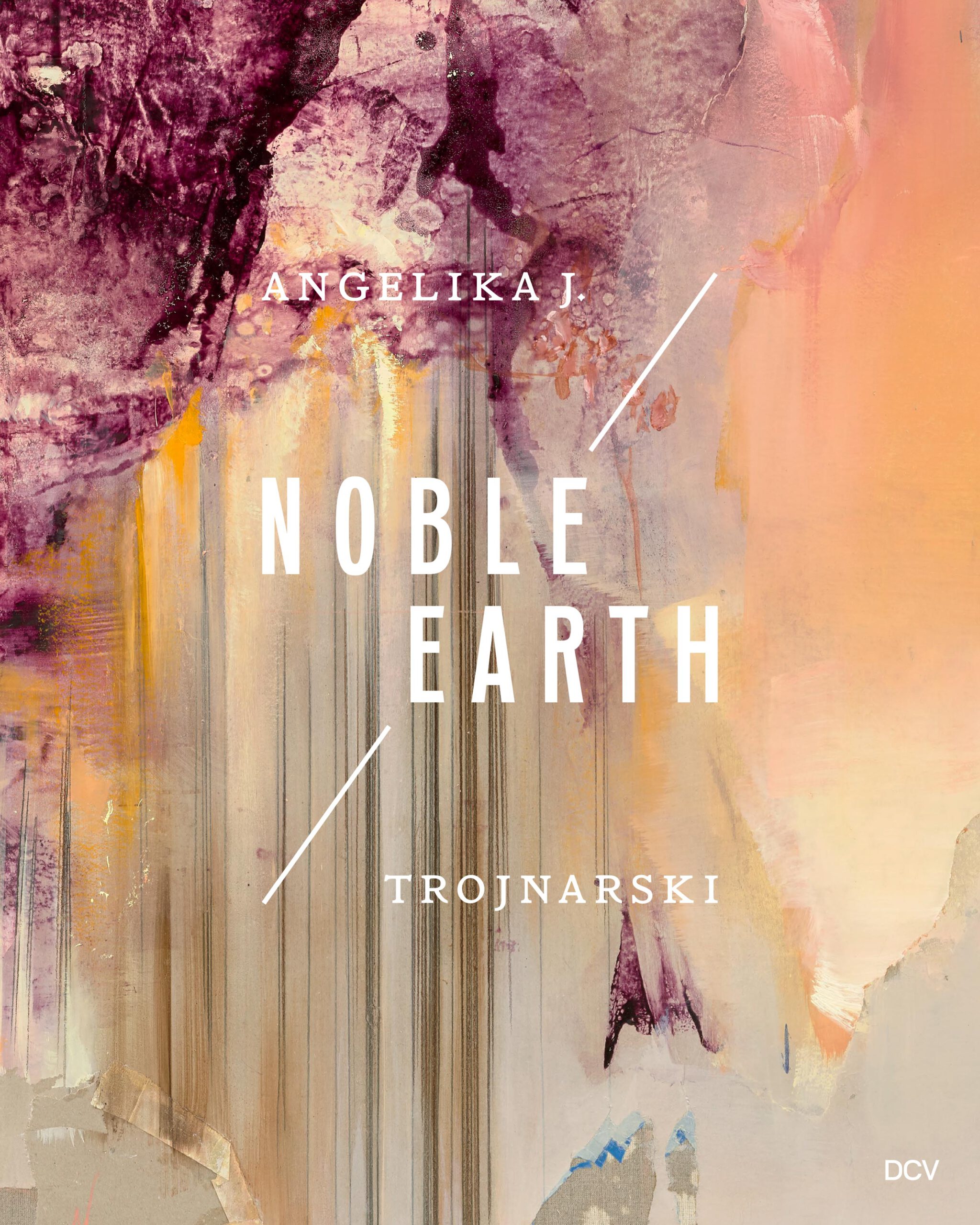
Angelika J. Trojnarski
Noble Earth38€ Add to cartAngelika J. Trojnarski (born 1979 in Mrągowo/Polen; lives and works in Düsseldorf) examines facets of nature through an ecological, scientific, poetic study of their phenomena. Through a process centered on painting, her art articulates allegorical relationships between some of the most significant contentions of our time: humans and nature, strength and fragility, crisis and hope. She expresses a desire to understand nature by reproducing its workings, pointing to its incredible might while underscoring its increasing fragility. Trojnarski overlays raw canvases with paper fragments, employing brushwork and collage to apply materials like graphite or soot, generating a source of energy and suspense through color and contrast. The monograph offers an overview of the last decade of Trojnarski’s work.
Angelika J. Trojnarski 2006–2013 studies at Kunstakademie Düsseldorf. 2006–2009 Painting with Jörg Immendorff, Markus Lüpertz and Herbert Brandl, from 2010 Free Art with Andreas Gursky.
-

Agostino Iacurci
10€ Add to cartAgostino Iacurci’s (b. Foggia, Italy, 1986; lives and works in Berlin) paintings, sculptures, installations, and murals are based on vegetal forms and botanical subjects. Lucid compositions in radiant colors unfurl fantastical ornaments that transcend the division between figuration and abstraction and the hierarchical distinctions of applied art, design, fine art, and folk art. His central theme is the painted garden, in which he stages plants, humans, architecture, geometry, and decoration in a fashionably theatrical landscape. In Iacurci, the interpenetration of nature and civilization is real, integrating mythological motifs from across the history of art and culture, from antiquity to futurism and postmodernism, into his singular style.
Agostino Iacurci studied fine arts at the Accademia di Belle Arti in Rome. Since 2009, he has realized numerous large-format murals and installations for public and private institutions. He has also worked with international brands including Apple, Adidas, Hermès, and Starbucks.
- Out of Stock

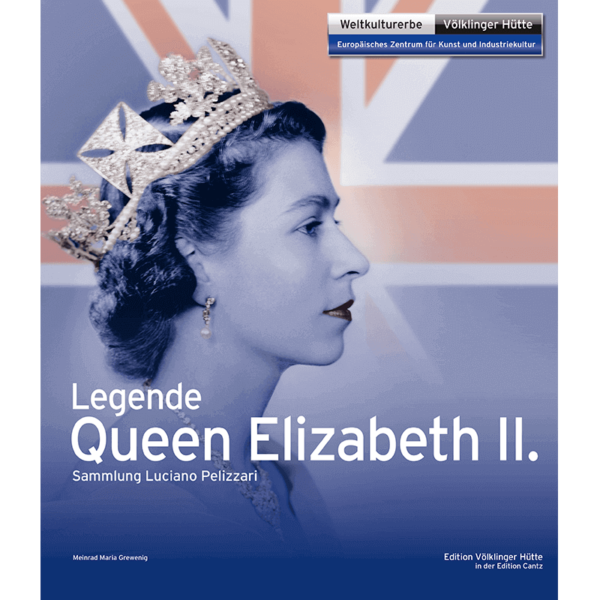
Queen Elizabeth II
Sammlung Luciano Pelizzari27,50€ Read moreErinnerungsstücke einer Legende
Im Leben von Elisabeth II. (geb. 21. April 1926 in London) spiegelt sich eine ganze Epoche. Die britische Königin hat alle deutschen Bundeskanzler und sämtliche englischen Premierminister von Winston Churchill bis Boris Johnson erlebt. Sie ist die am häufigsten abgebildete Person des 20. und 21. Jahrhunderts. Das Buch präsentiert Fotos, Gemälde, Briefmarken und Münzen aus der Kollektion von Luciano Pelizzari, einer der größten Sammlungen dieser Art weltweit. Es zeigt die Queen als Mensch und Monarchin, dokumentiert ihr Zusammentreffen mit bedeutenden Persönlichkeiten und Ereignissen ihrer Regierungszeit und präsentiert sie in zahlreichen Darstellungen aus Kunst und Kultur.
-

ELASTE
1980 – 198649€ Add to cartThe story of ELASTE is the story of a movement – that of the New Wave generation in West Germany. Founded in 1980 in Hanover, the magazine was a beacon of cultural revolt and the first glossy indie magazine of the Federal Republic: self-published, a statement somewhere between pop avant-garde, subversion, and a sharp sense of style. Among those who shaped the look and spirit of the magazine were Jon Savage, Ellen von Unwerth, and Diedrich Diederichsen. No other magazine operated at the intersection of music, fashion, and society quite like ELASTE — with headliners such as Warhol, The Rolling Stones, and Kraftwerk. This book by the magazine’s editors Thomas Elsner and Michael Reinboth, looks back — at the pioneering spirit, the minds, and the stories behind the magazine.
Incl. download code card for 14 tracks from ELASTE RECORDS
-

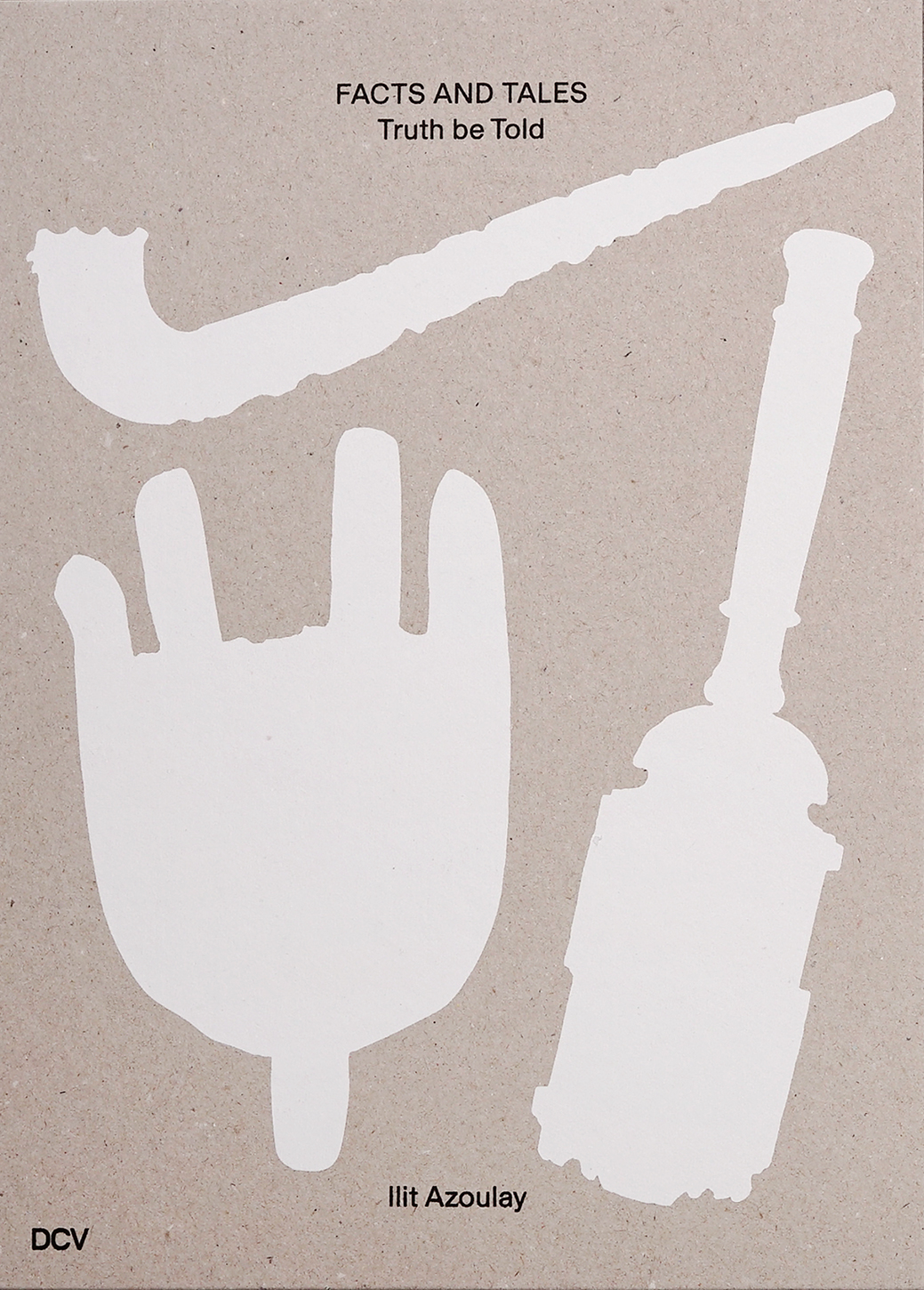
Ilit Azoulay
Facts and Tales. Truth be Told120€ Add to cartIn an era in which multiple perspectives and oral histories are increasingly vital, Facts and Tales—Truth Be Told delves into the haunting work of Ilit Azoulay. The artist, who was born in Jaffa in 1972, transforms objects, archives, and museum holdings into vessels, challenging traditional hierarchies of knowledge. In her most recent solo exhibition Mere Things at the Jewish Museum, New York, Azoulay presents works that probe the delicate balance between factual representation and nuanced storytelling.
The publication accompanying the exhibition includes archival pages, the artist’s notes, and depictions of the works as well as an introduction by curator Shira Backer and an essay by the art critic, curator, and writer Sarit Shapira, who passed away in 2018. Titled Houses of Junk and Specters: On Ilit Azoulay’s Early Works, it underscores the importance of honoring both factual accuracy and oral histories and invites readers to explore the complex interplay between concrete evidence and the rich and nuanced stories.
Azoulay has devised a singular method to shed light on the blanks in hegemonic narratives and expose them. As though to produce an extortion letter, she clips her pictures from archival materials and photographs of the walls of abandoned buildings and composes them in collages interweaving a multiplicity of views. The resulting works question the exclusive truth claim of museum expertise and reveal its constructed quality. The catalog of her works, designed as a box replete with texts and images, reflects this approach, aiming to dismantle established narratives and open up diverse perspectives.
Box containing 6 different standalone publications, limited edition of 500 copies
THIS PUBLICATION WAS MADE POSSIBLE BY THE GENEROUS SUPPORT OF THE GALLERY LOHAUS SOMINSKY, MUNICH
-
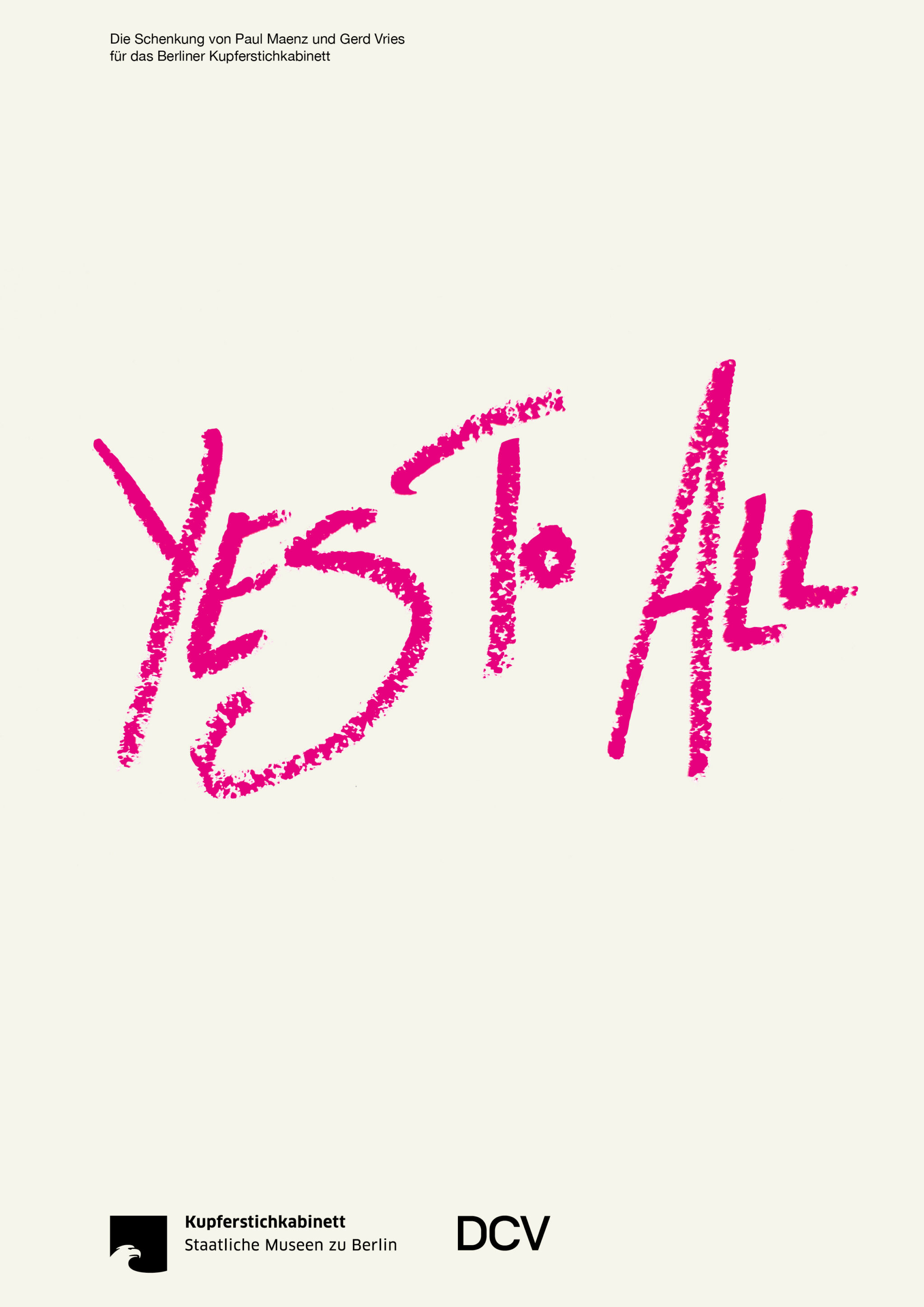
Yes To All
Die Schenkung Paul Maenz Gerd Vries42€ Add to cartThe catalog accompanying the exhibition YES TO ALL offers profound insight into a collection of over nine hundred works on paper—from postcards and drawings to photographs and posters—that was gifted to the Kupferstichkabinett in 2022, with subsequent additions over the years until 2025. The donors are Paul Maenz and Gerd de Vries, who ran a gallery for contemporary art in Cologne until 1990 and chaperoned the evolution of avant-garde art from the conceptualism of the late 1960s to the neo-expressive painting of the 1980s. The most recent works in the collection date from 2024. Several essays and a conversation with the donors invite the reader to experience the stylistic and thematic polyphony of Western art in the late twentieth and early twenty-first centuries in new ways.
EXHIBITION:
YES TO ALL. THE GIFTS OF PAUL MAENZ GERD DE VRIES TO THE KUPFERSTICHKABINETT
KUPFERSTICHKABINETT, STAATLICHE MUSEEN ZU BERLIN
UNTIL JANUARY 11, 2026 - Release January 2026

Bettina Buck
Finding Form45€ Add to cartThe German sculptor Bettina Buck (1974-2017) called attention to herself with her “performative sculptures,” which she often presented vis-à-vis museal objects. Buck’s preferred materials came from the hardware store: corrugated cardboard, ceramic tiles, pressed foam, or plastic foil, which are all not meant to last. Out of these materials she created a kind of changeable and transient “protagonists,” who didn’t have a final form but rather emphasized the actual process of finding form (as well as losing form). In a provocative action in 2015, Buck dragged an oversized foam bloc through a museum collection and let it rest next to famous artworks, which gained a new dynamic in this interplay. Buck herself said once that her works were meant to “simultaneously attract and alienate the viewer.” In the exhibition space the objects should “create a tremor, a vibration and a conversation with its surroundings.”
Finding Form, a posthumous monograph presents Bucks complete sculptural works on over 300 pages and contains texts by Phyllida Barlow, Paolo Icaro, Cecilia Canziani, and Andrea Maria Popelka. The book was conceived and published by the artist’s estate, Bureau Bettina Buck.
-

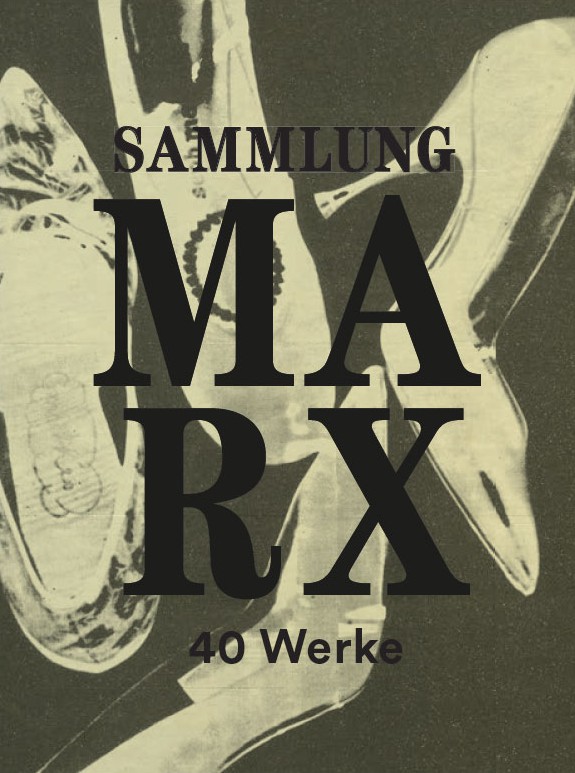
Sammlung Marx
40 Werke29€ Add to cartThis is the German edition, follow here for the English edition
-
Mirror
Collaborative Pictures by Merrick d’Arcy–Irvine x Julia Bajanova40€ Add to cartWe humans are social creatures. Without others to reflect our behavior back to us, we lose what defines us—language, culture, the capacity for creative expression. That is why photographer Merrick d’Arcy-Irvine and fashion designer Julia Bajanova are invested in intense encounters: not only with the people who appear in their pictures, but also with each other, as artists and as humans, and between their media and the materials out of which they are made. The materiality and sensual experience of these media in the physical world are the focus of the pictures gathered in this volume, which is why d’Arcy-Irvine and Bajanova eschewed all digital technologies. Sensuality forges an emotional bond between their creative universes, whose boundaries become permeable, as do the dividing lines between genres. Colors and forms are fused in a shared language of visual art and fashion in which d’Arcy-Irvine and Bajanova write their messages in light on photographic paper. They speak to what makes us human: creative energies untrammelled by the necessities of everyday life. The pictures in Mirror, then, are reflections of our existence and portals of self-knowledge.
- Release November 2022

X x X
Semjon Contemporary50€ Add to cartFounded by Semjon H. N. Semjon in 2011, the gallery Semjon Contemporary has built a distinctive and singular profile that has earned it an unrivaled position in the art world. It represents international positions in contemporary art that, their divergences notwithstanding, are united by the extraordinary intelligence of their engagement with the material. The result is an unmistakable visual language that permits of no modification of established choices. Despite the considerable differences of material, technique, and expression, the artists’ works enter into dialogue with one another, as parallel solo presentations and special exhibitions showcasing numerous visiting artists have demonstrated.
The book features Colin Ardley, Edward L. Buchanan, Takayuki Daikoku, Dittmar Danner aka Krüger, Ute Essig, Experimental Setup (Kata Hinterlechner and Bosko Gastager’s collective moniker), Katja Flint, Andreas Fux, Dave Grossmann, Renate Hampke, Marc von der Hocht, Nataly Hocke, Michael Kutschbach, Henrik U. Müller, Cornelia Nagel, Susanne Knaack, Katja Kollowa, Susanne Pomrehn, Thomas Prochnow, Dirk Rathke, Ursula Sax, Gerda Schütte, Gil Shachar, Li Silberberg, Karina Spechter, Klaus Steinmann, Stefan Thiel, Hitomi Uchikura, Royden Watson, and Bettina Weiß in dedicated chapters. It is rounded out by statements from collectors including Thomas Lenhart, Cornelie Kunkat, Gabriele Quandt, Roland Schnell, Nobert Fuhr and Klaus Werner, Roswitha and Jürgen König, and Helmut Ließ. Remarks by art critics and scholars and an interview with Semjon by Jan Maruhn provide additional insight into the gallery’s work.