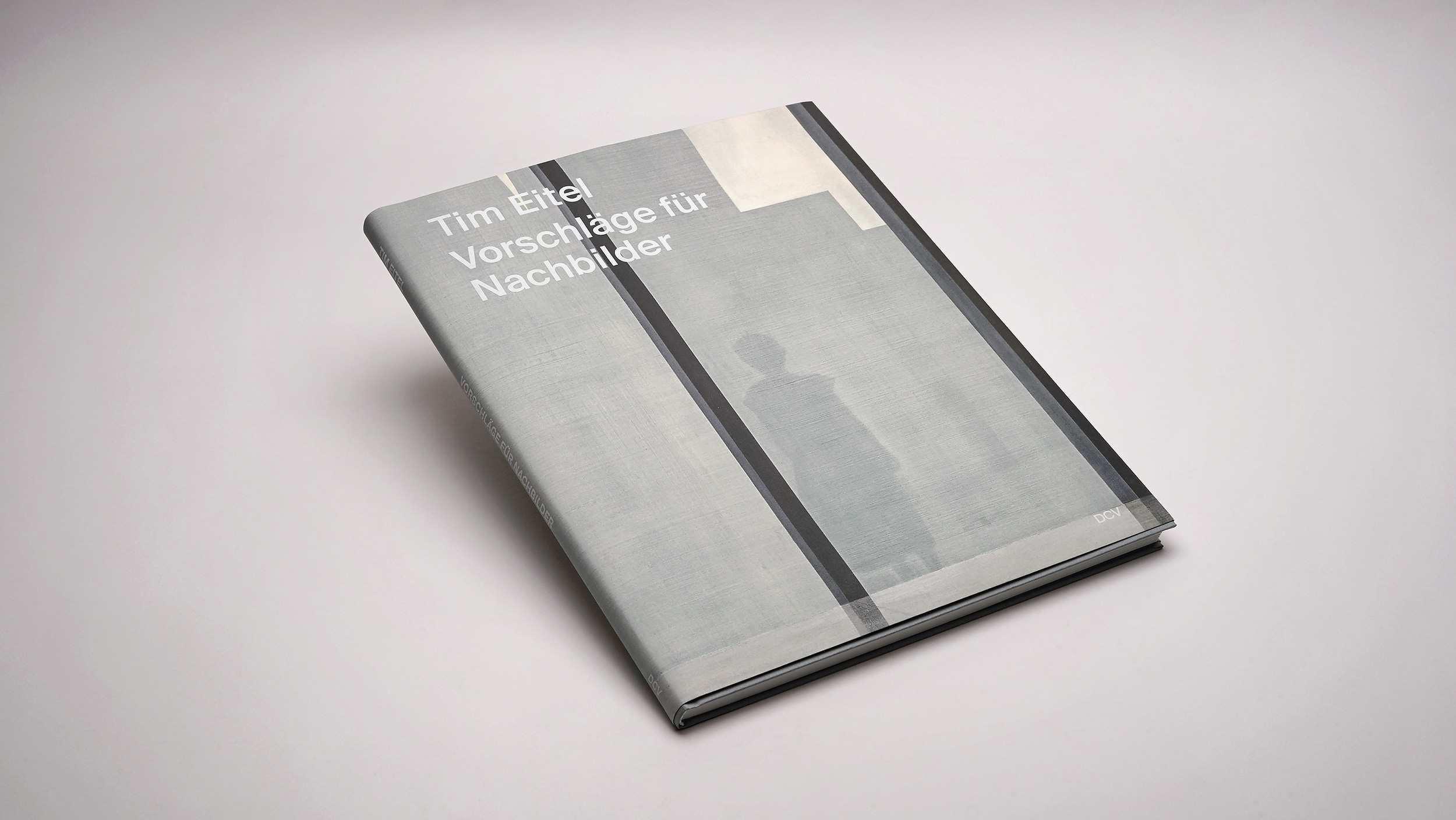
Tim Eitel
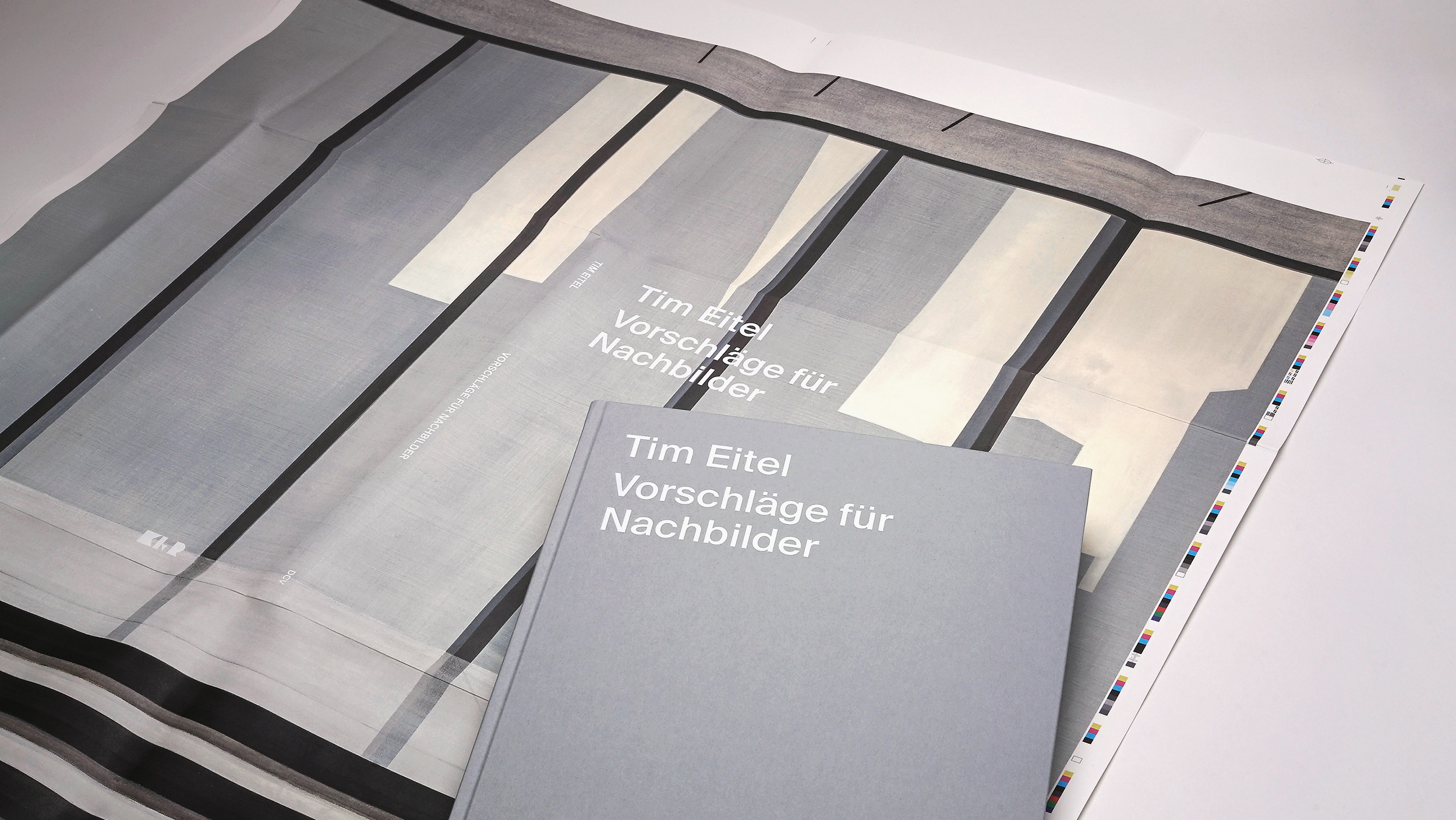
Propositions for Afterimages 2015–2024
 | |
|---|---|
| Editor(s) | Kunsthalle Rostock |
| Author(s) | Michael Bracewell |
| Design | Huelsenberg Studio |
| Size | 24.2 x 32.3 cm |
| Cover | Hardcover with thread stitching & American dust jacket |
| Pages | 112 |
| Illustrations | 72 |
| Language(s) | German, English |
| ISBN | 978-3-96912-211-2 |
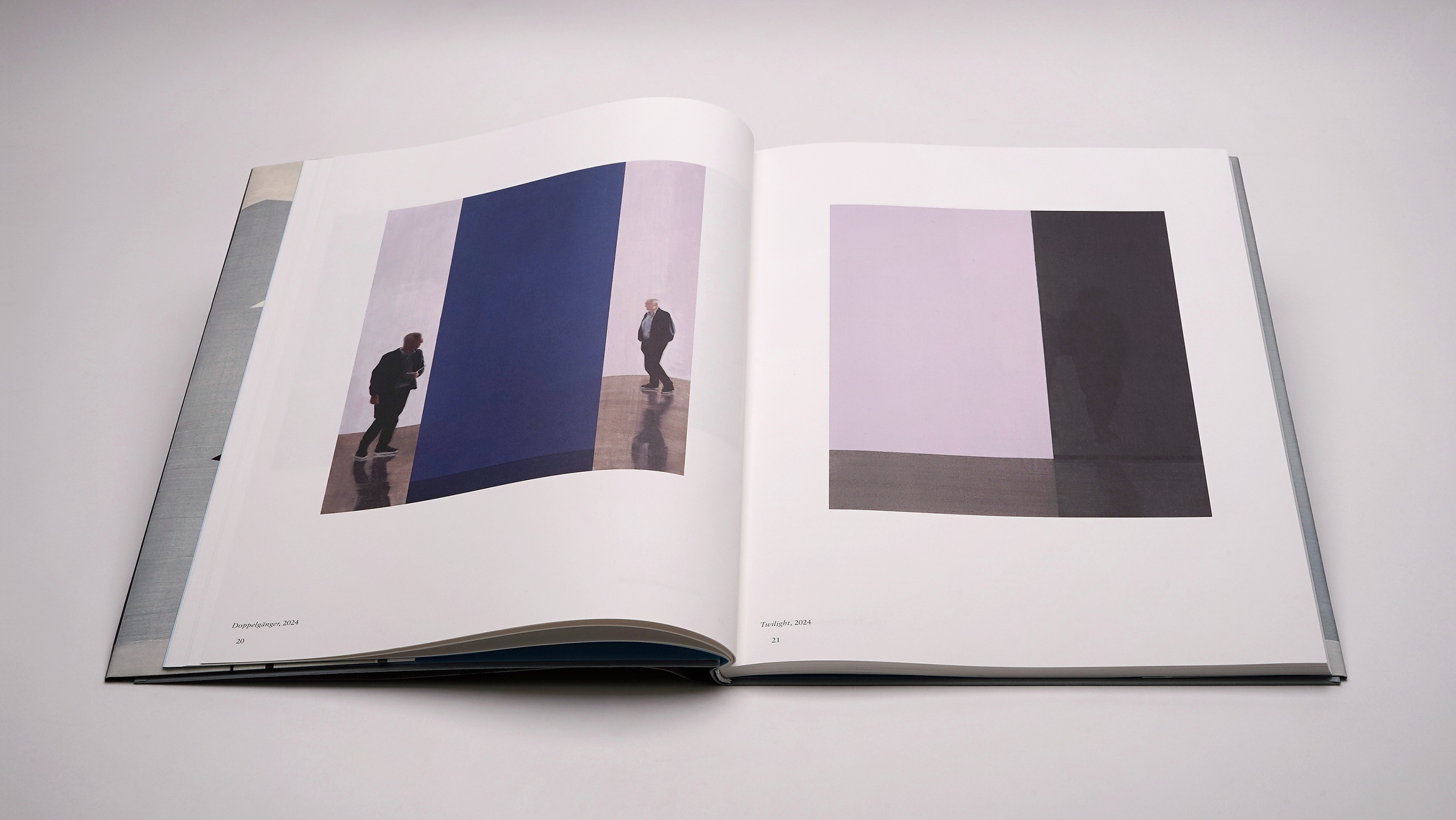
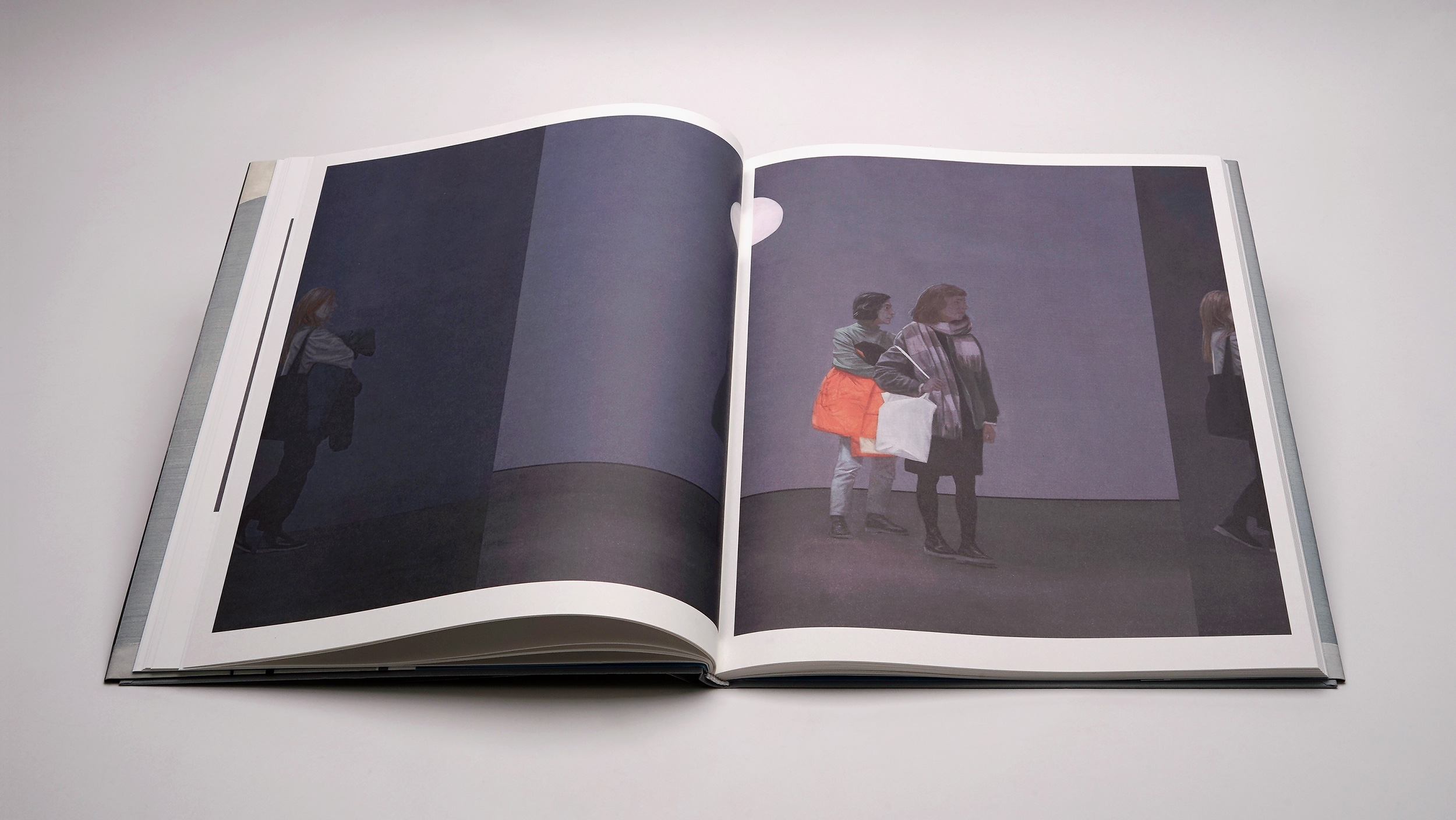
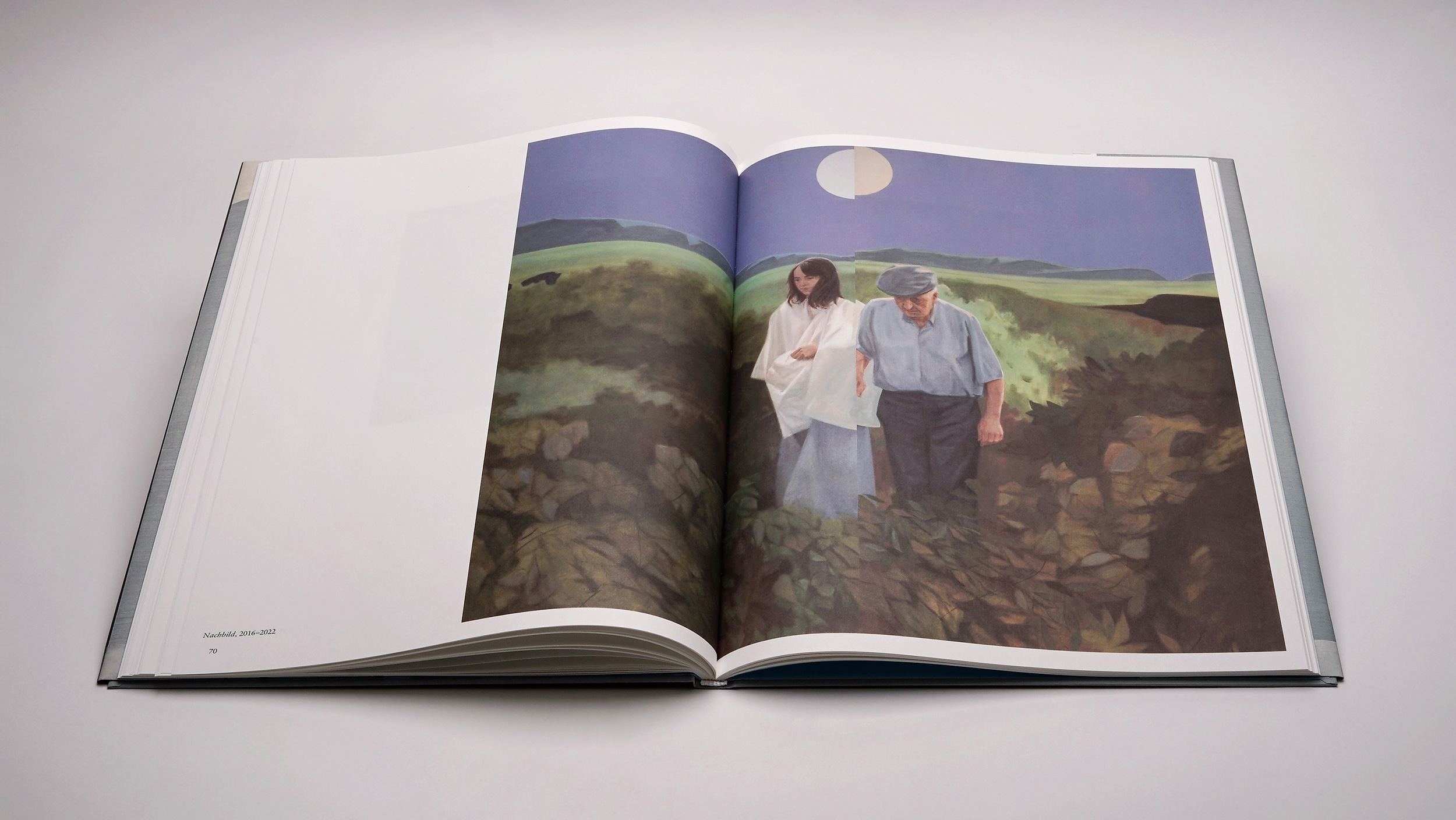
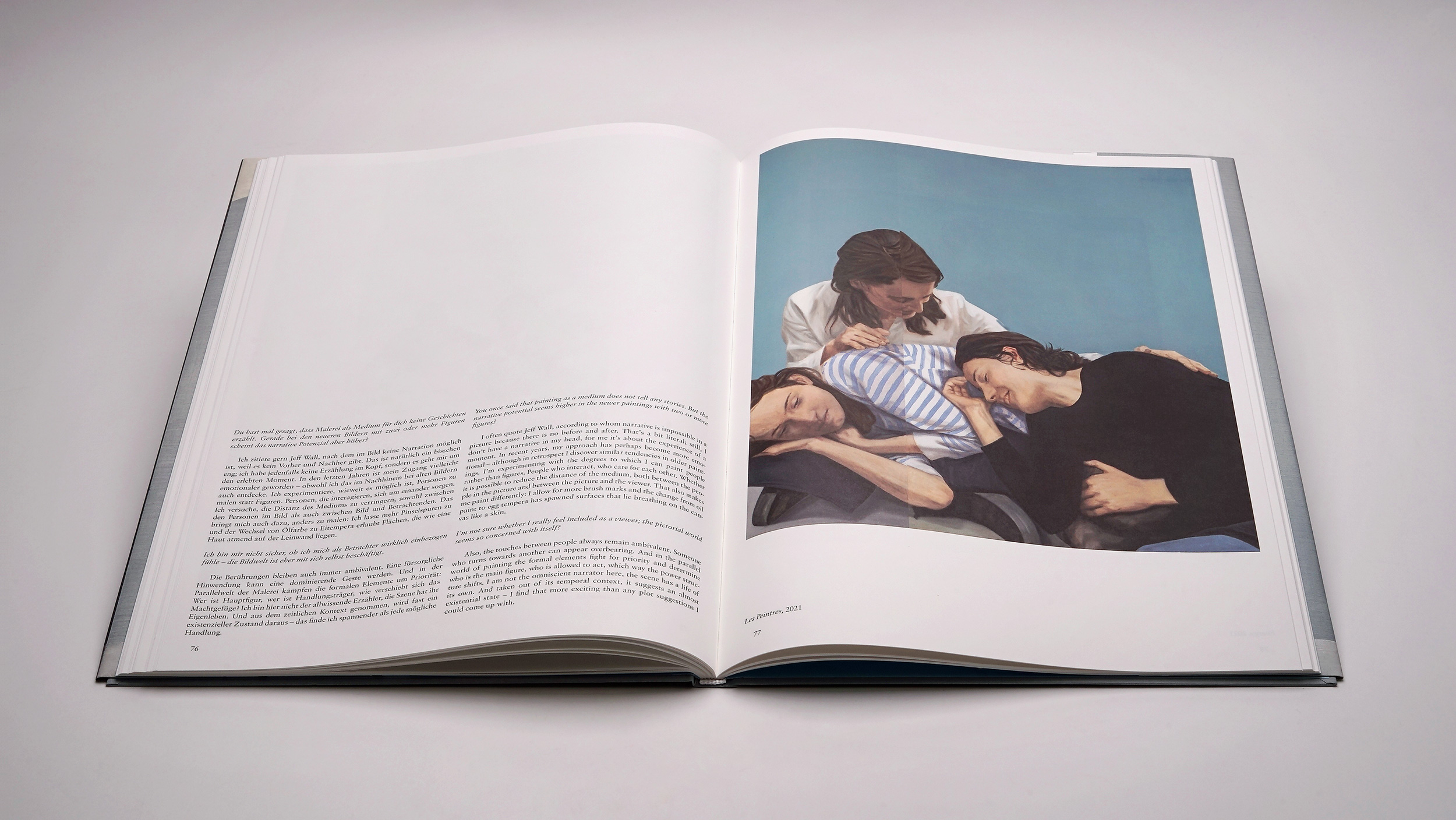
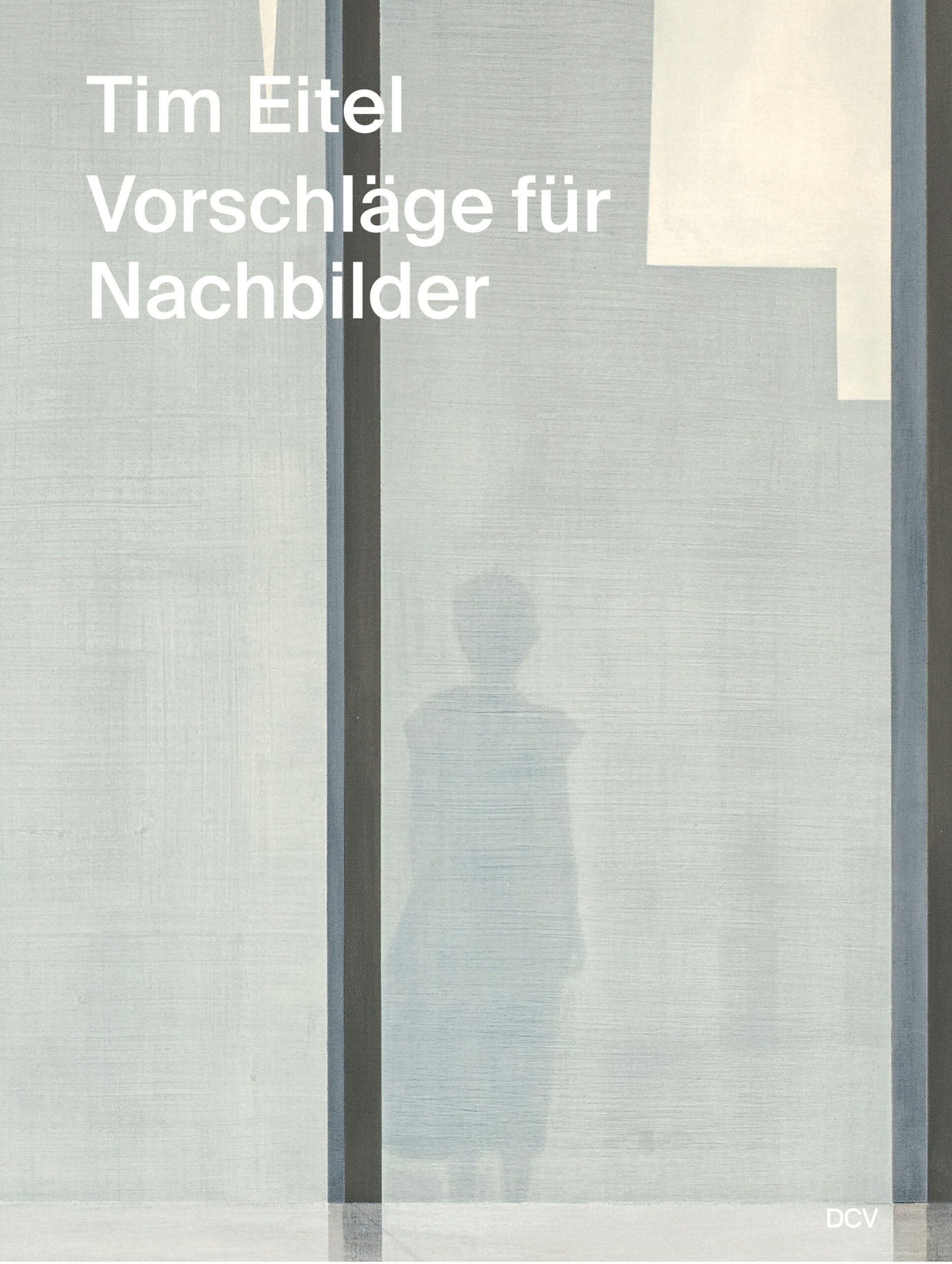
Tim Eitel initiates an exchange between recollection and painting. The work on his pictures, he says, is “a conversation about reality and memory” in which he engages the canvas. In the course of this dialogue, Eitel reflects on personal experiences, creating a standalone figural-abstract reality that needs to be internally consistent—the canvas has a strong will of its own. That makes the scenes depicted in his paintings analogues or afterimages of a situation rather than renditions of it. They are characterized by a certain openness that enables the beholders to inject their own recollections into the pictorial space as well. The dialogue between canvas and artist thus gives way to a colloquy between audience and finished work. Not by coincidence, many of the paintings by Eitel gathered in this catalog show people in museums: these scenes facilitate the leap into the pictorial space. The beholders have experienced a situation like the one shown in the pictures in the past or are experiencing it right now, and so they are already at the heart of the works; they become part of the painting, and the picture becomes a particle of their recollection.
More books
-

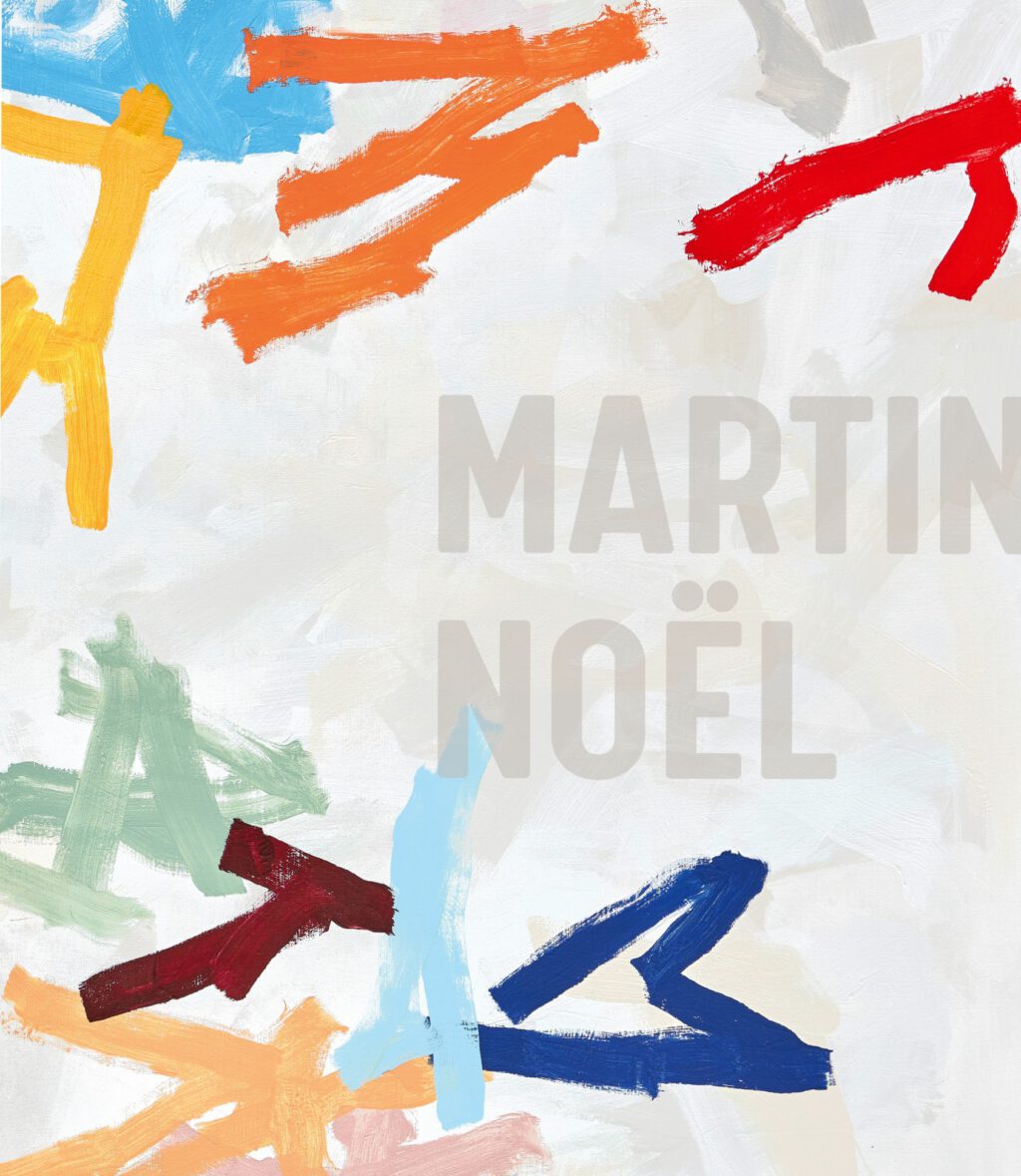
Martin Noël
paintprintpaint35€ Add to cartA Comprehensive Overview on the tenth Anniversary of the Death of Martin Noël
Martin Noël (b. 1956, Berlin; d. 2010, Bonn) was a German painter, draftsman, and printmaker. He was one of the formative innovators of the long-neglected techniques of linocut and woodcut. With his large-format works on paper, he created a position for himself in contemporary art that is as much respected as it is independent. On the occasion of the tenth anniversary of the artist’s death, this volume presents a comprehensive overview of his work from the mid-1980s to the last year of his life in 2010. Thirty-five exceptional works document Noël’s path from his early years as a painter, via the middle phase marked by printing blocks, linocuts and woodcuts, up to his late paintings.
Martin Noël studied Graphics and Painting at the Rheinische Fachhochschule Köln, Cologne. His works are included in, among others, the Federal Collection of Contemporary Art, the Kunstsammlungen Chemnitz, and the collection of the Museum Pfalzgalerie Kaiserslautern.
-

Sonja Yakovleva
10€ Add to cartSonja Yakovleva (b. Potsdam, 1989; lives and works in Frankfurt am Main) uses pornographic representations and images from the internet as templates for papercuts, some in large formats, that grapple with personal and public stories about women, power relations, sexuality, and violence. The silhouettes show popular motifs that have served to ingrain fairy tales, myths, and ideologies in the collective consciousness from the colonial era to modernism and the early twenty-first century. Yakovleva, whose art is often associated with sex-positive feminism, appropriates this folkloristic visual idiom and hybridizes and sexualizes it. Dessous and strap-on dildos, for example, figure as preserved specimens of butterflies and insects, bringing historic scientific expeditions to mind. Yet her work also addresses the capitalist urge to categorize, evaluate, and market every kink.
-

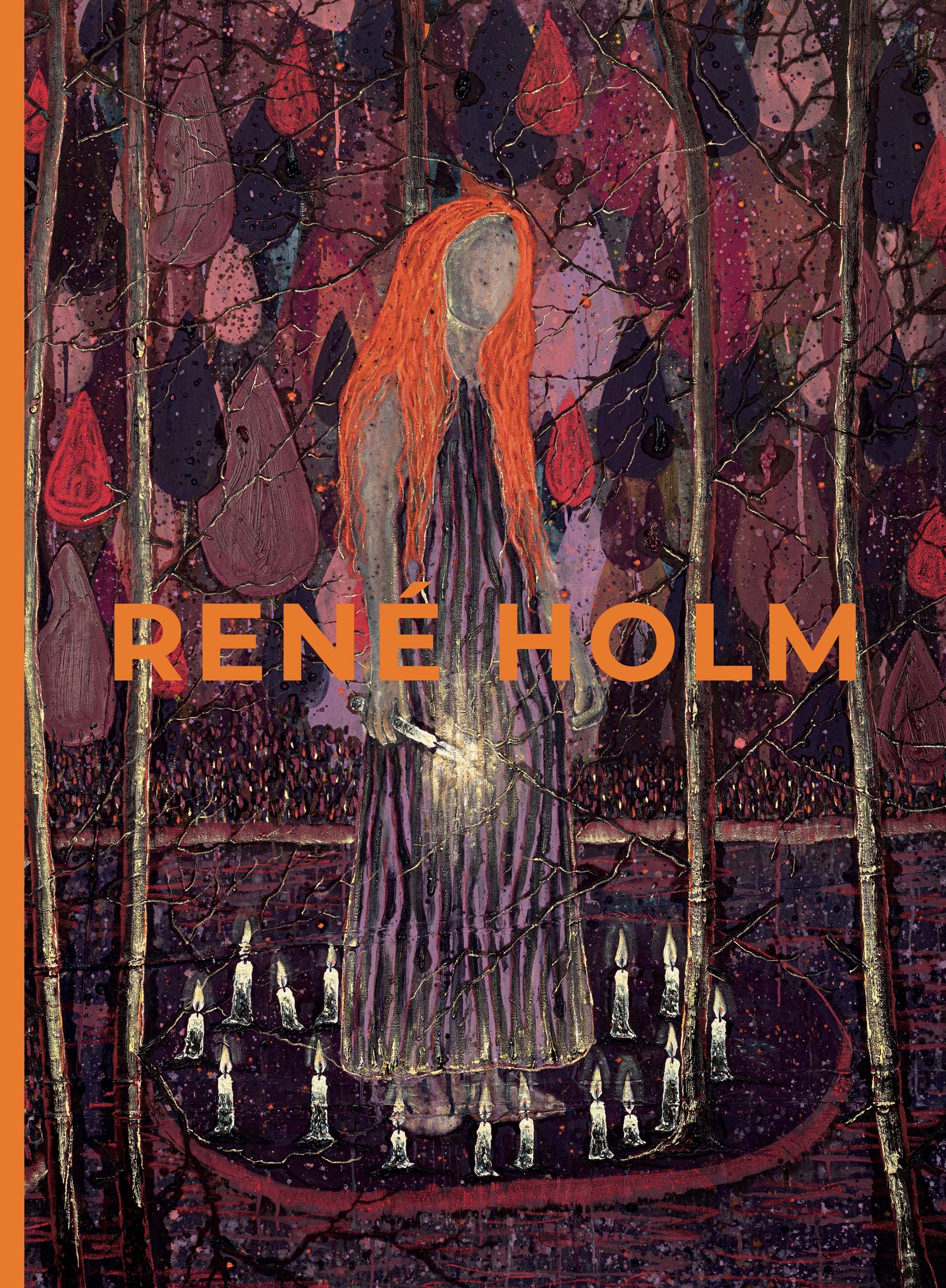
René Holm
Let me be your everlasting light25€ Add to cartLight is the theme of the new paintings by René Holm (b. Esbjerg, 1967). Faceless protagonists traversing symbolic forests with leafless trees occurred already in previous works, stripping them of individual or local signifiers and moving them into a spiritual and universal realm. Skulls with burning candles in Still lifes symbolize the fragility of life and unavoidability of death. Holm goes a step further and makes his figures carry the symbols in their hands or even has them become themselves live “still lifes” with burning candles on their backs. The presence of death is not a picture to behold from afar but a truth to be aware of and carry with us every day. The burning candles also mean that we’re here with our sorrow as well as our light. We must burn to shine. This book accompanies the artist’s gallery exhibition Let me be your everlasting light in Horsens, Denmark.
-

Alexandra Tretter
24€ Add to cartThe art of Alexandra Tretter (*1988) is as deep as it is playful. Owing just as much to the gentle spirituality of Hilma af Klint’s late geometries as it does to Sonia Delaunay’s exuberant disc paintings, almost bursting with sheer chromatic pleasure. Her compassionately designed artist’s book combines monumental paintings with intimate works on paper, all of which are imbued with the contexts of Tretter’s own life as an artist, as a woman, as a mother.
Her kaleidoscopic figurations unfold from a center at rest in itself and multiply in symmetry and asymmetry towards all sides. She contrasts the circular form, the unchanging basic element of her compositions, with the oval, which constantly strives beyond itself, transforming itself in ever-new permutations from one figure into the next, into eyes, mouths, breasts, petals or vulvas.
Her images strive for composure, unfold and blossom, only to let go of all gestalt-like form. Once gained stability is instantly pushed into turmoil. Colors flare up violently or flow delicately about, lighten or shade each other, carry or throw each other off course. Tretter equally realizes materialization and dissolution as basic principles of her painting.
Whereby all, what her images absorb, preserve and release, is experience, growth and slow maturing. Her paintings are “figurations of affection”, in which each individual turns towards something else, doubts or grows, at times turns away or surrenders all the more consciously. They question everything, start anew and yet find their way back to themselves, into their very own.
-
Ann Wolff
Observations and Reflections44€ Add to cart“Art is coming from my inside. I am working as its servant.—I let it out not thinking too much—using my hands and gesture—choosing a material to put it on place. I do not use the art. It is using me.“
Ann Wolff (b. Lübeck, 1937; lives and works in Visby and Kyllaj, Sweden) has ranked among the most significant and most influential glass artists on the international scene for over five decades. Yet she has also worked in bronze, aluminum, nickel silver, and concrete, creating abstract as well as figurative sculptures, and produced a sizable oeuvre on paper: pastels, drawings, and fine art prints. Ann Wolff enrolled at the legendary Ulm School of Design in the 1950s to study visual communication with Otl Aicher. From 1993 until 1998, she was professor of “materials-related design” at the University of Fine Arts (HFBK) in Hamburg. Her works, which have garnered an array of prizes, have been shown in numerous solo exhibitions and are held by renowned public and private collections all over the world.
-

Ion Bitzan
48€ Add to cartThe painter and object artist Ion Bitzan (b. Limanu, 1924; d. Bucharest, 1997) belonged to the generation of Romanian artists who, in the 1960s and 1970s, broke through their country’s isolation to connect to the international avant-garde. His creativity and the quality of his artistic experiments, which drew inspiration from conceptual art, Dada, and other sources, made him a leading figure in the Romanian art of the Ceaușescu era. This book also sheds light on the complex relationship between artistic innovation and political (propaganda) art behind the Iron Curtain during this period, in which nothing was ever black or white. Bitzan represented Romania at the Venice (1964) and São Paulo Biennales (1967, 1969, 1981). In 2017, the National Museum of Contemporary Art (MNAC) in Bucharest mounted a major retrospective of his oeuvre.
-

Sabine Hornig
Passage through Presence45€ Add to cartLayered Spacetimes in Large Formats
Sabine Hornig (b. 1964; lives and works in Berlin) has earned international acclaim with sculptures, photographs, and architectural interventions that interweave image, perspective, and space in distinctive ways. Her works feature translucent pictorial planes on glass panes; integrating these sculptural elements into the setting, she creates environments in which meaning unfolds as viewers allow their gazes—and themselves—to wander. For her new works, which engage with architecture, the artist superimposes enormous photographs on entire façades and concourses. This publication is the first to put the focus on Sabine Hornig’s art in three dimensions, detailing her process from the building of sculptural models and the combination with transparent photographic layers to her creation of works in public settings. It showcases her largest installation to date, at LaGuardia Airport in New York City, which she discusses in a conversation with Nicholas Baume, director and chief curator, Public Art Fund, New York.
-

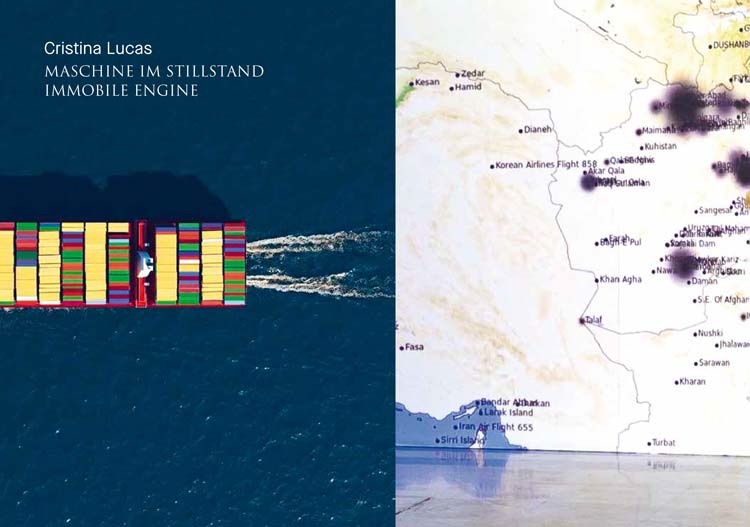
Cristina Lucas
Immobile Engine29€ Add to cartMechanisms of Power
The Spanish artist Cristina Lucas (b. Jaén, 1973; lives and works in Madrid) works in a wide range of media and genres. Central concerns include the confrontation of subjective and political historiographies and a critical examination of cultural stereotypes. The publication’s point of departure is the multichannel video installation Unending Lightning, begun in 2013, in which Lucas undertakes a painstaking study of the history of aerial warfare. The book also showcases works that limn a contemporary perspective on value chains and the capitalization of time and landscape. Moreover, the artist has developed a corpus of critical cartographic models that offer algorithmic, philosophical, poetic, or, in some instances, humorous visualizations of unexpected nexuses. The first German-language publication on Cristina Lucas’s art, it offers a comprehensive survey of her oeuvre to date.
Cristina Lucas studied fine arts at the University of California and the Universidad Complutense, Madrid. She has had residencies in Paris, Amsterdam, and New York. Her work has been exhibited at MUDAM, Luxembourg; the Museo de Arte Contemporaneo, Santiago de Chile, and the Museo Nacional Thyssen-Bornemisza, Madrid; Kiasma, Helsinki; and the Centre Pompidou, Paris, among others.
-

Roland Schappert
Coronasehnsucht14€ Add to cartThe coronavirus pandemic hit us in a time of disparate foci of attention. A fundamental lack of comprehension and hate speech contrast sharply with an unspoken consonance of ideas as well as feelings. What do reality, statistics, love, and yearnings do to us? They are playing a game with reality, sans fiction. Relationships sustain our lives. What was unmistakable before is now manifest, with stark certainty. Are we ready for loving dissension? Can we bear to think only as far ahead as we can see? How do our emotions answer these questions, and how does our intellect? The Cologne visual artist and writer Roland Schappert retraces his personal voyage through this sun-kissed rain-drenched time. The book is a diary-like tour de force of digital amorous overtures, an attempt to explain the world of art via WhatsApp, and the real challenges of life as a single artist in a major German city in precarious circumstances.
-

Ohne Schlüssel und Schloss
Chancen und Risiken von Big Data19,90€ Add to cartVon Kunsthandwerk zu digitaler Verschlüsselung
An jeder Haustür ziehen wir Grenzen, wir schließen auf und schließen ab. Und noch in jüngster Vergangenheit war eindeutig, was als Verschlusssache galt. Ganz anders stellt sich diese Frage im IT-Zeitalter. Ausgehend von der kunsthandwerklichen Sammlung des Museum Pfalzgalerie Kaiserslautern wird deutlich, wie in früheren Jahrhunderten über mechanisch und symbolisch aufwendig gestaltete Schlösser, Schränke oder auch Reliquienbehältnisse Distanzen austariert wurden. Sie alle sind sichtbares Vehikel für die bewusste Wahrnehmung von innen und außen, zugehörig und ausgegrenzt, wissend und unwissend oder öffentlich und privat. Für Big Data gilt dies in keiner Weise mehr. Beim Digitalen werden Serviceleistungen mit Datenerhebungen verbunden, deren weiteren Einsatzbereiche wir weder unmittelbar verstehen noch überblicken können. Historische, technologische und philosophische Überlegungen bieten wichtige Beträge zur aktuellen Debatte und Einschätzung der Risiken und Chancen von Big Data.
-

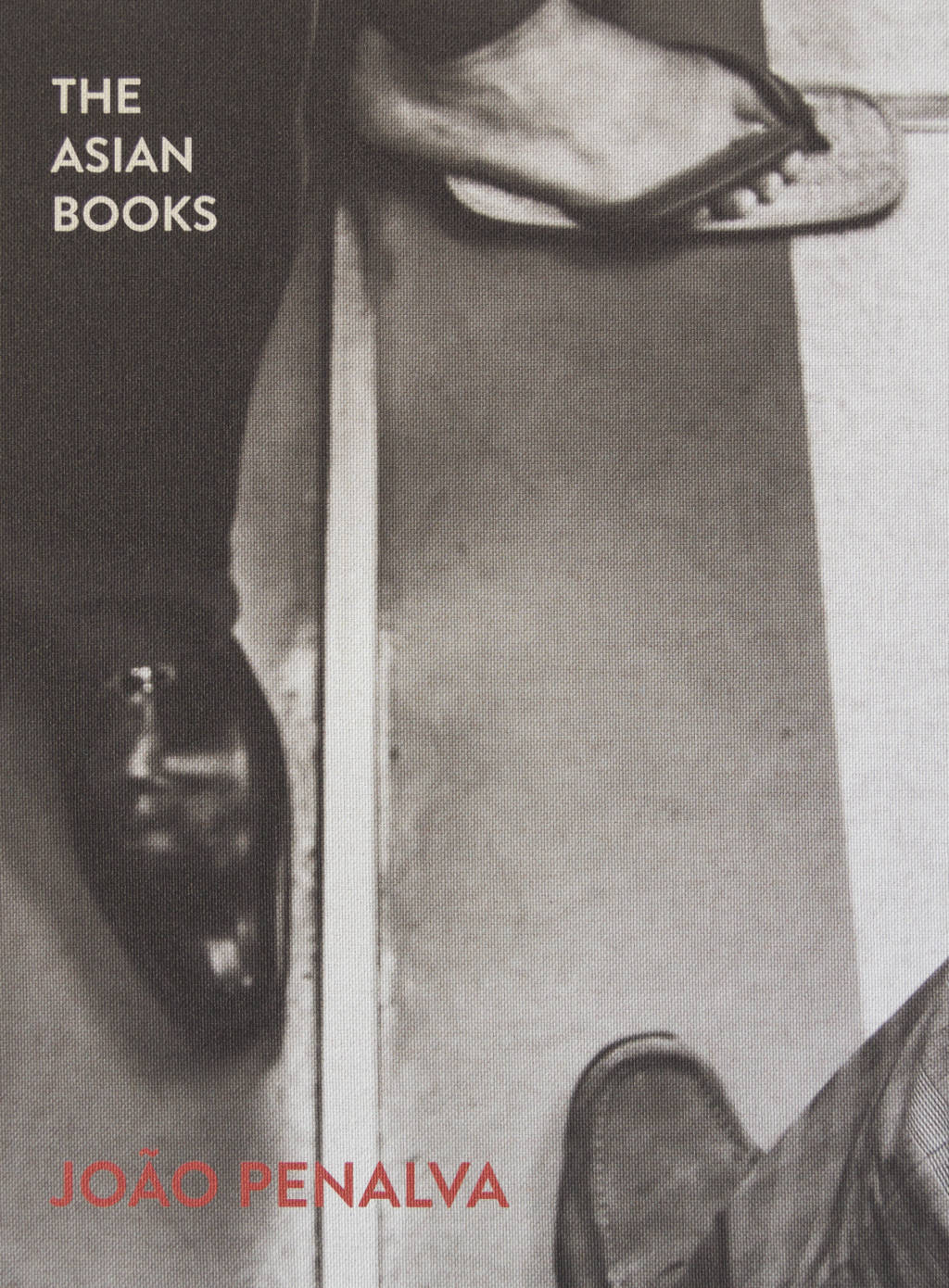
João Penalva
The Asian Books40€ Add to cartThe First Survey on the Exceptional Artist Books of João Penalva
Since 2007 João Penalva (b. 1949, Lissabon; lives and works in London) has exhibited large format unbound books, printed with archival inks on fine art paper, displayed on tables with chairs, to be handled freely. Each one is published in an edition of three and one artist’s proof. Those whose content relate to Asia, whether factually or fictionally, are collected here for the first time: Taipei Story, 2007; Portraits: Machines and Kabuki Wigs, 2009; The Toshiba Book of Happiness, 2009; Hello? Are you there?, 2009; Michio Harada, 2015; Boro, 2017.
João Penalva studied Fine Art at the Chelsea School of Art in London. His works have been shown in manifold international exhibitions. Penalva represented Portugal 2001 at the Venice Biennale and 1996 at the São Paulo Biennale.
-

Gabriel Vormstein
40€ Add to cartGabriel Vormstein (b. Konstanz, 1974; lives and works in Berlin) explores themes of impermanence, temporality, and futility through a unique visual language. He paints using newspapers as a canvas, and creates installations out of tree branches and other organic matter. These “poor” materials subvert a prevailing notion in Western culture that an artwork should be eternally preserved. Through the adaptation of various styles and symbols, Vormstein’s paintings likewise speak to the transience of art historical and cultural trends. Over 300 pages, this richly illustrated book provides an overview of Vormstein’s oeuvre over the past two decades, while also offering an atmospheric glimpse into the artist’s source material and working methods. The publication is enriched by an essay by Gean Moreno, who characterizes Vormstein’s work as follows: “Gabriel Vormstein’s paintings and sculptures (…) announce their condition as withering artifacts, as if no other manner of existing was available to them (and maybe to us, as well).”
- Release May 2026

Simone Haack
NEW MAGICAL REALISM44€ Add to cartTalking about magical realism today, we typically think of the literary genre. Yet when Franz Roh coined the term, he was referring to a tendency in German visual art in the years before the rise of fascism. What marked a major departure from Expressionism and abstraction has seen a renaissance in the New Magical Realism pioneered by Simone Haack since the turn of the millennium, now framed by a comparable geopolitical situation. The influence of Giorgio de Chirico and his pittura metafisica is unmistakable in Haack, as are those of the New Objectivity, Kafkaesque painting, and the metaphysical dimension of Surrealism. One of the most eminent artists of our time.
-

wolfgang thiel
skulpturale standpunkte38€ Add to cartWolfgang Thiel (b. Zweibrücken, 1952; lives and works in Plochingen) is a sculptor who makes figurative work. He is especially interested in the southern German tradition of colorfully painted sculpture, which he seeks to bring into the twenty-first century. His experimental handling of various genres and materials suggests a researcher’s mind. Switching between different materials is key to Thiel’s approach because their particular characteristics demand his constant attention. Å playful aspect is essential to all his works, which include large-format sculptures in public settings (more than thirty have been installed in Germany) as well as sculptural garden landscapes, stage designs, and costumes.
The opulent wide-format book containing almost three hundred illustrations offers a representative overview of Wolfgang Thiel’s oeuvre and includes the first complete chronological catalogue raisonné of his works in wood.
Wolfgang Thiel studied at the Stuttgart State Academy of Art and Design from 1970 until 1976 and later taught at his alma mater from 1987 until 1991. From 2008 until 2018, he held a teaching position at the Hochschule für Technik Stuttgart. In 1990, he won the Art Award of the City of Stuttgart. Since 1977, Thiel’s work has been showcased in numerous solo exhibitions in Switzerland, France, and Germany.
-

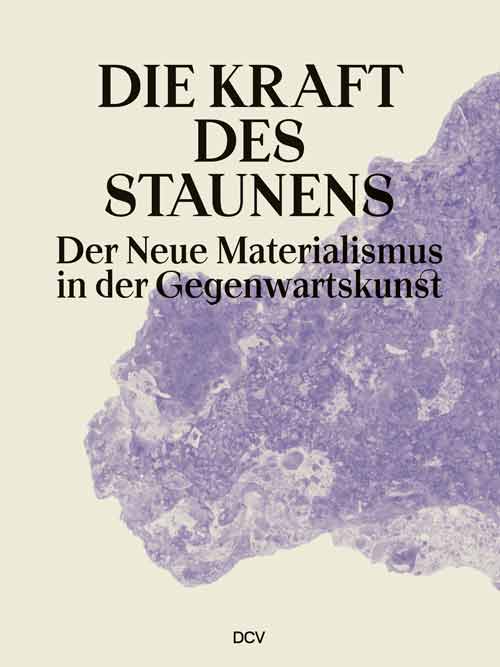
The Power of Wonder – New Materialisms in Contemporary Art
34€ Add to cartFor the longest time, physical matter was seen as no more than a passive and lifeless object. Since the early years of the twenty-first century, however, visual artists and scientists alike have initiated a change of thinking, conceiving matter as active, unruly, and autonomous. The ethnologist Hans Peter Hahn has called it the “willfulness of things,” while the Belgian philosopher Isabelle Stengers has underscored the “power of wonder”—the bracing sense of marvel and surprise instilled by a material world that sometimes defies the attempt to put it into words.
This pioneering publication features six selected artistic positions that highlight the New Materialism’s significance for contemporary art. The artists employ materials that are millions of years old such as rocks from an open-pit mine as well as classic inorganic staples like ceramics and cutting-edge materials like digital products transformed in high-tech procedures into hitherto unseen hybrid objects. Their work lends art a powerful voice in contemporary debates around man’s position vis-à-vis his environment, around sustainability, participation, and justice.
With works by Ilana Halperin, Agata Ingarden, David Jablonowski, Markus Karstieß, Robert Smithson, and SUPERFLEX.
-

Thomas Lehnerer
Grott18€ Add to cartA Facsimile by the Theologian and Artist
The genesis of images is a central aspect of the work of the Munich-based theologian and artist Thomas Lehnerer (b. Munich, 1955; d. ibid., 1995). In drawings and sculptures, as well as in spatial and conceptual works, the production of images creates a counter-world to our own lives. By transferring fundamental experiences of human existence into art, Lehnerer creates an equivocal, anthropological space for observation and reflection. The artist’s book Grott, published in 1986, contains ambiguous elements. All drawings are positioned on the right page. In the not yet dried state, a double image was formed on the left side, which relativizes the “primary image.” The depictions of animals, people, and the environment were drawn nearly without interruption from a single line. In this style of continuous movement, the overall image can be traced back to its beginning. For Lehnerer, it was important to understand human (self-)consciousness from the perspective of the history of evolution, since there are countless models of thought and belief within this narrative. Grott refers in the title, as well as in the drawings, to the charged relationship between the earthly and the spiritual.
-

Corona, Queens
Photographs by Cara Galowitz32€ Add to cartFor seven years Cara Galowitz (b. 1964, lives and works in New York) walked the streets of Corona, Queens every day during her lunch break from her nearby museum job, where she worked as an art director. These photographs, which she calls “an exercise in seeing”, capture the vivid juxtapositions of one of the most ethnically diverse neighborhoods in the world.
Through layers of irony, humor, and visual sophistication, these photographs evoke a place that is a continual work-in-progress, where the past, be it faded lettering or crumbling architecture, collides with the present in the form of spontaneous street decorations, signage, graffiti, and religious iconography. The images evoke the struggle and resilience of the people of Corona, as well as capturing the quirky beauty of the streets.
Cara Galowitz is a graduate of the Cooper Union School of Art where she focused on graphic design, photography, and fine art. She has pursued a long career as a museum art director and has shown work at the Newark Museum, the Museum of the City of New York, and the Grey Art Gallery.
- Release February 2026

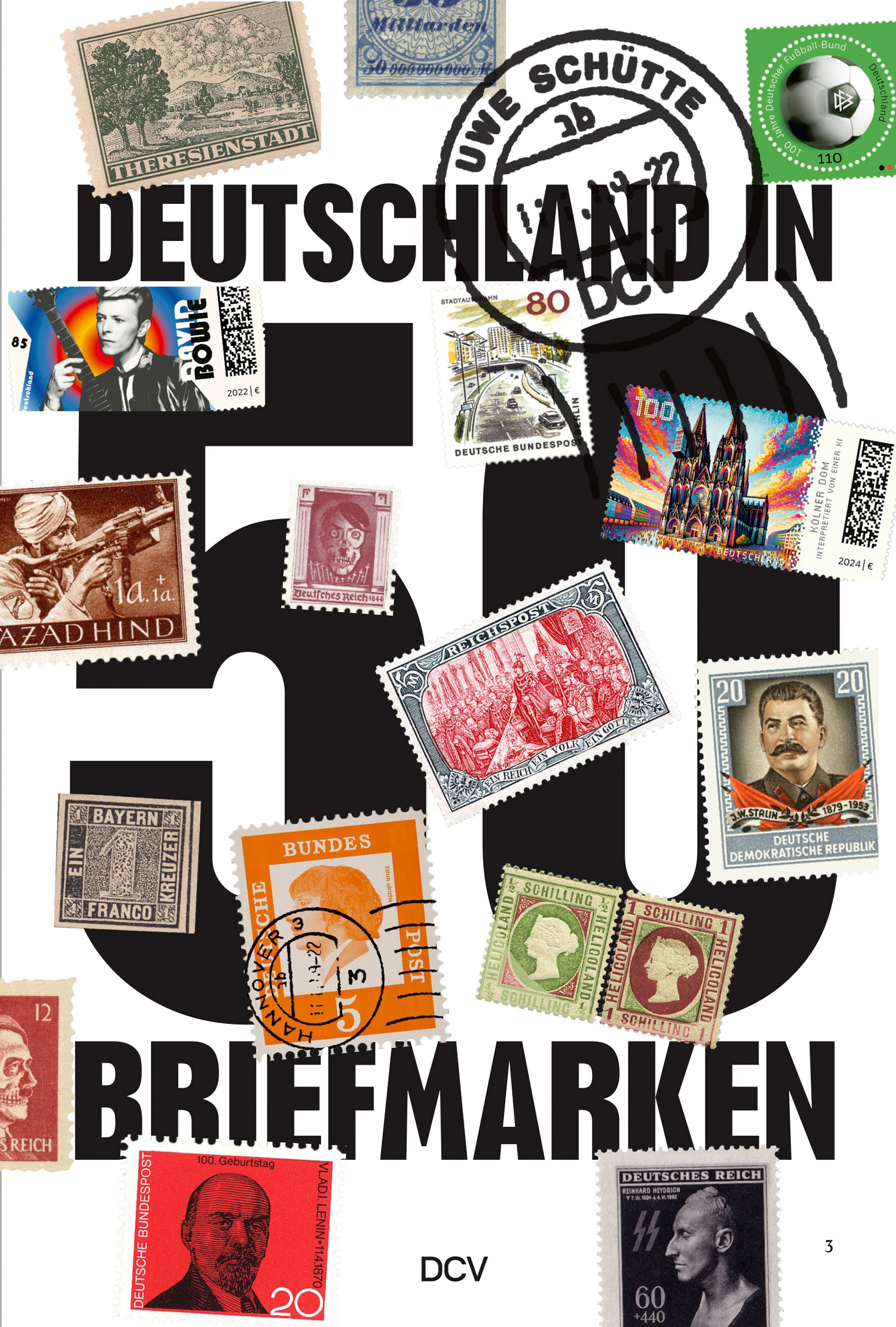
Uwe Schütte
Deutschland in 50 Briefmarken24€ Add to cartThe postage stamp, the avid philatelist Walter Benjamin prophesied in 1928, would “not survive the twentieth century.” Time, then, for a look back: in fifty essays, Uwe Schütte embarks on a voyage through 175 years of German postal history to decode the mentalities that shaped it. Analyzing the visual language of the stamps and their significance for Germany’s collective memory, from the One kreuzer black to Deutsche Post’s cutting-edge crypto-stamp, he shows how the stamp broke the shackles of its function as a proof of postage paid to emerge in the early twentieth century as a medium of mass-circulation miniature-format graphic art. It went on to serve as an instrument of propaganda, was collected and counterfeited, and proved a capacious mirror of discourses in society.
The cultural essayist Uwe Schütte, born in Sauerland in 1967 and a philatelist since childhood, completed his doctorate in German Literature under W.G. Sebald. After two decades as a university lecturer in England, he now lives and works in Berlin. His work includes more than 30 books dealing with extremist art and occultism as well as advanced pop culture and contemporary literature.
-

Winston Roeth
Speed of Light32€ Add to cartColor Is Light
Intense monochrome areas of color, radiant pigments, and multifaceted surfaces are the characteristics of the art of Winston Roeth (b. Chicago, 1945; lives and works in Beacon, New York, and Waldoboro, Maine). He has devoted himself to abstract color field painting since the 1970s, with the grid as a leitmotif running through his oeuvre; both are fraught with painterly memories of light, “a light that can jump out and grasp the beholders, a color saturation that throbs with a deep glow,” as the artist himself puts it. It emanates from the strata of paint in his pictures, encountering the light that, falling upon his works, molds their chromatic effect. Roeth experiments with pure pigments, which he mixes by hand to make paints he applies in layers to diverse media including paper, aluminum, honeycomb, slate, and wood panels. The book documents a tour of an exhibition, presenting works dating from between the early 1990s and 2020.
-
Jagoda Bednarsky
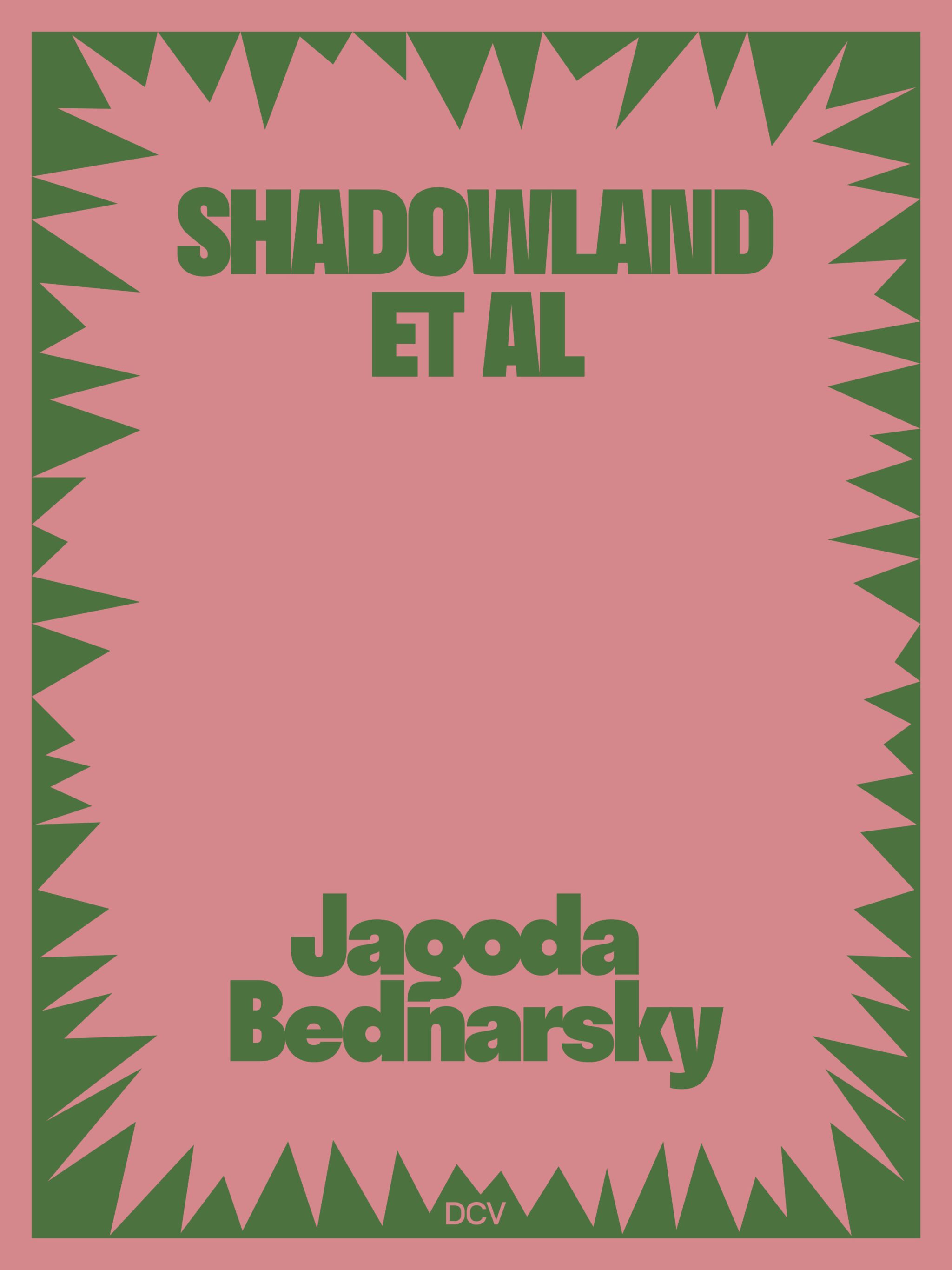
SHADOWLAND ET AL40€ Add to cartJagoda Bednarsky’s (b. Złotoryja, Poland, 1988; lives and works in Berlin) paintings are pop-cultural and nostalgic borrowings that she transfers into the grotesque register, with allusions to stereotyped role models between hypermasculinity and matriarchy. Unfurling pastel-colored hillscapes composed of breasts, breast pumps, vulvas, figures from Greek myth, and motifs from flora and fauna, Bednarsky’s Shadowland series interrogates traditional ideas of femininity and motherhood. The depiction of the female breast serves as a metaphor referring to the titular “Shadowland,” where this part of the body is still perceived as a sexualized object rather than as natural. The title, one might note, is borrowed from a culture magazine first published in New York in 1919 in which the artist spotted Art Deco illustrations that became a vital source of inspiration. Despite the dense aggregation of fraught symbols and referential gestures, the sensual, poetic, and richly imaginative works exude a lightness that stems from their translucency and subtle irony.
The comprehensive volume presents Bednarsky’s works from between 2018 and 2023 and a singular conversation with the artist.
Jagoda Bednarsky studied fine arts, first at Kunsthochschule Kassel (2008–2009), then at HfBK Städelschule, Frankfurt am Main, with Michael Krebber and Monika Baer (2009–2014).